• The move to the new server is done. There are some software and database maintenance updates in process. This has us passing the hat around to help out. We appreciate any donations. Seriously, even a dollar helps. The payment page may be found here - https://www.audiokarma.org/support.html

Zilch's AK Design Collaborative - Econowave Speaker

Here you go...

newlcr.jpg


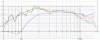
1m away, center of waveguide, resistor inline with + terminal, no xo, 500hz-20khz sweep.
 
Did you ever try measuring a different, non-diy speaker? If that's just the compression driver, your noise floor is real high.
 
Last edited:
OK Chris. I think you meant the cap in line with the +.

The 3 drivers are close enough for Selenium. I have had much wider variance than that.

If you don’t want to mess with rotating diaphragms, use the purple as your Center, blue and green as your L & R.

The notches at 9/12.7/15.3 kHz all appear on my graph when I remove smoothing, and at about the same depth.

You appear to drop about 13 dB between 2-9kHz.
Mine about 9 dB.

Overall, my driver drops about 13 dB from 2K up (smoothing turned off.)
Yours drop about 15 db, if you don’t count the top end of the response, which is the most problematic for non-calibrated ECM-type mics. So I am discounting that. However, the general trend is there.

Now what you need to figure out is how you fried the compensation cap when soldering your x-o boards. All 3…. :D

Seriously, there’s no way you did that. But look the crossovers over, again. If all is really well, then you might want to to follow Kegger’s suggestion.
I am sure other EWavers will have comments. Feel free to mail me a x-o if you want to compare that way.


Here you go...

newlcr.jpg


1m away, center of waveguide, resistor inline with + terminal, no xo, 500hz-20khz sweep.

 
Haha, why do you mention that I may have fried my caps, hypothetically? I must have missed that.

Also, as far as the downward trend, you can see that my Paradigm did very well in the upper spectrum, why not the E-wave? Now that I think about it, could it be the receiver for whatever reason? The only real difference between the two AVR's is that the upstairs AVR/speakers setup has been calibrated with Audyssey, could this be the reason? I can bring one of my E-waves upstairs and run it through the 5003 and see what yeilds... I couldn't bring my Paradigms downstairs because it would have been difficult to hookup.

Thoughts?
 
I see nothing that tells me the amp/avr is the culprit, so no need to swap amps.

What you measured is that raw frequency of the drivers, and what we'd expect
to see, the xover is suppose to flatten out that top end response but it isn't for
whatever reason, so I'd suspect you either have bad components or wired wrong.

I just looks like the xover isn't doing much to the raw response of the driver there.

If it isn't to much trouble for the 2 of you and you can't find the issue, then send
a xover/driver to Skywave to check out is probably a very good way to find it. ;)
 
Haha, why do you mention that I may have fried my caps, hypothetically? I must have missed that.

Also, as far as the downward trend, you can see that my Paradigm did very well in the upper spectrum, why not the E-wave? Now that I think about it, could it be the receiver for whatever reason? The only real difference between the two AVR's is that the upstairs AVR/speakers setup has been calibrated with Audyssey, could this be the reason? I can bring one of my E-waves upstairs and run it through the 5003 and see what yeilds... I couldn't bring my Paradigms downstairs because it would have been difficult to hookup.

Thoughts?

We want no EQ for measurements, obviously. You could try the other receiver, but you'll have to make sure any EQ is off (flat). That would include within Audyssey.

But I think the EWaves did not do well because there is something wrong in the crossover, as Kegger says. We just showed that your drivers are similar enough to mine on the protection cap, no crossover.

It seems like C3, the bypass or compensation cap which lifts attenuation as frequency rises, is not working for whatever reason. If you feel comfortable sending a crossover through the mail, that's cool with me.

Do you have a multimeter which can read capacitance?
 
What else puzzles me is the lack of output, he says he's got the pot turned
all the way up but before it wasn't really any louder then the woofer output.

So I really do suspect something funky in that xover setup. (especially now)
 
Just for the heck of it, here's skywave's and chris's measurements scaled to match. I guess the ~6dB difference in the top octave could be the mic.. The paradigm could definitely be 6dB hot in the top octave at the two ends of that V shape and flat in the middle. On the other hand, that V shape looks kind of unnaturally smooth.

So, it's red compared to green+turquoise+purple here:
attachment.php
 

Attachments

  • dchris+skywave.gif
    dchris+skywave.gif
    37.5 KB · Views: 139
I just tried simulating the classic, which it turns out is hard because those guys gave a lot more sketchy details during the classic design, but it looks to me like the L-pad wide open is actually flat or maybe +2db treble... I also can't figure out anything that has an effect like chris is measuring except an open 0.47uf cap, which has exactly the same effect: a drop off starting around 6k and increasing.

edit: I guess an L-pad with pins 1 and 3 swapped looks vaguely similar... should really be lower by 3-4k if that was going on, though.
 
Last edited:
So you guys are probably going to kick me in the butt but I just went over my parts list from PartsExpress and found this... I now remember what I did...

Here's what was on Zilch's parts list...

027-406 - Dayton Audio DMPC-0.47 0.47uF 250V Polypropylene Capacitor
027-420 - Dayton Audio DMPC-3.3 3.3uF 250V Polypropylene Capacitor
027-428 - Dayton Audio DMPC-10 10uF 250V Polypropylene Capacitor

Here's what I ordered instead...

027-206 - Dayton Audio PMPC-0.47 0.47uF 250V Precision Audio Capacitor
027-222 - Dayton Audio PMPC-3.3 3.3uF 250V Precision Audio Capacitor
027-244 - Dayton Audio PMPC-10 10uF 250V Precision Audio Capacitor

One of the caps on Zilch's list wasn't in stock at the time so I opted for the more expensive one and just ordered the similar models at the correct ratings, maybe I'm an idiot? :headscrat
 
You bought tighter spec'd caps. That's not a problem. Maybe it really is possible you fried all three 0.47uf caps... You could try measuring one speaker, removing that cap completely, and measuring again from the same place.
 
So you guys are probably going to kick me in the butt but I just went over my parts list from PartsExpress and found this... I now remember what I did...

Here's what was on Zilch's parts list...

027-406 - Dayton Audio DMPC-0.47 0.47uF 250V Polypropylene Capacitor
027-420 - Dayton Audio DMPC-3.3 3.3uF 250V Polypropylene Capacitor
027-428 - Dayton Audio DMPC-10 10uF 250V Polypropylene Capacitor

Here's what I ordered instead...

027-206 - Dayton Audio PMPC-0.47 0.47uF 250V Precision Audio Capacitor
027-222 - Dayton Audio PMPC-3.3 3.3uF 250V Precision Audio Capacitor
027-244 - Dayton Audio PMPC-10 10uF 250V Precision Audio Capacitor

One of the caps on Zilch's list wasn't in stock at the time so I opted for the more expensive one and just ordered the similar models at the correct ratings, maybe I'm an idiot? :headscrat

Are those values from the Standard parts list? I thought it was 12uF and 4.7uF, plus the 0.47uF. Either way, it looks like you need to try a new 0.47 to see what that does to your sweeps.

http://www.audiokarma.org/forums/attachment.php?attachmentid=151281&d=1242968714
 
Could I have fried them just by soldering? Maybe I heated them up too much? :headscrat

And no, I don't think my DMM can measure capacitance. Any other tests I can do without desoldering the 0.47uf capacitor?
 
Back
Top Bottom