• The move to the new server is done. There are some software and database maintenance updates in process. This has us passing the hat around to help out. We appreciate any donations. Seriously, even a dollar helps. The payment page may be found here - https://www.audiokarma.org/support.html

12 AWG Speaker Wire with an Impedance of 100Ω - 150Ω

Lou-in-USA

New Member
It's funny how there are so many marketing buzz words describing speaker wire, yet the most basic info, like the exact dimensions of the insulation, or the nominal Z, are nearly impossible to find. I have an RF application I'm experimenting with, and since the impedance that I need for balanced line, being between 100Ω - 150Ω, isn't made, I figured zip cord or speaker wire word likely fall in between my criteria of between 100Ω - 150Ω characteristic impedance.

Anyway, if anyone know where I can find wire with that spec, or where I can find a manufacturer's dimension, please post a link.
Thanks!
 
Last edited:
Register to hide this ad
Couldnt you just use a LCR meter to measure the impedance? Give me a second and I;ll grab some readings from a couple of speaker wire in the garage to find out.
 
Couldnt you just use a LCR meter to measure the impedance? Give me a second and I;ll grab some readings from a couple of speaker wire in the garage to find out.
The problem is I don't have the wire yet. If I had the wire, I could test it, but if I could find some meaningful specs, I could calculate the characteristic impedance before I buy 500'.
 
LCR meter isnt gonna work for impedance but it may provide useful info to someone smarter than me. I measured some normal ole 15' 18ga and 12ga cooper speaker wire and got these readings. An impedance meter is what would be needed and I donated my antique one years ago.

12ga / 18ga
c
300uf / 144uf @1kz
522uf / 200uf @120hz
r
.165 ohm / .22 ohm @1kz
.133 ohm / .30 ohm @120hz
L
10uh / 6.1uh same for both frequencies


What was interesting is when I tried use a 50khz ESR meter they read negative ohms, 18 gauge wire about -.5ohm and 12 ga wire about -1ohm but those are estimates because my analog dial has no negative markings and never seen it try to go negative before.
 
Last edited:
You might be measuring some L & C, but I don't think you're measuring characteristic impedance. There are a few ways to measure it, but they involve a VNA, or a frequency generator, and an oscilloscope. I am just looking for a manufacturer that published insulation specs, with knowing that and the conductor diameters, I can rule out wires with a calculation.

The voltage inversion you saw is typical of an AC signal being reflected in a transmission line, and meeting an inbound signal, out of phase; but if your test device is operating at 50-100kHz, I doubt that was the reason.

If you're interested, here's a video that shows three methods of testing transmission line, and it applies to coax and twin lead like speaker cable. However, unlike coax, which had concentric conductors, testing twin lead with parallel conductors, some care needs to be taken about keeping the wire under test, a few inches away from conductive objects that would locally change the impedance and therefore the overall load characteristics of the line, and throw off any measurements.
Testing for Characteristic impedance
 
Wouldn't a cable impedance vary based on the frequency you're testing at?
That said, if you were to buy from a known manufacturer ( Belden for instance) they likely have extensive data sheets available for many (all?) applications.
 
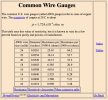
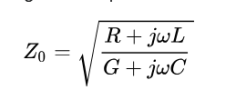
Since lamp cord is (relatively speaking) low loss, if you measure L and C for the same length of wire. The characteristic impedance will be Sqrt(L/C). A more precise formula is 1733861891769.pngwhere R is the twice the end to end resistance per unit length, G is the leakage conductance per unit length, L is the inductance per unit length, and C is the capacitance per unit length. G is very small if the insulation is good. You can get R from the table from BmWr85; for example, for 24 gauge wire it is 0.0842 ohms per meter. As long as that is much less than wL, you can drop the R term, yielding the simpler Sqrt(L/C) formula.
 
I figured zip cord or speaker wire word likely fall in between my criteria of between 100Ω - 150Ω characteristic impedance.

Anyway, if anyone know where I can find wire with that spec, or where I can find a manufacturer's dimension, please post a link.
Thanks!

FYI/FWIW, CAN bus cable is typically 120 ohms characteristic impedance. Dunno that I've ever seen it in 12ga, but maybe??

Also I believe you can search Belden's eCatalog with nominal (characteristic) impedance as a filter/parameter.

That said, I'm wondering why a company would publish a spec for characteristic impedance of a cable that they were thinking isn't normally used in an impedance matched type system.
 
Last edited:
Wouldn't a cable impedance vary based on the frequency you're testing at?
That said, if you were to buy from a known manufacturer ( Belden for instance) they likely have extensive data sheets available for many (all?) applications.
You might think so, but no, the impedance of parallel conductors is largely frequency independent. That being said, I was really just looking for a low cost way to get my hands on some inexpensive, low impedance, transmission line. I ordered and just received a 250' reel of SatMaximum brand speaker cable. This should be close enough, and the good aspect of balanced line is, it can contain impedance mis-matches very well.
Thank you to everyone who spent the time to read and reply.
SatMaximum.jpg
 
Wouldn't a cable impedance vary based on the frequency you're testing at?
That said, if you were to buy from a known manufacturer ( Belden for instance) they likely have extensive data sheets available for many (all?) applications.
Yes. Impedance is a function of the frequency. It's an alternating-current kind of thing.

Resistance is a direct-current kind of thing.

Another, perhaps more critical, issue is the wire construction and insulation consistency per length. :idea:
 
Copper clad aluminum speaker wire ? = usually not recommended but it will work of course. it’s just a smaller gauge required for the same dc resistance as pure copper which is more expensive
 
You don't want the wire to have that impedance, you want the wire to deliver the votage and necessary current to drive that impedance of the load with a minimum of loss. Look up the specs for the RG cables for instance. They're designed to drive a higher load impedances. RG 8 and RG 11 for instance.
 
Yes. Impedance is a function of the frequency. It's an alternating-current kind of thing.
Resistance is a direct-current kind of thing.
Another, perhaps more critical, issue is the wire construction and insulation consistency per length. :idea:
As I said before, "You might think so, but no, the impedance of parallel conductors is largely frequency independent."
Impedance of an inductor or capacitor is related to frequency, like in speaker coils and crossovers, but not when it comes transmission line, as a TL is essentially a series of inductances and capacitances. At audio frequencies this barely matters as the wave lengths of the audio signal are very long compared to the wire run, in this application it's more about DC resistance. At radio frequencies it matters because you can have several complete cycles of a signal on the TL simultaneously, going to a load. Here's a calculator that can be used to estimate the impedance of a variety of transmission line arrangements: https://www.mantaro.com/resources/impedance-calculator.htm
Here's a decent video about the topic of transmission line impedance:
Copper clad aluminum speaker wire ? = usually not recommended but it will work of course. it’s just a smaller gauge required for the same dc resistance as pure copper which is more expensive
I need the strength of aluminum is actually desirable in my application since the wire will be under some tension and aluminum might limit the stretching. Also, at the frequencies I'm using it for, current travels on the surface of the wire, known as the "skin effect". Audio frequencies as so low, again, compared to the line length in most applications, that speaker wire can be treated more like a DC application.
 
Last edited:
I'd reach out to a couple of cable manufacturers with your desired specs and let them work up an estimate for a custom cable.
 
How about " Ladder line" RF transmission flat line pair that is used to feed a balanced output transmitters to a balanced connected antennas, like the much smaller 300 ohm flat wire used sometimes on old analog TVs/FM s to connect to the balanced TV/FM antenna`s balanced connection screws.
Some Ham radio operators may use this type RF feed due to its very low loss, and it`s been many, many yrs. since I`ve looked in any Ham radio catalogs, but I remember seeing it advertised fully insulated, and also uncertain of the nominal impedance (though 150 ohms seems to lurk in my old brain) or wire size gage, though for transmitting RF power of any strength and used outside, I would think it was offered in decently large diameter gages.
 
UTP Category 6 (or 5 or 5E) are 100 to 200 ohms. Specifics are readily available about offerings from specific manufacturers.
While that`s correct, the largest wire gage that I`ve ever seen advertised is 23 AWG, and I believe the OP was looking for a much, much larger zip cord like wire gage for his RF power transmission experimentation.
 
How about " Ladder line" RF transmission flat line pair that is used to feed a balanced output transmitters to a balanced connected antennas, like the much smaller 300 ohm flat wire used sometimes on old analog TVs/FM s to connect to the balanced TV/FM antenna`s balanced connection screws.
Some Ham radio operators may use this type RF feed due to its very low loss, and it`s been many, many yrs. since I`ve looked in any Ham radio catalogs, but I remember seeing it advertised fully insulated, and also uncertain of the nominal impedance (though 150 ohms seems to lurk in my old brain) or wire size gage, though for transmitting RF power of any strength and used outside, I would think it was offered in decently large diameter gages.
Ladder line, open wire, twin lead, all are too high in impedance for my purposes, and they don't have the physical characteristics that I need, which is that the wire insulation serve as the spacing mechanism. I'll try the 12 AWG speaker wire I have. My load is nominally 120Ω (~95Ω on the lower frequencies, 145Ω on the higher frequencies) and 12AWG speaker wire will handle the voltage I plan on applying without the insulation breaking down. When I get a chance, I'll test the impedance and post my results for anyone who cares.
 
Back
Top Bottom