• The move to the new server is done. There are some software and database maintenance updates in process. This has us passing the hat around to help out. We appreciate any donations. Seriously, even a dollar helps. The payment page may be found here - https://www.audiokarma.org/support.html

a better 2" mid driver?

Gigantic

A big, big love
A number of us have gotten tremendous results from the PRV Audio D2200Ph driver and to be sure, it performs better IRL with the PRV WG45-50 horn than its stats from the manufacturer suggest that it should. It is perhaps one of the best values in High Efficiency Audio out there. That said, it's not without its flaws: on paper, it's specified to only extend down to 500Hz; a number of us are getting it down to 400Hz with the WG45-50, but in making it extend that low, we do run a risk of distortion. I've not encountered it, but the risk is there, just the same. The other problem I've encountered is that in crossing over at traditional points of say 5000 or 6000 Hz, we either have significant overlap with the tweeters if using low order low pass filters, as the D2200Ph extends upwards to 8kHz, before its mass rolloff or we have excessive phase is we use higher order filters. I've found this to be especially problematic when implementing a quasi-linear phase filter scheme with a DSP and parametric EQ.
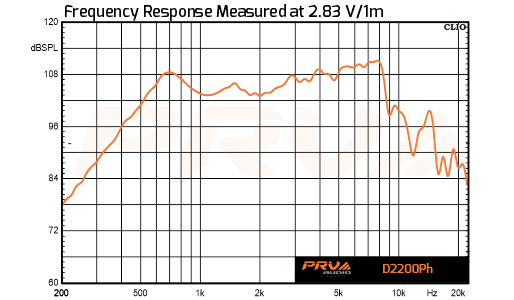
PRV-Audio-D2200Ph-Frequency-Response.png


I have been digging around and found another offering from PRV, the D4500PH. Grated, its nearly triple the price of the D2200PH, but given the paucity of 2" drivers that extend below 600Hz, it's still considerably less than other options. Whereas the D2200PH has quite a few peaks in its response, the D4500PH is comparatively flat from 500Hz, all the way up to its peak 7K.
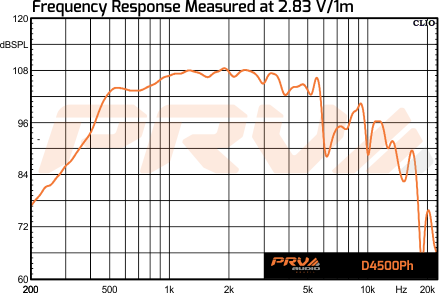
PRV-Audio-D4500Ph-Graphic.png

if it performs like the D2200PH does down low in the WG45-50, it ought to be more manageable at the top of its range with IIR PEQ and/or low order filters, no? What says youse? Thoughts?
 
Register to hide this ad
I would say, mated to a PRV horn, you are getting the best data from their "insider" engineering department.
The curve shown on the 4500PH model has a "flat middle" which is more typical of 2" compression drivers, rather than a saggy middle on the 2200PH. The greater model number and the higher price is also what is used by bandC, who is the premier driver maker in the world, as far as I'm concerned.

What you do with it with all of your accumulated toys, is entirely up to you. We are all explorers in different ways and at different ages, I started at 12 and I'm not done yet either.
 
The 4500Ph looks like a good candidate for a great midrange driver similar to it's little brethren the D2200Ph. But, as you point out, it is three times more money. However that only equates to $180USD.

The 2200Ph on the 18x10 horn is extremely flat with no EQ, which is a feat for such a wide bandwidth. At the low power levels being used in the home environment, distortion is not really an issue for either the 2200Ph or 4500Ph. The main advantage of the 4500Ph would be its high frequency roll-off (if the manufacturer curves are somewhat accurate) compared to the 2200Ph.

Chris did indicate that driver overlap was not that much of an issue when using the "Zeroth" method of integrating drivers without using conventional crossovers.

How is the Thomann working out so far?


D2200Ph on 18x10 horn
1712071523369.jpeg
 
How is the Thomann working out so far?
I have the initial filters laid out. Tonight, I'll get the new ZA3 installed. my s/o is going to the office tomorrow, so early evening, before she gets home, I'll run some sweeps and plug in the preliminary eq and see where we get. after that, I may have to tweak the filters, then I'll play around with the FIR filters to see if I can improve the low end group delay, but that's a long term project, I suspect.
 
I'm curious where you end up on the high crossover. I've played with everything from 8k down to about 3800 with happy smooth sums but my ears seem to like it on the lower end so far.
 
I'm curious where you end up on the high crossover. I've played with everything from 8k down to about 3800 with happy smooth sums but my ears seem to like it on the lower end so far.
I’ve been at 6k, but I’m looking at 5k for the new dsp to see how that works.
 
I recommended this driver last year for the same reasons and you guys about ran me out of the thread lol.
"You guys" is an appropriate generic assignment to diffuse guilt. Rather than delete the offensive posts from the individuals, the entire thread was removed. I understand, since it happened to me recently.
Basically, it just proves that most people can't handle the truth, when presented.
Or they just don't know the difference, and want to revel in their ignorance of the details.
Either way, guys like me, you, and a handful of others on these types of forums, just get pissed/frustrated, and just quit trying to help, since only 2%, statistically, can even comprehend or accept those truths, which must include Data for veracity, and even then, it's not accepted!
 
"You guys" is an appropriate generic assignment to diffuse guilt. Rather than delete the offensive posts from the individuals, the entire thread was removed. I understand, since it happened to me recently.
Basically, it just proves that most people can't handle the truth, when presented.
Or they just don't know the difference, and want to revel in their ignorance of the details.
Either way, guys like me, you, and a handful of others on these types of forums, just get pissed/frustrated, and just quit trying to help, since only 2%, statistically, can even comprehend or accept those truths, which must include Data for veracity, and even then, it's not accepted!
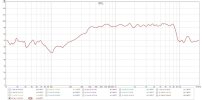
The data that you provided showed that your driver/horn choice had no high end at your listening position.
IMG_2529.png
Again, if the mic can’t pick it up at all, how are you supposed to hear it?
 
@mtg90 posted some measurements with the PRV WG45-50 and several 2” drivers a while back.

None of which look to reach down to 400Hz as well as the D2200PH.

 
@mtg90 posted some measurements with the PRV WG45-50 and several 2” drivers a while back.

None of which look to reach down to 400Hz as well as the D2200PH.

Wisdom of the ages for a greater form of reason: "Never argue with a fool, no one will know the difference."
 
I recommended this driver last year for the same reasons and you guys about ran me out of the thread lol.
I don't remember you mentioning the D4500Ph, but my memory is not what it used to be. The last thing I remember about the 4500Ph was Claude asking about it near the beginning of the 18x10 Horn & D2200Ph thread.

The 4500Ph would probably be a good fit on the 18x10 or 11x17 horns if you needed the power handling of it.
 
I'm curious where you end up on the high crossover. I've played with everything from 8k down to about 3800 with happy smooth sums but my ears seem to like it on the lower end so far.
Due to the center to center distance of the drivers, it’s probably going to sound more unified if you have the crossover point set lower rather than higher.
 
Wisdom of the ages for a greater form of reason: "Never argue with a fool, no one will know the difference."
So would you like to explain why other peoples data shows high frequency content off axis when using the WG45-50 horn and your measurements show nothing above 10kHz?

At this point your data is contradicting your words.
 
@mtg90 posted some measurements with the PRV WG45-50 and several 2” drivers a while back.

None of which look to reach down to 400Hz as well as the D2200PH.

That is a great website if you have or are thinking about using one of the horns/waveguides that they tested.
 
I would say, mated to a PRV horn, you are getting the best data from their "insider" engineering department.
The curve shown on the 4500PH model has a "flat middle" which is more typical of 2" compression drivers, rather than a saggy middle on the 2200PH. The greater model number and the higher price is also what is used by bandC, who is the premier driver maker in the world, as far as I'm concerned.

What you do with it with all of your accumulated toys, is entirely up to you. We are all explorers in different ways and at different ages, I started at 12 and I'm not done yet either.
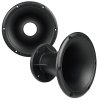
This is the horn (WG14-50 Series/45x45 exponential) that the factory spec sheet indicates was used with D2200Ph curve posted above. The D4500Ph spec sheet does not say what horn was used, but it might be the same one.

The 14-50 and 18x10 horns are apples and oranges. I am very interested in the 4500Ph, but don't really want to spend $189 to experiment right now. Even if the frequency response was similar or flat throughout it's frequency range compared to the 2200Ph it may or may not sound better. The only way to tell is to buy it, test it and listen.

I am very curious though.

1712259979379.jpeg
 
The data that you provided showed that your driver/horn choice had no high end at your listening position.
View attachment 3167688
Again, if the mic can’t pick it up at all, how are you supposed to hear it?
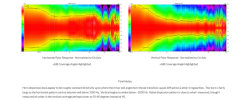
Trying to use the 18x10 horn full range (on the high end) is probably not the best choice. The polar response after 7kHz (horizontally) is not looking good at all and the vertical response is pretty crummy too. No EQ/PEQ will fix those frequency aberrations/anomalies in the polar responses.


1712261038139.png
 
Trying to use the 18x10 horn full range (on the high end) is probably not the best choice. The polar response after 7kHz (horizontally) is not looking good at all and the vertical response is pretty crummy too. No EQ/PEQ will fix those frequency aberrations/anomalies in the polar responses.


View attachment 3167980
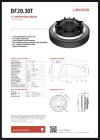
That looks like the LaVoce DF20.30T which has a large dip around 7kHz even directly on axis.1BF5ABE5-CF79-4C45-82C5-B6A2FEF353AD.jpeg
 
Back
Top Bottom