

You are using an out of date browser. It may not display this or other websites correctly.
You should upgrade or use an alternative browser.
You should upgrade or use an alternative browser.
across the bench: an electronic menagerie of diagnostic oddities plus photos and design analysis
- Thread starter sae-7125
- Start date


sae-7125
Super Member
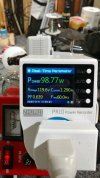
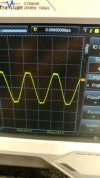
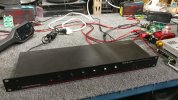
ok, now the little amp testing has concluded.
lots of potential if the company decides to revise the initial design to include an upgrade tier/level route (higher wattage power brick, active cooling). high frequency response and accuracy could be improved in future product evolution which could rival more than a few get-rich-quick kilo-buck so called hifi/audiophile companies. to have a palm sized stereo amp (aptx-hd would be a plus, hint...hint...) with high end sinad score that would make portable demo shopping extremely enjoyable.
especially when feeding the system with a dc-dc boosted power pack (usb battery?). ideally dual mono modules that could sit on the speakers terminals, wireless charging possible option.
upcoming douk a5 pro testing shows improvement plus an open path for modz that push things even further. the standard model a5 was recently reviewed over at asr and even though it did not hit a top ten position with sinad it did achieve some decent numbers.
 www.audiosciencereview.com
it is interesting to note how 10-20w/ch can be quite capable especially after working on the fisher x-100 even though thats a tube system. since most speakers are inefficient its not surprising that 100-200w/ch is optimal for a universally capable system.
lots of potential if the company decides to revise the initial design to include an upgrade tier/level route (higher wattage power brick, active cooling). high frequency response and accuracy could be improved in future product evolution which could rival more than a few get-rich-quick kilo-buck so called hifi/audiophile companies. to have a palm sized stereo amp (aptx-hd would be a plus, hint...hint...) with high end sinad score that would make portable demo shopping extremely enjoyable.
especially when feeding the system with a dc-dc boosted power pack (usb battery?). ideally dual mono modules that could sit on the speakers terminals, wireless charging possible option.
upcoming douk a5 pro testing shows improvement plus an open path for modz that push things even further. the standard model a5 was recently reviewed over at asr and even though it did not hit a top ten position with sinad it did achieve some decent numbers.
Douk A5 Budget Stereo Amplifier Review
This is a review and detailed measurements of the Douk Audio A5 stereo class D amplifier. It was sent to me by the company and costs US $99.99 as of this writing on Amazon including free shipping. I really like the look of the unit. The control on the right turns the amp on and adjusts the...
www.audiosciencereview.com
it is interesting to note how 10-20w/ch can be quite capable especially after working on the fisher x-100 even though thats a tube system. since most speakers are inefficient its not surprising that 100-200w/ch is optimal for a universally capable system.
sae-7125
Super Member
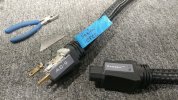
a quick cable autopsy even though this is a rather painful way of doing things, open neutral on a relatively new condition cable (low hours if any).

it was a 50/50 guess as to which end termination had the issue. difficult to see but somehow the small gauge wire sheared off during manufacturing under all the plastic candy coating. this particular brand is not known for quality, like most things in the market place.
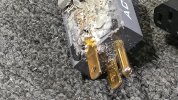
a usb microscope might have helped with this type of inquiry since standard photos are somewhat lackluster. also using a sharp razor blade would have been nice as well, dull as a butter knife seems appropriate.
would have been interesting to see what gauge wire was used vs advertised. the solder junction on the broken neutral prong seems like a quick blob assembly of small gauge conductor(s).

Pangea Audio AC-9 MKII Power Cord
Pangea Audio AC-9 MKII Power Cord Upgraded power cable specifically designed for high-current components Pangea Audio's AC-9 high current power cable has been one of our bestsellers for years. And now this high performance, affordable cable gets a nice performance boost with the AC-9 MkII...
 upscaleaudio.com
sae-7125
Super Member
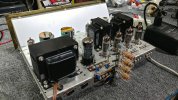
brief owner requested mod for the recent fisher x-100.
perhaps new zealand fantail, havent figured out a creative designation for this reversible + non-destructive modification.

i wonder if avery was a bird person
Avery Fisher - Wikipedia
sae-7125
Super Member

scrap banana terminal block from a recycled rotel multi channel receiver plus a thick metal angle bracket (also scrap from an amp heat sink) plus some non-conductive spacers and various bolts from other scrap.
the delicate fisher screw terminals will need to be accessed if a particular output impedance is needed but far less mechanical stress and strain on the system when the owner uses hifi spade/banana terminated speaker cables regardless of 16ga normal wire or high profit margin fire hose diameter particle accelerating room temp super-duper conductors that will also mow the neighbors lawn...
sae-7125
Super Member
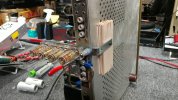
using preexisting vent holes for some mounting screws to hold stacked pieces of wood which in turn creates a solid and stable exterior anchor point. the metal angle bracket has two mounting points, one under the chassis (shown above) and the other uses stock mounting hole for the single rear screw. smaller diameter bolt used so it does not damage original chassis threads.
keep in mind that i am using the origin threaded holes in the scrap angle bracket, no mods/drilling/cutting with it. the under slung assembly does not interfere with the height of the stock chassis feet. chassis sits flat as normal.
improv trial & error evolution engineering, or something...
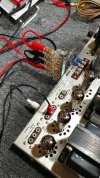

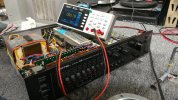
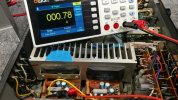
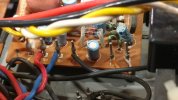
sae-7125
Super Member
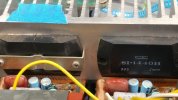
sanken si-1440h module looks like it will be a rare find when shopping for a potential replacement
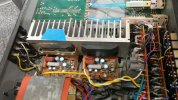
to do a recap looks problematic as well. power resistors surrounded be electrolytics, what could possibly go wrong in a short amount of time. output relay might need servicing, messy surgery indeed.

sae-7125
Super Member
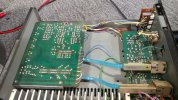
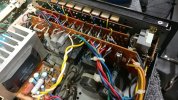
indeed it is. i wonder if the mechanical stress from the metal bracket installed at the factory combined with a thermal runaway event (+rail to +output dead short) encouraged the shell fracture.That left Module looks like its cracked right down the m middle !!
i suppose it does make a visual inspection easier in regards to where the gremlin is hiding. gremlins need a cave door too, not exclusively for magic smoke holiday travel.

couldnt find a suitable "the far side" example of when a gremlin moves into the electrical circuit neighborhood. this will have to suffice until an adequate cartoon example is found.
i wonder if gary larson has an electrical engineering minded twin on planet earth somewhere. sort of a "dilbert meets the far side" type of cartoonist.
sae-7125
Super Member
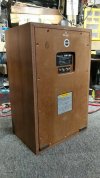
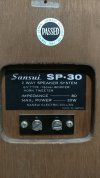
Sansui SP-30 | hifi-wiki.com
SANSUI SP-30の仕様 サンスイ
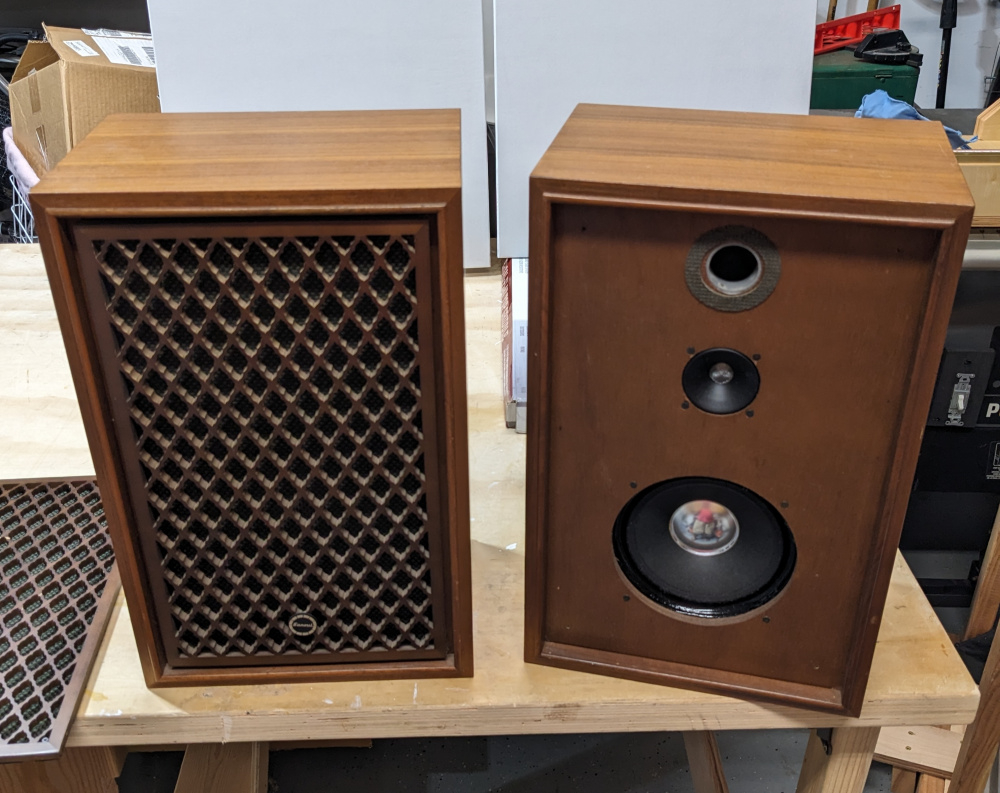
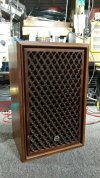
Sansui SP-30 Speakers
These followed me home from an estate sale today: (Image)
 diy.midwestaudio.club
sae-7125
Super Member

youtube.com/watch?v=vgmqUhvQlww
nice comparison with decent measurements and a rather sweet precision power analyzer.
LMG671 - 7-Channel Power Analyzer - ZES ZIMMER
Precision Power Analyzer for Enhanced Measurement, One-shot Results for Narrowband, Full Spectrum and Harmonics
 www.zes.com
sae-7125
Super Member
still kicking around ideas about using the zk-ht21 2.1 amp in square wave (distortion output) mode as a power supply for an upcoming pse tube mono block system (EL34 x4 each). filtering/smoothing ripple from a flat top waveform helps reduce b+/b1/b2 noise without needing high uf caps. depending on isolation between channels (sub output) might be able to do three individual supplies with one class-d amp (200hz input).
voltage quad circuit tuned for 380v dc bus unless designing a fisher style output bias circuit (cathode +60v vs grid ~gnd). GaN power brick feeding 2.1ch amplifier should be sufficient (36v 5a). only loose end will be heater/filament circuit, perhaps 60v pwm (20k-25k hz carrier) at around 10% duty cycle. already have a 15usd solution in my junk collection for that, guessing 50w minimum for each mono block.
voltage quad circuit tuned for 380v dc bus unless designing a fisher style output bias circuit (cathode +60v vs grid ~gnd). GaN power brick feeding 2.1ch amplifier should be sufficient (36v 5a). only loose end will be heater/filament circuit, perhaps 60v pwm (20k-25k hz carrier) at around 10% duty cycle. already have a 15usd solution in my junk collection for that, guessing 50w minimum for each mono block.

sae-7125
Super Member
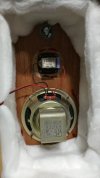
closer look at drivers, w-30 woofer 8r 5w
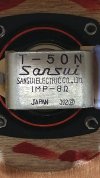
tweeter t-50n 8r 10w
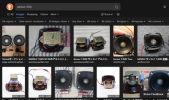
more than a few search engine photo results of the tweeter
a tube amp with 12at7 or 12ay7 parallel single ended would be sufficient, 3 bottles with 2 triodes each running at 1w output (6w high bandwidth per channel). could be an interesting project especially with output caps vs usual txf.
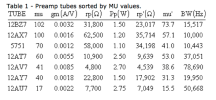
nice reference info for comparing parameters