

You are using an out of date browser. It may not display this or other websites correctly.
You should upgrade or use an alternative browser.
You should upgrade or use an alternative browser.
ADC's Bricks
- Thread starter wualta
- Start date

Doug G.
Lunatic Member
Hehe, sorry about the delay. Various nuisances kept interfering with the really important things in life. 
Anyway, I don't really have anything earth-shaking. Just that I believe the 660 is all gray including the stylus carrier and the 770 is gray with a black metal body and a red stylus carrier. Or is it the opposite? I have never been absolutely sure. I have one with the red stylus carrier and it doesn't have the same magnet as is typical of ADC styli. There are two wedge-shaped magnets on either side of the cantilever near the rear.
I seem to remember you writing about that before, wualta. Am I correctomundo? I guess this looks like a bonded elliptical to me.
My 220 I bought in 1969 (I think it was only about 20 bucks or maybe even only 10 bucks, not the cost as indicated in the cartridge database) and it did have a little gold sticker on the front "220" which seemed to fall off shortly after I removed the cartridge from its bubble hang card package.
It still sounds good to this day.
That's a beautiful TT setup, chicks.
Doug
Anyway, I don't really have anything earth-shaking. Just that I believe the 660 is all gray including the stylus carrier and the 770 is gray with a black metal body and a red stylus carrier. Or is it the opposite? I have never been absolutely sure. I have one with the red stylus carrier and it doesn't have the same magnet as is typical of ADC styli. There are two wedge-shaped magnets on either side of the cantilever near the rear.
I seem to remember you writing about that before, wualta. Am I correctomundo? I guess this looks like a bonded elliptical to me.
My 220 I bought in 1969 (I think it was only about 20 bucks or maybe even only 10 bucks, not the cost as indicated in the cartridge database) and it did have a little gold sticker on the front "220" which seemed to fall off shortly after I removed the cartridge from its bubble hang card package.
It still sounds good to this day.
That's a beautiful TT setup, chicks.
Doug

hifitommy
Super Member
before the XLM, these were the faves at tas. apparently, the cantilever suspensions were VERY delicate.
i don't buy the exceedingly low vtf ratings. i think this war with shure ended up causing many records to be damaged with mistracking.
it takes an exceptional tonearm to allow even an XLM to track at 1.0 gram. usually it took 1.5gr.
i don't buy the exceedingly low vtf ratings. i think this war with shure ended up causing many records to be damaged with mistracking.
it takes an exceptional tonearm to allow even an XLM to track at 1.0 gram. usually it took 1.5gr.

Nope, you had it right the first time, if the old ads and brochures handed down to us are anything to go by. But of course there's nothing stopping someone from swapping styli at some point in the last 48 years on a random sample that's washed up here in the 21st century, so the color of the metal body is the only way to be semi-sure.Doug G. said:... I believe the 660 is all gray including the stylus carrier and the 770 is gray with a black metal body and a red stylus carrier. Or is it the opposite?
Whoa, that's different. I don't think I've ever seen that. Got a good macro photo of that magnet?Doug G. said:I have one [770?] with the red stylus carrier and it doesn't have the same magnet as is typical of ADC styli. There are two wedge-shaped magnets on either side of the cantilever near the rear.
If it's an OEM red stylus assembly for the 770, it's a bonded conical. At least that's what the materials I have at hand say.
As I recall, the 220 was almost crazy-cheap. No one even minimally hip paid the MSRP for cartridges and the street price was often a third of that, especially if you mail-ordered. I can easily believe $10 or even less. It's one of the cartridges you'd see advertised for a penny when bought with a turntable.Doug G. said:My 220 I bought in 1969 (I think it was only about 20 bucks or maybe even only 10 bucks) and it did have a little gold sticker which seemed to fall off shortly after I removed the cartridge from its bubble hang card package.
When I look at the 220, I'm reminded of some British streamline-style chairs of the 1930s, the forerunner of the style Douglas Adams would call "excitingly chunky" 40 years later. I wonder if either Pritchard (a British expat) or the person who sculpted the cartridge bodies for him was influenced by that style.
And yes, very few of those teeny gold stickers survived.
Last edited:
Doug G.
Lunatic Member
before the XLM, these were the faves at tas. apparently, the cantilever suspensions were VERY delicate.
i don't buy the exceedingly low vtf ratings. i think this war with shure ended up causing many records to be damaged with mistracking.
it takes an exceptional tonearm to allow even an XLM to track at 1.0 gram. usually it took 1.5gr.
A lot of people think all ADCs were/are low tracking weight cartridges but my 220 package clearly has "Tracking force range 2-5 grams" on it.
EDIT: I guess I kind of agree with you, Tommy, because I remember being obsessed with using the absolute lowest tracking force back in the seventies because I had read articles on the record wear difference between 1 and 1.5 grams. Later, however, I realized I had been a little too nuts about it and my records are still fine.
Doug
Last edited:
Doug G.
Lunatic Member
I meant to add that I did get that 220 mail order. It was from one of three sources - Allied, LaFayette, or Olson although it almost had to have been from Olson because I got one of those little preamps (the black ones with the two input jacks on one side and the two output jacks on the other) to use with my amp, which did not have magnetic input, at the same time and I know that was from Olson.
I couldn't use it, however, because the hum pickup from the motor in my VM changer was too loud when the tonearm got too close to the motor. I admitted defeat and reinstalled the ceramic Astatic cartridge.
Doug
I couldn't use it, however, because the hum pickup from the motor in my VM changer was too loud when the tonearm got too close to the motor. I admitted defeat and reinstalled the ceramic Astatic cartridge.
Doug
[takes off invisible hat] A moment of silence for Allied, Lafayette and Olson. I miss those places. I did get good service from Chicago's Musicraft/Illinois Audio, Baltimore Stereo Wholesalers and suchlike. Great places to buy ADC cartridges and VFETs from.
Last edited:
That's how he avoided ever having to use exotic metals. But imagine what might have happened if he had. Too bad there is no SAS stylus for any ADC or Sonus (or for any induced-magnet design) cart.
By the way, here's the spec sheet for the 660E.
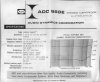
By the way, here's the spec sheet for the 660E.
Last edited:

chicks
Lunatic Member
Thanks for all the info.
The 660E sounds great on the ELAC, but at some point I will need to move to a cart for which quality stylii are available.
I have a new Shure 97xe, would it be a good match?
I had a Dual 1019 with a Grado Black which had a very similar "fullness" of sound to the ELAC/ADC, perhaps it would be a good choice?
The 660E sounds great on the ELAC, but at some point I will need to move to a cart for which quality stylii are available.
I have a new Shure 97xe, would it be a good match?
I had a Dual 1019 with a Grado Black which had a very similar "fullness" of sound to the ELAC/ADC, perhaps it would be a good choice?
Well, you already know what I'd like to say-- keep it ADC, as the original owner wanted it. But by rights, since Shure based their entire cartridge future on ELAC's patents... Yep, the 97xE would be good-- plus there's a cheat option to turn it into an M97HE, with flatter response than the xE, for not-outrageous money. UPDATE: sadly, the sanely-priced Shure N16 styli are all gone.
I have very little experience with Grado cartridges, but like their approach-- moving-iron operating principle combined with very low inductance and value for money at the low end, all things Peter Pritchard would have smiled upon.
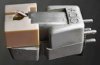
Oh-- and if anyone, let's say anyone on a certain online auction site, tries to sell you a combination of a Brick stylus on a Pre-Brick body, like this Brick stylus on a 660 body... I didn't know the two would even fit together. They do, but they won't produce sound. Why? Because in this combination there are exactly zero magnets. No magnets? No sound.
I have very little experience with Grado cartridges, but like their approach-- moving-iron operating principle combined with very low inductance and value for money at the low end, all things Peter Pritchard would have smiled upon.
Oh-- and if anyone, let's say anyone on a certain online auction site, tries to sell you a combination of a Brick stylus on a Pre-Brick body, like this Brick stylus on a 660 body... I didn't know the two would even fit together. They do, but they won't produce sound. Why? Because in this combination there are exactly zero magnets. No magnets? No sound.
Last edited:
The 10/E (1966)
This may look like a Brick, but it isn't. Yet. Since we were discussing the 1964 660E, and I got this 1966 10E (and its relatively rare R11E stylus) because the auction incorrectly called it a 660, good excuse as any to put it here. Note the unique appearance of the 10/E's R11E magnet and suspension box. This changed a year later with the 10E Mk II.
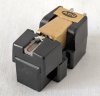
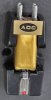
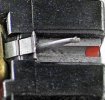
ADC 10/E and R-11E STYLUS
Those of you who own 220s will recognize the shape of the body. In three more years, the Bricks would arrive.
The 10E (originally "10/E"; the slash was later dropped) represents Pritchard's second thoughts on his Point Four. The cantilever is still tapered, the stylus is a square-shank nude mount 3x7 elliptical "tombstone" diamond, but now the cantilever is held into the rubber mount/pivot block strictly by the compression of the rubber. Apparently Pritchard started out by using an adhesive to make sure the cantilever stayed put-- I can't pull out the Point Four's canti. But the 10E's is removable, and that's the way ADC-built cantilevers would be until the end, although one more refinement, the flats stamped or ground into the soft-iron sleeve, was yet to come.
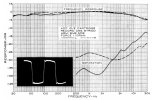
The inductance is down from the 880mH of the Point Four, down to 600mH, about the same as the last XLMs, and the channels match to within a single milliHenry. Not surprisingly, the cartridge as a whole is still a heavyweight at 7.4g. That wouldn't improve until the XLM. How does it sound? Shockingly (to me) good. Tracks my S-sound torture tests. Not too shabby for nearly 50 years old! This model was quickly followed by the R-12 equipped 10E Mk II, the only visible difference being a stylus with a redesigned gold-colored suspension block frame and a gold magnet. Oh, and an ADC badge that's black plastic rather than gold metal.
See how the response curve (Hirsch-Houck labs) is a big, lazy arc, with a droopy treble end? It sounds like that graph looks. I put the R-11 stylus in a blue 990E body with about half the inductance to prop the high treble up. Sounds very nice, but I think tone controls could do the job too. 5kHz turnover on the treble and maybe 300Hz on the bass.
This may look like a Brick, but it isn't. Yet. Since we were discussing the 1964 660E, and I got this 1966 10E (and its relatively rare R11E stylus) because the auction incorrectly called it a 660, good excuse as any to put it here. Note the unique appearance of the 10/E's R11E magnet and suspension box. This changed a year later with the 10E Mk II.
ADC 10/E and R-11E STYLUS
Those of you who own 220s will recognize the shape of the body. In three more years, the Bricks would arrive.
The 10E (originally "10/E"; the slash was later dropped) represents Pritchard's second thoughts on his Point Four. The cantilever is still tapered, the stylus is a square-shank nude mount 3x7 elliptical "tombstone" diamond, but now the cantilever is held into the rubber mount/pivot block strictly by the compression of the rubber. Apparently Pritchard started out by using an adhesive to make sure the cantilever stayed put-- I can't pull out the Point Four's canti. But the 10E's is removable, and that's the way ADC-built cantilevers would be until the end, although one more refinement, the flats stamped or ground into the soft-iron sleeve, was yet to come.
The inductance is down from the 880mH of the Point Four, down to 600mH, about the same as the last XLMs, and the channels match to within a single milliHenry. Not surprisingly, the cartridge as a whole is still a heavyweight at 7.4g. That wouldn't improve until the XLM. How does it sound? Shockingly (to me) good. Tracks my S-sound torture tests. Not too shabby for nearly 50 years old! This model was quickly followed by the R-12 equipped 10E Mk II, the only visible difference being a stylus with a redesigned gold-colored suspension block frame and a gold magnet. Oh, and an ADC badge that's black plastic rather than gold metal.
See how the response curve (Hirsch-Houck labs) is a big, lazy arc, with a droopy treble end? It sounds like that graph looks. I put the R-11 stylus in a blue 990E body with about half the inductance to prop the high treble up. Sounds very nice, but I think tone controls could do the job too. 5kHz turnover on the treble and maybe 300Hz on the bass.
Last edited:
Doug G.
Lunatic Member
So, the 10E is kind of a "deluxe" 220 then? Hehe. Black and gold instead of plain old red and black.
And all those pre-bricks and bricks had those kooky little stickers on the back which have confounded ADC owners from the beginning as to which wire goes where.
I mean, they SHOULDN"T confound because they are completely logical but, there you have it.
Doug
And all those pre-bricks and bricks had those kooky little stickers on the back which have confounded ADC owners from the beginning as to which wire goes where.
I mean, they SHOULDN"T confound because they are completely logical but, there you have it.
Doug
The chronology is (of course) murky, but at the moment, I believe the 10E (aka 10/E) hit first, followed by the group of 220, 550 and 990. So if that's correct, the 220 would actually be a de-refined (though surprisingly slightly) 10E. Interestingly, the 220 and 10E share the lowest claimed effective tip mass: 0.25mg. The others in the group are all 0.3mg. So maybe Doug G. is on to something.
220 owners: not that I want you to try this unless your stylus is worn or bent, but can you pull your 220's cantilever all the way out, then slide it back in so the flats on the cantilever lock in place in the rubber pivot block? Are there flats at all?
220 owners: not that I want you to try this unless your stylus is worn or bent, but can you pull your 220's cantilever all the way out, then slide it back in so the flats on the cantilever lock in place in the rubber pivot block? Are there flats at all?
Last edited:
That's very interesting. Maybe they kept using adhesive on the heavier-tracking models. This is only significant because in ads for the XLM, the copy boasts of the lack of tie wires and adhesives, implying that they'd tried it and found it had some ill effect. What that effect might have been....
Yes, and it could also be that the adhesive only holds the top layer of rubber and simply tears it off when something yanks hard on the diamond. My Point Four stylus is like that. Not completely torn yet, but getting there, and the characteristics probably start getting really unpredictable from there. Better to have the cantilever pull out of the pivot block undamaged so you can slide it back in. Hint: sometimes you can get a used ADC cartridge cheaply because the seller thinks a pulled-out cantilever (looks like suspension collapse at first glance) means the stylus is trashed. If complete pullout occurs, the canti's iron sleeve will usually stick to the magnet so it won't get lost. Buy it with a straight face; then, later, smile as you simply slide the canti home. Then frown as you find the diamond is worn out. Oh well.
Meanwhile, a relative of the 10E Mk II, the 550E, got in a few days ago. I know, these aren't Bricks, but for a long time I didn't see these 1967 models come up for sale for sane prices. Now they're all over the place and going for very reasonable prices. For now.
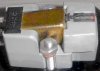
That's a web photo. Mine still had its sparkly little gold sticker saying "550E", but the cartridge was so dirty that I decided to experiment by dropping the whole thing, body and stylus together, into the ultrasonic bath. Nothing odd happened to it. Surprisingly low inductance: 209mH left, 265mH right. Meanwhile, some advice: if you ever get your own pre-Brick from the 1967 group (220, 550E, 990E, 10E) and you find someone's glued the stylus assembly to the body, they haven't. That's just how tightly they fit together. Just pull straight out the front and eventually it'll let go. Don't be tempted to pry anything.
And now, a word from the base-model Brick, the 220X/XE:
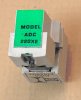
Mine has the late-production XLM-style cast-metal pole-piece "mouth". What's interesting is that a reliable source tells me he has a 220XE with around 160mH (if we can guesstimate from his DCR reading, which he's kindly done for me twice). This one, which arrived yesterday, measures around 500 ohms and about 280mH, about what we'd expect from measuring many Bricks. Still, we know ADC let slip some outliers, cartridges that had inductance either ~twice as high or ~half the usual amount. The question is, were they intentional, and if so, why, or were they truly slipups in production and nothing more?
Meanwhile, a relative of the 10E Mk II, the 550E, got in a few days ago. I know, these aren't Bricks, but for a long time I didn't see these 1967 models come up for sale for sane prices. Now they're all over the place and going for very reasonable prices. For now.
That's a web photo. Mine still had its sparkly little gold sticker saying "550E", but the cartridge was so dirty that I decided to experiment by dropping the whole thing, body and stylus together, into the ultrasonic bath. Nothing odd happened to it. Surprisingly low inductance: 209mH left, 265mH right. Meanwhile, some advice: if you ever get your own pre-Brick from the 1967 group (220, 550E, 990E, 10E) and you find someone's glued the stylus assembly to the body, they haven't. That's just how tightly they fit together. Just pull straight out the front and eventually it'll let go. Don't be tempted to pry anything.
And now, a word from the base-model Brick, the 220X/XE:
Mine has the late-production XLM-style cast-metal pole-piece "mouth". What's interesting is that a reliable source tells me he has a 220XE with around 160mH (if we can guesstimate from his DCR reading, which he's kindly done for me twice). This one, which arrived yesterday, measures around 500 ohms and about 280mH, about what we'd expect from measuring many Bricks. Still, we know ADC let slip some outliers, cartridges that had inductance either ~twice as high or ~half the usual amount. The question is, were they intentional, and if so, why, or were they truly slipups in production and nothing more?
Last edited: