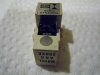
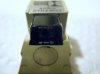
Finally, now, at last: a Model 25 of my own
Finally, at long last, we come to the UberBrick, the one that started the whole crazy fad for heavy brick-shaped phono cartridges.
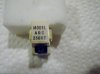
The ADC Model 25 arrived today, so, as promised, here's the update. Why have I wanted one? Among other things, to reassure myself (and all of you) that the 25 was the basis for, and thus no different internally from, all the beige-body Bricks that followed it. The idea was that if you were lucky enough to have an R-251 stylus, you could use it in a cheap and easily-obtainable beige body and still get the best sound the Bricks ever offered-- no need to pay top dollar for the rare 25 and 26 bodies.
If my guess was correct.
But, sadly, it wasn't. This body measures a staggering-- for a Brick-- 710mH average, and the channels match within 20mH, so I think it's a reliable figure. This makes it, as I feared, unique-ish among Bricks [EDIT: the same as Models 26 and 27]. Does this mean Benchley can't enjoy the R-251 or R-26 stylus he snagged for cheap in his cheap 230XE? No, but he'll have to compensate for the extra brightness in the top two octaves. A 3:1 inductance mismatch will be audible, especially if you're a cat. If you can find a 10E Mk IV body, the mismatch becomes 1.5:1, which for most humans will not be a problem.
Now, having said that, all is not day/night won/lost. Don't be afraid to experiment. Any Brick stylus will fit any Brick body. If the result is bright, flip your treble control turnover point to 5kHz and turn the treble down a few dB. It's only a frequency-response problem, not some crazy magnetic misalignment that increases distortion.
The 25's extra inductance was probably needed to keep output level up. Output might have gone down because the mass of the soft-iron collar was reduced to minimize effective tip mass; that's my guess.
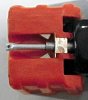
This 25 is one of the earlier ones. As you can see, it has the tapered cantilever. Also a beautiful square-shank natural nude-mount diamond. This one was cared for better than my earlier blue-dot elliptical.
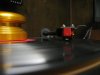
How does it sound? Very nice indeed. It tracks my current sibilants tracking torture test, Joe Jackson's
Night & Day, s.1 t.1, perfectly at 0.75g VTF. This is in the Onkyo CP-1030F's carbon arm, remember. As much as I admire these carts, I didn't think it was going to succeed in tracking that cut when way too many expensive aftermarket styli I have can't do it at twice the force. But we know that the tapered-cantilever version of the R-251 stylus is nearly impossible to get these days. Question is, can the more normal-looking R-251s do the job.
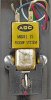
You'll also see in the photo above that when the cartridge arrived, the cantilever pointed toward the center of the record. I have the funny feeling, having owned one in the '70s, that the AR XA turntable this 25 was living in had just a wee bit too much lateral arm friction to do a typical high-compliance ADC cartridge any good. As the skating force yanked the cantilever inward, the arm friction was trying to, in effect, pull the cartridge body back toward the armrest, with the results you see in the photo.
The stylus assembly arrived intact but full of crud, including magnetic crud stuck to the "flux lens" (my name for it), the channeled/grooved metal circle under the stylus, as you can see, barely, in the photo. The ultrasonic bath took care of all of it very nicely. The ultrasonic treatment has the advantage of cleaning an ADC stylus' suspension element as well, so the cantilever now points straight ahead. Nice.