• The move to the new server is done. There are some software and database maintenance updates in process. This has us passing the hat around to help out. We appreciate any donations. Seriously, even a dollar helps. The payment page may be found here - https://www.audiokarma.org/support.html

AK Design Collaborative - Insubnia

It will act like a horn to the rooms corner frequency. Once the wavelengths start to overwhelm the dimensions of the room, it does act like a direct radiator.

Ok. so it's room dependent in relation to horn configuration then :scratch2: If thats the case, is a tapped horn better suited to smaller rooms?

The one octave deal concerns me also. Lets say that the tapped horn would get you down to 30 Hz working as a horn (in the right room). One octave would be 60 :scratch2:

Just slap me if I'm getting too annoying ;)

RC
 
:lurk::beer:

I-N-S-U-B-N-I-A....:drool: (who am I kidding, its ANOTHER project that MUST be completed)
russellc
 
About 25 years ago I was a car audio installer and subs were the deal.

I set out to make a sub that was very fierce but cost effective at the time.

I really did not have design tools and software just a box program that would help with tuning.

I was using a driver called an MTX Blue Thunder (first iteration).

I was designing for pickup truck install because these where typically hard to get sub bass in as most where single cab trucks and of course that's what I had, a 78 f150.

What I eventually had was a bed mounted box similar in design to what peteb's link showed but instead I had 4 individual chambers for the 4 10" drivers into a mouth as wide as the box that housed the drivers with increasing dimension into the cab of the truck. I think they were in the area of 2.3 cu ft per chamber.

The "boot" kind of like a camper boot got it from the bed to the cab without water leakage.

The individual cabs where then ported into the mouth at an angle on the baffle at the rear or smallest part of the mouth. If I remember correctly they where tuned to about 28 hz.

This design worked very well and I ended up putting in about 30 of these over the next few years. The outside of the box was covered in fiberglass for weather/water protection.

As said earlier I did not have any measurement tools so I really do not know how they looked in simulation but this box was driven with 50 watts per driver and playing some content at and below 30 hz would really shine. If you rolled down the windows you could tune it even better.:D

Here is a crude drawing.
 
Last edited:
The one octave deal concerns me also. Lets say that the tapped horn would get you down to 30 Hz working as a horn (in the right room). One octave would be 60 :scratch2:
See Ray's post again:

http://www.audiokarma.org/forums/showpost.php?p=3386253&postcount=17

The objective is not a general-purpose sub, rather, a compact one to augment Indignias in a small HT "package" comprising Indignias, Mindignias, Incentria, and Insubnia.

I am torn between Incentnia and Incentria.

[That's my job here.... ;) ]
 
Last edited:
Mindignia is the surrounds. Downsized version of Indignia in 0.25 cuft. cabs.... :yes:
 
Mindignia is the surrounds. Downsized version of Indignia in 0.25 cuft. cabs.... :yes:

I went back and reread some, nice. The smaller woof from the Mindignia,
sort of a "mini Indignia"...might not be a bad stand alone itself, or with a sub combo.:scratch2: My "home theatre" is 2 way, alas. But this sub looks like a killer Indignia add-on. Thanks for the effort! Any thought to multiple (3-4) small subs?

russellc
 
I have the smaller woofers playing here in some Jamo cabs; they sound very much like Indignias, and are suitable as stand-alones, yes, as in computer speakers. The sub will go nicely with them, as well.

Yes to multi-Insubnias for HT.... :thmbsp:
 
This system is essentially a bandpass design with the ported box side replaced by a transmission line. Valid comparisons would have equal volume boxes. Try that driver in an equal volume box port tuned to 30 or 20-25 Hz if there is peaking at 30.

Here is an example that I believe is better vented, which I showed through simulation:
http://www.hometheatershack.com/for...lutions/22059-trio8-unhorn-proof-concept.html

All subs see similar boundary reinforcement when put in a corner. True horns have their LF cutoff extended in the corner but this does not being more like a TL bandpass.

It is the flare rate and mouth area that determine the LF cutoff of the horn - it has little to do with the driver.
Consider that if it flares out fast you are making a midrange horn, the flare has to be gradual in proportion to
the wavelengths.

If the mouth sees an impedance mismatch to the air then the energy put in is reflected back down the line
rather than radiated, the mouth has to be large as compared to the wavelengths for a good impedance match.

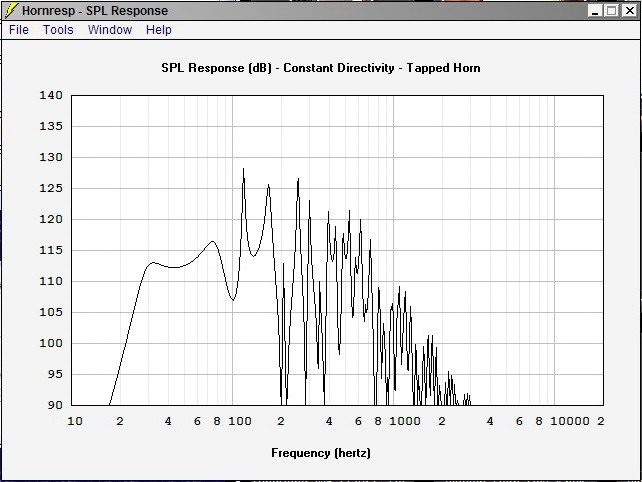
The "horn" under consideration here is acting like a horn above 100 Hz where you see numerous peaks and
dips due to reflections.

Please post the graph of the 25-30Hz ported design you mention for comparison. The driver parameters are readily available at PE.

Whatever you want to call the box (T-line, Bandpass, TQWT, Horn, TH, whatever), it gives the needed SPL in simulation for a realtively small size, and low cost. I'll leave the semantics for someone else...We'll see how it measures in real life soon. If you have a better design in mind for this application, please enlighten us.

The reason the peaks and dips occur further up in freq response is that I played with rear chamber volume to get decent reactance annulling, giving me reasonably flat freq response in the passband needed. I can change the numbers to create peaks and dips all the way to the low corner if needed...

JSS
 
Ok, I did some quick simulations and what I am able to get in a normal vented design is a bit more deep bass extension but with 3dB less sensitivity - and I am trusting Hornresponse's number for the sensitivity.

Looking more closely at your design, I believe that it is acting like a bandpass with a poorly terminated mid bass horn as the port. What I did not notice at first is how slow the taper is in your design.

I tried a single tuned traditional bandpass and I can duplicate your sensitivity using the bandpass gain at say 30 Hz, but it is a high narrow peak with virtually no flat passband. I believe that the horn section, being effective at higher frequencies is what lifts the pass band back up.
Your excursion curves show minimum excursion at 38 Hz and I'd expect that this is the l/4 resonance of the horn/line which is analogous to a vented system.

So there is an advantage to this design, you can raise the efficiency of the driver and trade off bandwidth for a given size box. Still, it is a highly resonant structure with resonances far up into the midbass. It is like a bandpass with the ability to tune lower and still maintain a reasonable passband, however the long tapered section requires a lot of box volume and it is reasonable to consider if you can choose another driver for as good/better performance in the same size box.

A different driver is needed in this 1.5 cu ft vented system to provide similar performance with comparable efficiency and box size. I'd choose one of these, if 4 ohms is a requirement with 50W available, and I'd tune below Fs 25-35 Hz to get subwoofer type performance. I'd use a 3" flared port - if possible:
http://www.parts-express.com/pe/showdetl.cfm?Partnumber=295-374

http://www.parts-express.com/pe/showdetl.cfm?Partnumber=295-376

What are the plans for a crossover? Will it be powered?
 
Last edited:
Thanks for this analysis, Pete.

I am anxious for someone to work out and post the double-folded 30 Hz tapped horn for TB W6-1139.... :yes:
 
Last edited:
Thanks for this analysis, Pete.

I am anxious for someone to work out and post the double-folded 30 Hz tapped horn for TB WS1139.... :yes:

I'm not sure which one you mean by this, the one at this site, the 30Hz TH? http://www.volvotreter.de/th.htm

Let me say that he shows a plot for the 30 Hz TH with 20V drive that he says is into quarter space. I believe that it is actually 1/8 space or corner loaded which provides another 6 dB of gain. The numbers don't seem to make sense.

It is very difficult to determine if these designs have any real LF SPL gain because they're not simulated under standard conditions. Should be 2V into 4 ohm driver, 2.83V into and 8 ohm, or else stated as 2.83V sensitivity plot. It should always be half space for a baseline since this is the standard for T&S theory. I'm not speaking of JSS's work here - he's got the 2V 2pi curve.

Do you know of 2.83V or 1W curves simulated and or measured for the DTS-10?
 
I'm not sure which one you mean by this, the one at this site, the 30Hz TH? http://www.volvotreter.de/th.htm
Yes, but double folded, like he did the 38 Hz variant.

Max is about to post a thread on how to calc the folding part, which could produce a preliminary plan.

Do you know of 2.83V or 1W curves simulated and or measured for the DTS-10?
I believe that is discussed in AVS forum thread, and there's an index in the first post over there, now.

I was following it for a while during the builds, but the rest was only of marginal interest to me, and did not warrant continuing attention.... :dunno:
 
For a crossover, I'll first have to see how much gain we get above 60Hz, see how much hornresp is fibbing, and how much the folds will attenuate upper bass response...I was thinking a plate amp's crossover with maybe some receiver crossover supplementation if needed to tame the upper bass response...but first I need to see if what I sim will come true...

I was thinking that anyone who builds the KIT will have a receiver with some lowpass crossover capability, and a plate amp with the same....combined they could get the job done...add in Audyssey to equalize the bumps before the crossover takes effect, and you are cookin'...

Zilch, we have someone with some Tapped Horn kung-fu coming on board here soon. Lilmike will post what he can get TH wise with the TB driver...

I am also working on a 20Hz version with the TB W8-740P. It will be twoce the volume of the 30Hz Insubnia v1.0, same 85dB sensitivity. For people who have a little more room...

My thoughts on the KIT include 2-4 Insubnias in a room's ceiling corners, mounted with little custom shelves. Out of the way bass....If you have the room, make them 20Hz Insubnias....then you should be able to get ~20dB below reference sound in a small package. ~15dB below reference in a small room....great for most movie watchers....I was a 20dB below reference movie watcher for years...then I discovered horn subs....

JSS
 
Yes, but double folded, like he did the 38 Hz variant.

Here is a lumped, vented analogy to his 30 Hz TH with the same TB driver. It requires a 25 liter box tuned to 30 Hz, here's the sim.
I used 112W which is 20.0 V input so that it can be compared to the 30 Hz TH at the Volvotreter site, this is half space - add 12 dB for
ideal (rigid) corner loading.
Note that I would never do a peaked up response like this for my own design, I simply wanted to show that the LF response of that TH could be
duplicated with a normal vented system, and it is in a significantly smaller box. It reaches max excursion at 27 Hz with 20V
drive and is well below that above. It makes more sense to use a more efficient driver that will reach Xmax with 50 to 75 W if
this is the planned power:
 

Attachments

  • TB1139SI.jpg
    TB1139SI.jpg
    100.9 KB · Views: 64
Last edited:
Here's the 30 Hz TH simulated response linked from the VolvoTreter site, 20V drive:
Mini-TH_max-SPL.jpg
 
Last edited:
Thanks again, Pete!

I've seen Lilmike smooth out the TH response via tweaking the lengths on another site. The proof is in the building and measuring, of course. I'm guessing getting the folding right is not trivial.... :dunno:
 
forgive my pondering, as im an inexperienced wench in these mateters.(no shame)

But doesnt the bose scoustimass exhibit the same looss of freqs in the lower mid bass?

Or does the glossing over fix it?

Still interesting to read. and learn.
 
Back
Top Bottom