

You are using an out of date browser. It may not display this or other websites correctly.
You should upgrade or use an alternative browser.
You should upgrade or use an alternative browser.
AK Design Collaborative - Insubnia
- Thread starter Zilch
- Start date


Thanks again, Pete!
I've seen Lilmike smooth out the TH response via tweaking the lengths on another site. The proof is in the building and measuring, of course. I'm guessing getting the folding right is not trivial....
Sorry I was late for the party.

I have some information and performance data regarding these drivers, and might have a bit I can add to the discussions, but I have to get up to speed with all that has been posted first.

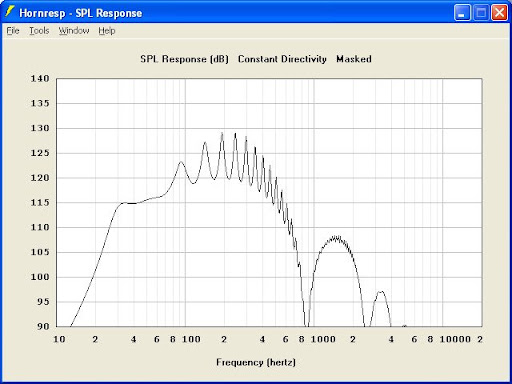
I've been curious to try out hornresp for some time now, downloaded it a long time ago. I simmed a normal vented lumped analogy to the first design here in this thread to see if it agrees with Unibox, and what the predicted output would be at 15V with corner loading. I found that hornresp required a much smaller box and I believe that this is due to probably zero damping in the port, and perhaps in the box also which is equivalent to infinite Q - Qb, Qp, and Ql. I used a large diameter port which in turn has to be long, even so the box is only 16 l and the port about 5 l more. The long port is what causes the transmission line resonances above 200 Hz. I trust the box size determined in Unibox which was 20 - 25l. The input and the results are attached:


I attempted to make this as close as possible to JSS's first design in this thread for a comparison to a vented system.
Efficiency is close, the "horn" gains 1 or 2 dB but requires a much larger box. There is droop in the vented design's
response because the driver is not in an optimal vented alignment - still performance is impressive for such a small box:
I attempted to make this as close as possible to JSS's first design in this thread for a comparison to a vented system.
Efficiency is close, the "horn" gains 1 or 2 dB but requires a much larger box. There is droop in the vented design's
response because the driver is not in an optimal vented alignment - still performance is impressive for such a small box:
Attachments
Last edited:

Yes, we had difficulty with the requisite port lengths using this driver in conventional alignments, which is why we went to bandpass in our first round with it. Others seem to have made it work satisfactorily, however....So far all of my sims have been with that driver, yes.
Reference: http://www.audiokarma.org/forums/showthread.php?t=189759
http://www.rjbaudio.com/Cerberus/cerberus.html
Last edited:
Have we been using the published or measured parameters? I'm still trying to come up to speed here, so I don't want to step on toes or repeat what's been said.
I have measured Thiele-Small parameters of four of these drivers. With the measured parameters, I had good success using them in a 30 Hz tapped horn. Results (impedance, phase, and SPL) were quite close to predictions. I used all four in the same horn, so it was not exactly small....
Here is what I measured. I use a Woofer Tester 2. Variation was near 10% on Vas (delta mass), but closer to 5% for the rest of the parameters.
Re = 3.642 Ohm
Fs = 44.70 Hz
Qes = 0.627
Qms = 2.995
Qts = 0.518
Le = 1.110 mH
Diam = 127 mm
Sd = 126.678 cm^2
Vas = 7.512 L
BL = 7.927
I have measured Thiele-Small parameters of four of these drivers. With the measured parameters, I had good success using them in a 30 Hz tapped horn. Results (impedance, phase, and SPL) were quite close to predictions. I used all four in the same horn, so it was not exactly small....
Here is what I measured. I use a Woofer Tester 2. Variation was near 10% on Vas (delta mass), but closer to 5% for the rest of the parameters.
Re = 3.642 Ohm
Fs = 44.70 Hz
Qes = 0.627
Qms = 2.995
Qts = 0.518
Le = 1.110 mH
Diam = 127 mm
Sd = 126.678 cm^2
Vas = 7.512 L
BL = 7.927
All of my work is with the published specs. I was suspicious of the claimed Sd of 140, your figure looks more reasonable, and your Vas is significantly less than published. Did you use half of the surround in calculating Sd? I don't have any of these drivers and my main interest is to compare these designs to conventional vented types.
Yes, we had difficulty with the requisite port lengths using this driver in conventional alignments, which is why we went to bandpass in our first round with it. Others seem to have made it work satisfactorily, however....
Reference: http://www.audiokarma.org/forums/showthread.php?t=189759
A slot loaded port folded in the box should do it, could cut down the area to get a more reasonable length.
I suppose it could just be made from PVC pipe and elbows. I'd want
it flared.
Yes, half the surround as best I could with a ruler.
Vas was measured with delta mass (I added weight to the cone), so it is probably not as accurate as a test box, but as tapped horns are seriously sensitive to compliance, and my measured results tracked the model pretty well, I think I'm pretty close.
These are a good driver for a tapped horn, but they really want to play a bit lower than 30 Hz. The general rule of thumb is ~1/2 the Fs for a driver like this one, so 25 Hz is certainly within reach.
Though I only skimmed it, I didn't really see anything in this thread detailing the size limits or desired performance (spl and bandwidth). The quick model I just threw together suggests that with one of these drivers in under 3 cubic feet, 2.83 V gets you 90 dB 2 pi @ 25 Hz. Reasonably speaking, there is an additional 15 dB of headroom available, netting ~105 dB.
With a 25 Hz highpass in place, excursion (x-max limited) should not be an issue until 100 W (past the driver's RMS thermal limits). I have fed these drivers up to 125 W each and could not bottom them out free-air. I ran out of amp at ~500 W into 4 drivers series/parallel wired, and since that was all the amp I planned to use with the project, I stopped there.
The model is a first attempt and is not at all polished (impulse looks pretty bad yet and phase isn't quite right). If I'm in the ballpark WRT the project objectives, I'd be happy to work it over a little further. The biggest issue will be fitting the driver inside the horn when it gets folded up, but I have an idea or two that might work.
Vas was measured with delta mass (I added weight to the cone), so it is probably not as accurate as a test box, but as tapped horns are seriously sensitive to compliance, and my measured results tracked the model pretty well, I think I'm pretty close.
These are a good driver for a tapped horn, but they really want to play a bit lower than 30 Hz. The general rule of thumb is ~1/2 the Fs for a driver like this one, so 25 Hz is certainly within reach.
Though I only skimmed it, I didn't really see anything in this thread detailing the size limits or desired performance (spl and bandwidth). The quick model I just threw together suggests that with one of these drivers in under 3 cubic feet, 2.83 V gets you 90 dB 2 pi @ 25 Hz. Reasonably speaking, there is an additional 15 dB of headroom available, netting ~105 dB.
With a 25 Hz highpass in place, excursion (x-max limited) should not be an issue until 100 W (past the driver's RMS thermal limits). I have fed these drivers up to 125 W each and could not bottom them out free-air. I ran out of amp at ~500 W into 4 drivers series/parallel wired, and since that was all the amp I planned to use with the project, I stopped there.
The model is a first attempt and is not at all polished (impulse looks pretty bad yet and phase isn't quite right). If I'm in the ballpark WRT the project objectives, I'd be happy to work it over a little further. The biggest issue will be fitting the driver inside the horn when it gets folded up, but I have an idea or two that might work.
The great thing about horns...move them inside and stick them in a corner:
I don't get it.... why do you keep saying this, like no other subwoofer design other than horn gains sensitivity and output in a corner?
You are most welcome, Mike...I can't wait to see what you come up with TH-wise...I'm sure it'll beat the flh version...also, I didn't do an exhaustive search for a driver...there may be something better out there...
JSS
Maybe, maybe not - it all depends on the goals and limitations on what we can do so that it fits in with the rest of the project. This driver is a good candidate for use in a tapped horn, but the mouth section gets a little long to flatten things out. Multiple drivers work better than a single.

budgetaudio6
Addicted Member
thanks for clarifying about the bose acoustimass missing freqs, as comspared to the shown graph. Project is looking interesting already.
90 db at 25 hurtz? that would be some thing else.
90 db at 25 hurtz? that would be some thing else.
We looked at VolvoTreter's double-folded 38 Hz tapped horn, which is just under 2 cuft. external, and suggested that was sufficiently compact. 3 cuft. is 24" x 24" x 9", and that's certainly within the realm of what we were earlier considering with our bandpass approach. We probably want to pay attention to dimensions from the perspective of economical use of materials, as well. Many builders will be purchasing MDF or birch ply solely for constructing this project.Though I only skimmed it, I didn't really see anything in this thread detailing the size limits or desired performance (spl and bandwidth). The quick model I just threw together suggests that with one of these drivers in under 3 cubic feet, 2.83 V gets you 90 dB 2 pi @ 25 Hz. Reasonably speaking, there is an additional 15 dB of headroom available, netting ~105 dB.
I believe we have agreed that 30 Hz is an acceptable target, but I doubt anyone would object to it playing to 25 Hz, instead. This is intended to mate with and augment Karma Indignias, an earlier successful collaborative project here, which play with some authority down to 40 Hz. They do have their limits down there, though, admittedly unknown. I believe Max is running the calcs on those for us. The plan is to include a plate amp in the design, which could incorporate highpass filters for both sub and mains, though nobody has looked at that aspect in detail.
We don't aspire to THX spec SPL with this compact system, but as we proved with Indignia, I believe we can easily surpass the performance of similar commercial offerings. One driver per box would be preferred, and those who so desire can build multiple inexpensive Insubnias. Typical deployment would be at floor and wall boundaries, i.e., 1-pi, corner placement optional for those who can take advantage of that for additional SPL....
Last edited:
Thanks for the insight.
So - a max SPL of 105 dB/100W/2pi per cabinet would be adequate?
With these criteria in mind, we're also likely concerned with "constructability" too. In other words, it has to be something that someone can put together without a full-on cabinet shop and micrometer-level measurements and still achieve reasonable performance. I will do my best to keep the design, folding and construction as simple as I can.
(Primarily cause I gotta build one too - real world tests trump hornresp screengrabs...)
I think I see where this is intended to go.
Let me tweak that model a bit, I'll get back to you. Stay tuned.
So - a max SPL of 105 dB/100W/2pi per cabinet would be adequate?
With these criteria in mind, we're also likely concerned with "constructability" too. In other words, it has to be something that someone can put together without a full-on cabinet shop and micrometer-level measurements and still achieve reasonable performance. I will do my best to keep the design, folding and construction as simple as I can.
(Primarily cause I gotta build one too - real world tests trump hornresp screengrabs...)
I think I see where this is intended to go.
Let me tweak that model a bit, I'll get back to you. Stay tuned.
I don't get it.... why do you keep saying this, like no other subwoofer design other than horn gains sensitivity and output in a corner?
With a horn, the room corner reflections acts to make the mouth 'larger', and the room corner also makes the horn 'longer', lowering the corner frequency. Pete is correct in that the flare for this horn is very small and constant, and so the low corner drop is not noticeable until you start stacking a bunch of them. But for other horns, the corner drop is definitively there when corner loaded...
JSS
Thanks for the insight.
So - a max SPL of 105 dB/100W/2pi per cabinet would be adequate?
With these criteria in mind, we're also likely concerned with "constructability" too. In other words, it has to be something that someone can put together without a full-on cabinet shop and micrometer-level measurements and still achieve reasonable performance. I will do my best to keep the design, folding and construction as simple as I can.
(Primarily cause I gotta build one too - real world tests trump hornresp screengrabs...)
I think I see where this is intended to go.
Let me tweak that model a bit, I'll get back to you. Stay tuned.
Mike,
Thanks for posting driver measurements....I'll run the numbers again for my 1st iteration with them....Ever measure the TB W8-740P? It is my candidate for the 20Hz iteration of Insubnia...and on sale...
JSS
Last edited: