• The move to the new server is done. There are some software and database maintenance updates in process. This has us passing the hat around to help out. We appreciate any donations. Seriously, even a dollar helps. The payment page may be found here - https://www.audiokarma.org/support.html

Altec Model 19 Technical Info? Similar Econowave?

Pete B

AK Member
Subscriber
I've been interested in the Altec Model 19 (M19) since I was in my teens and read the review in
High Fidelity 1978. Page 37 in the .pdf:
More:

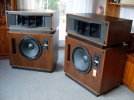
NICE - not mine:
Altec-Lansing-Model-19-1.jpg


Lately, I've been thinking about buying a pair and that led to wanting to first try something similar by way
of an Econowave. I can think of doing an Econowave as close as possible to the original, or with one of the
upgraded crossovers, and also one that retains the good qualities but improved, on a budget, as much
as possible. Also, one with a MiniDSP so that crossover changes can be easily tried.
I don't need very high efficiency so I don't mind giving up 3-6 dB in an Econowave version.

I don't know a lot about Altec speakers and that is the reason for this thread. If there's full documentation
somewhere please point me to it.
The purpose of this thread is to learn as much as possible about the original Model 19, including:
Box size (volume) and dimensions,
Nice scratch build here: Altec Model 19 Speaker Building Project
Port size and tuning,
Drivers used originally and if they were improved along the way, etc.
What are considered the best substitutes as improvements/replacements for the originals.
Crossovers, original, Z19, others and impressions of them if anyone has compared them.

I've read on here that these are end game speakers, so I don't need to be convinced about listening impressions,
I do want to hear about faults and how to fix them and how any upgrade changes the sound.

First question is how would one build a clone (this is not my plan but I want to understand them) and what
upgrades make them the best sounding speakers possible?

I think that I can work out a much cheaper Econowave version once I know how the original was built, but I
do welcome suggestions for drivers, horns, etc.

Thanks all
 
Last edited:
Register to hide this ad
M19 woofer info: 16" Woofer: 416-8B
Interesting test of this woofer in 100 l sealed including frequency response and distortion:
This is a new driver from Great Planes Audio:

I've read that the internal volume is 8.1 cu ft or 229 liters.
Have also read on here that the port tuning is 45 Hz. I'm going to use 42 Hz which is close enough
and provides slightly flatter response.

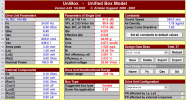
======== ENTERED THE T&S PARAMETERS FOR THE GREAT PLANES 416-8B INTO UNIBOX:
Some say that this driver is not an exact copy, anyone know for sure? User enters the parameters for a new driver
into the entries in blue the program computes those shown in red: Some things to note, Fs is a bit low at 24 Hz
since for a maximally flat B4 design Fs=Fb, here Fb=42 Hz. If we were designing from scratch and wanted to
tune higher at 42 Hz we could take this as compliance error and jamming methods would say try it where you
want it. The Qts is low at .23 but if we were to "fix" the compliance for an Fs of 42 Hz then the new Qts would
be .23 x 42/24 = .40 which is about right for a B4.

2.83V SPL is high at 98.4 and efficiency is also high at 3.6%.

The program computes values to 1KHz and I adjusted the Le lower so that the impedance there matches that
measured on another site at 9 ohms.

I also entered 100W in order to avoid overpowering the driver, even at this power it requires an overdrive
allowance of 1.5X which is fairly typical. The HF test report stated that it easily handled 100W and would
handle short term peaks of 900W in the woofer range. At 1.5X Xmax distortion might be 5 to 10 percent
but we tolerate very high levels of distortion from most woofers in the bass range. Most test to 50 percent
distortion or buzz for absolute max power. These numbers should be reasonable.
The nominal power is used for the FR plot so at 100W we see the maxSPL, and you can set it to 1W to see the
small signal output level. This program does not model thermal or motor non-linearity so changes in power
simply scale the curve in proportion. We know from the table below that at 1W the pass band would be about 98 dB:

ALTEC 416-8B SIM1.PNG

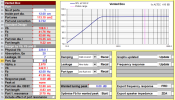
======== PREDICTED FREQUENCY RESPONSE:
The compliance error causes a very slight droop in the response, if the box were smaller there would be
less output at Fb and show more of an extended bass shelf response. The large box provides strong
output at Fb with no peaking above the passband and an F3 of about 41Hz. Box volume and port tuning
are entered below, and Damping, Leakage, and Port Type set determine Qb, Ql, and Qp these can be
overridden by directly entering a value. I entered Ql as 7 since this is the value suggested by Thiele:
This shows a nicely extended bass response, I prefer to go a bit lower say -3dB in the low 30s to high 20s
but most high efficiency designs start rolling off at 50 Hz or higher, often much higher. At 100W input
the woofer is putting out about 116 dB in the passband. The test report measured 114 dB at 100W not
too far off: This is a linear simulator, it does not simulate port compression so I do not enter any values for it.
ALTEC 416-8B SIM2.PNG

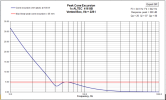
The next plot shows the 100W woofer cone displacement vs. frequency, and this is a fairly short throw woofer at 3.3mm Xmax. Allowing
the 1.5X overdrive factor allows 100W to just hit Xmax plus the overdrive factor. Excursion dips at the port tuning and shows an in
band max at about 55Hz. Run 50 to 75W if you want to stay in the more linear range, but 200W is also fine for just a bit of extra headroom:
ALTEC 416-8B SIM3.PNG

Input impedance, note that I allowed for .1R of hookup wire R but didn't enter the woofer inductor R, either use
a low DCR inductor or rerun the sims, Qts will go up a bit with higher DCR:
ALTEC 416-8B SIM4.PNG

I exported the predicted Zin up to 1000Hz, then added a handful of points up to 20KHz from the
graph at this site: It is smooth so Xsim will interpolate and it is good enough:

Zin from the above site:
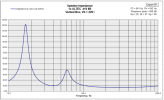
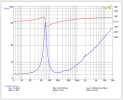
ALTEC 416-8B MEASURED ZIN.PNG

Measured FR from the above site:
ALTEC 416-8B MEASURED SPL.PNG

======== Jeff Markwart on cabinet plans:

======== Poorly scanned cabinet plans, see attached .pdf.
 

Attachments

Last edited:
For M19 driver/horn info
======== ZILCH WROTE THIS ABOUT 811b and 511 horns:
"All Valencias were 800 Hz.
Model 19 moved it up to 1.2 kHz.
Ultimately, 811B was acknowledged as being a 1.2 kHz horn, and 511B, 800 Hz.
All of this culminates in what I have repeatedly advised here:
If you want to stay Altec, replace the compression drives with new 902-8As and upgrade the crossovers to Model 19, vintage or new builds.... :yes:"


======== 802-8G DRIVER INFO


M19 DRIVER.jpg

======== 811b HORN INFO
ALTEC 811b Spec Sheet.jpg

======== SELENIUM D220ti on 811b:
SEL 220ti on 811B.JPG
 
Last edited:
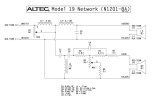
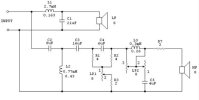
======== ALTEC M19 CROSSOVER NETWORK N1201-8A
The crossover point is 1.2KHz and people have mentioned here that this was Altec's best home system and the earlier,
less good, designs employed an 800 Hz crossover, so it seems that 1.2K is a good choice.

Altec engineers were clever in that by putting L1 at the input of the system it can be shared between the woofer and horn.
L1 being a small value attenuates the top end of the woofer, at midrange frequencies, the 8R pot across it makes it a
shelving filter ranging from the max at 8R to none at min R since it shorts L1. Because of the large L2 value it would not
work properly if it was only on the woofer section, it needs the loading from the horn to provide the midrange attenuation.
It also shelves down the horns output across the entire operating range, but since the horn is so efficient it is a bit like a
level control for it. Because of the clever placement it take a bit off the top end of the woofer also.
L2 and C3 form a standard 2nd order crossover network, L2 is larger than text book to provide a few dB of baffle step. I've
not simulated this network (anyone have a .ZMA file for the woofer?) but you have to watch out for peaking at the top of
the woofer filter due to the VC inductance, a Zobel and sometimes just a resistor can be used across the woofer.
C1, C2 and L3 form a fairly standard 3rd order crossover filter and the T network comprised of C4, R2, R4, R3 and
R5 provide adjustable response shaping that the horn needs to flatten the response. R6 provides a bit more attenuation.

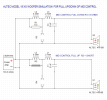
Zilch's (RIP) Z19 crossover eliminates the mid control from the woofer path, if you run the mid control full up then you
might like this mod - it essentially provides better parts. The tweeter section is also almost the same, but if I followed his
description of it, he found the midrange control from another Altec crossover design. The mid control is made up of L3,
LP2 and C5. Full up L3 is shorted by the pot and C5 is out of the circuit, the entire network is out of the circuit.
I don't believe that Zilch ever tested this on an actual Altec speaker, rather he used a JBL LE14A for the woofer, and a
DE250 on an Altec 511 horn with excellent results. Jackgiff also used a JBL LE14A and the standard JBL 6X12" with I
believe the Selenium driver, now we are really deviating from the M19 but he also enjoyed the final system.

This is from Jeff Markwart's site on the Wayback machine:
ALTEC M19 N1201-8A.JPG
Zilch Z19:

Zilch confirms in post #6 in this thread that this diagram from post #118 at LH IS the Z19 Crossover:
==== ZILCH Z19 CROSSOVER:
MAYBE ZILCH Z19.JPG
Zilch had several people test this with actual Altec speakers, Skywave rider was one at LHF.
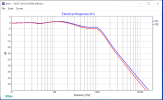
Zilch eventually put a B&C DE250 on an Altec 511A horn and this was the flattest response he got with that combo:
index.php


This was the range of adjustment:
index.php
 
Last edited:
======== M19 WOOFER XO SIMULATION IN XSIM

I exported .ZMA data up to 1KHz (the limit) from Unibox and then added some points by hand up
to 20 KHz. There's no phase info for the points added by hand so check the derive phase box in
Xsim to allow the program to do it.

I've provided two instances of the crossover and woofer in Xsim, one with the mid control full up
and the other down so that it is possible to plot both curves in the same chart. It can be seen that
this crossover has full 5-6 dB of baffle step:
ALTEC 416-8B XSIM WOOFER XO SIM1.PNG

This is the schematic in Xsim:
ALTEC 416-8B XSIM WOOFER XO SIM2.PNG
 
Last edited:
Altec used the N1201 with an additional accessory card to get a flat response out of the HF horn and driver combination. Why would you want to change that? I can see replacing the capacitors with new ones and maybe the two controls on the N1201 if they are giving you troubles, but thats all I would do. You want to make sure the diaphragms are the same and the woofer cones have the same part numbers, too.
 
Thanks for the tips, I don't own a pair at this point so there's nothing to work with at this point.
I want to understand the design and then consider building an Econowave that is similar, you might
say inspired by the Model 19.
 
Last edited:
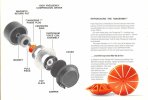
The nineteen was designed to be Altec's flagship model, it's design/engineering revolved around the introduction of two newly engineered drivers. Both the woofer and 802-8G compression driver introduced new 1 piece steel castings for their magnetic return structures, and the compression driver featured the new, radially slit tangerine plastic phase plug. The first 802-8G's produced used a special "light" diaphragm that proved a bit too delicate for long term high SPL playback.

Do not assume that the 416-8B offered by GPA is parametrically identical to the original 1975 design.

The N1201 network was not used with any additional accessories. The EQ/comp cards were supplemental to certain earlier speaker systems using the N501, and N801 networks, and could be purchased as stand alone accessories to be added to other Altec systems. The N1201/model 19 networks have those circuits built into the stock design.


1722847916510.png
 
The crossover is the secret sauce of the Model 19 (IMO one of the best turnkey speakers ever) and using a modified circuit means one no longer has a Model 19.

I think (but not sure) that later Model 19s used a ferrite version of the 416 and the ferrite 902 compression driver. When I had 19s just for Hell of it I put some 902s I had in place of the 802-8Gs and heard no difference. That might be good or might be bad, know what I mean?
 
I take it if you hear no difference then it is an acceptable replacement, is that your thinking?
 
It might take some exploring to find a replacement for the 416-8B. There aren't a lot of 15 / 16" drivers that can play well into the mid range and still produce bass. Smaller drivers won't have the same character.
 
Just my opinion, but ( for me ) any Model-19 wannabe must use the Altec 811b horn along with an Altec 802-8G compression driver ( with the N1201a crossover ).

I'm a bit more open minded about the 15" woofer ( as long as it sports a light cone assembly >> iow; a 60-70 mms figure, is efficient >> over 95db and can dig low enough to a solid 40hz ).

Over at diyAudio, the Eminence "Legend CB158" was mentioned. It's definitely worth reading the customer reviews within the link.

Since the woofer is quite affordable ( with apparent lots-a-love from Bass Guitarists ) it seems to be a pretty decent bet to try out ( & sell off to the M.I. types if found lacking ).

:)
 
It might take some exploring to find a replacement for the 416-8B. There aren't a lot of 15 / 16" drivers that can play well into the mid range and still produce bass. Smaller drivers won't have the same character.

A couple of B&C woofers I heard had good midrange and sounded very Altecish but I'm damned if I can recall the models. I judge woofers more on their midrange than on their bass.
 
So, to summarize the opinions presented here, you need to use the original crossover, the 416-8B, the 811 horn and 802-8G driver as well as the cabinet size and shape from the model 19.
Sounds simple.
 
So, to summarize the opinions presented here, you need to use the original crossover, the 416-8B, the 811 horn and 802-8G driver as well as the cabinet size and shape from the model 19.
Sounds simple.

There's quite a lot of inevitability built into the framing of the question.

I listen to Altec HF drivers and therefore recommend them to others.

:)
 
There's quite a lot of inevitability built into the framing of the question.

I listen to Altec HF drivers and therefore recommend them to others.

:)
I was just making a weak attempt at humour.
I use model 19s with original components though I have tried Z19 and active crossovers.
 
So, to summarize the opinions presented here, you need to use the original crossover, the 416-8B, the 811 horn and 802-8G driver as well as the cabinet size and shape from the model 19.
Sounds simple.
Sounds like just clone it (had a feeling you might be joking), which is an obvious way to go but I didn't know all the part
numbers and now I do.

I've heard from at least one member that the JBL LE14A and newer members of the family are a "jaw dropping" improvement
over the Altec woofer.

If I'm going to build something a main reason for doing it is to NOT pay insane prices for parts, ex: woofers $1000/pr
crossovers, $750/pr, etc. Might as well buy a pair of real M19s at those prices. I'm looking for a very econo version
and then either buying a real pair or a very high end and costly, inspired by version perhaps with new production
JBL woofers, thinking M2 woofers etc.
Edit: The very high end inspired by might turn out to be also, or more so, inspired by the JBL Synthesis 4367 but as a
2-way to keep costs in check.
JBL Synthesis 4367 White Paper:

 
Last edited:
Back
Top Bottom