
• The move to the new server is done. There are some software and database maintenance updates in process. This has us passing the hat around to help out. We appreciate any donations. Seriously, even a dollar helps. The payment page may be found here - https://www.audiokarma.org/support.html

Amplifier Distortion, DC-Offset, and You!

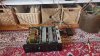
IMG_9620.jpg Samson S1000
Ch1 .8mv
Ch2 1.6mv
370wpc @8 ohms
Can’t believe how low these numbers are. All original, I replaced the broken binding posts. A standing bass on my Walsh 4/3000 sounds as realistic as I have ever heard on a recording. My favorite amp for a few months.

I don’t think I have $60 in it. I see these and larger Samsons under $100 fairly often.
 
Last edited:
JBL S800
2.4mV left
3.6mV right

Philips 7851
77mV left
18mV right
Now I want to do something about it and have to read up. Unit has no dedicated adjustments for DC-offset.
 
Last edited:
Philips 7851
77mW left
18mW right
Now I want to do something about it and have to read up. Unit has no dedicated adjustments for DC-offset.

Primary things that will affect output offset:
1. Q502/Q504 matching (but even *perfectly* matched parts may not give 0.0mV output offset)
2. Actual Zener voltage (Z502, is it different than the 10V spec?, compare it to the right channel)
3. Differential pair tail current.

Secondary items that will affect output offset:
4. Q502 collector load resistor R510
5. Input resistor R504
6. Vbe and gain of Q506
7. Everything else.

If that 77 mV really bothers you, I would suggest replacing the 4.7K ohm emitter resistor R506 with a 3.6K ohm in series with a 2.5K potentiometer.

Thank you so much for the detailed info on this. Does the 77mV really bother me? I don't know tbh, it might.
It's a nice receiver but not exactly high-end. Comparing it to other components I have around is not always fair and I have not thought about tracing some differences to the DC-offset.
I'd say, with the input given, it's project time!
 
How long should it take for the DC offset to "settle". When I turn on my H/K PM665vxi it is 390mV in the right channel and 190 mV in the left, after approx. 1 hour the DC offset has crept down to close to 0 which I adjusted the day before. Is this abnormal and what can be done about it in such cases?
 
How long should it take for the DC offset to "settle". When I turn on my H/K PM665vxi it is 390mV in the right channel and 190 mV in the left, after approx. 1 hour the DC offset has crept down to close to 0 which I adjusted the day before. Is this abnormal and what can be done about it in such cases?

That has been my experience with HK amps and receivers from 1980's as well. The all take a while to warm up and stabilize. Interestingly, designs with adjustable current (with VR's in the diff pair circuit, like HK795i) are less stable than the ones without, like PM645Vxi. Also, when I keep monitoring it with an active load (listening to FM at a medium volume for example), I see quite substantial DC intermittent swings (+/-50 mV or more).
 
I have 3 Sherwood 4901 receiver's they are pushing 8 -15 inch cabinets with horns and tweeters enclosed.
The amplifier is getting preamplified with an equalizer and a DJ mixer the sound is tremendous my only problem is that there is a very high pitch distortion sound coming out of the right channel it is quite annoying no matter how much I turn down the system soon as I turn up the volume the sound is back again it's more like a cracking sound of the amplifier is not getting hot it's not clipping and I've heard this before with certain songs on YouTube could it be YouTube or should I replace the amplifier...
 
I was trying to fix a Marantz PM 40SE, with a broke power transistors in the left channel. I replaced the transistor and adjusted bias current to the specified values.


Well the problem is the DC voltage in both channels is 14 Volts (not miliVolts) measured between the ground of the power supply transformer at the ground of the speakers, then the protection circuit operates, and there is not the tipical noise of the relay that connects the loudspeakers

Any clue will be welcome
 
I have 3 Sherwood 4901 receiver's they are pushing 8 -15 inch cabinets with horns and tweeters enclosed.
The amplifier is getting preamplified with an equalizer and a DJ mixer the sound is tremendous my only problem is that there is a very high pitch distortion sound coming out of the right channel it is quite annoying no matter how much I turn down the system soon as I turn up the volume the sound is back again it's more like a cracking sound of the amplifier is not getting hot it's not clipping and I've heard this before with certain songs on YouTube could it be YouTube or should I replace the amplifier...

Please start a new thread. This thread has 253 pages and will not be easy to follow.
 
I was trying to fix a Marantz PM 40SE, with a broke power transistors in the left channel. I replaced the transistor and adjusted bias current to the specified values.


Well the problem is the DC voltage in both channels is 14 Volts (not miliVolts) measured between the ground of the power supply transformer at the ground of the speakers, then the protection circuit operates, and there is not the tipical noise of the relay that connects the loudspeakers

Any clue will be welcome

Please start a new thread. This thread has 253 pages and will not be easy to follow.
 
Refurbished Harman Kardon PM645-VXi
Right channel: fluctuating between 0.8 and 1.3 mV
Left channel : fluctuating between 7.9 and 8.2 mV
 
So back to the OP...

I have a Hafler DH-100 preamp and DH-200 amp that I went through a “capacitor reformation” process with nearly two years ago. DC offset measures L: 13 mV, R: 33 mV. I haven’t had the nerve to connect any of my (sentimentally) valued speakers to them so I want to initially run the Haflers through a pair of sacrificial speakers. I’m thinking of grabbing the cheapest lab rat speakers that I can get my hands on that clock in at about 6 ohms or more. I don’t have a multimeter in front of me, so I don’t know if PC desktop speakers will fill this need.

Am I thinking sanely or do I need a neck-up checkup?
 
Sansui A-9 I just recently replaced a cap and resistor in.

Speaker B.
Left channel is -4mV
Right channel is +4mV

Leads are not reversed.


Wonder what that’s about?
 
Hi All,

Brand new here, and to vintage audio. Question on DC Offset: I've got a Pioneer Sound Project 300 (no offset or bias pots) that is measuring ~15VDC at the speaker terminals (power on, speakers disconnected, volume minimum, balance centered). The speakers actually sound ok (listened to them prior to discovering this check). Given the little I've learned about DC offset, these values are off the charts and don't make any sense unless something else is going on. One thing about this unit is that there is an external ground screw/terminal (not currently externally grounded). Could this be the cause of the discrepancy? If not, what else might be going on here?
Thanks!!
 
Hi All,
Brand new here, and to vintage audio. Question on DC Offset: I've got a Pioneer Sound Project 300 (no offset or bias pots) that is measuring ~15VDC at the speaker terminals
That unit has capacitively couple outputs, so the DC voltage at the outputs with no load is meaningless. Measure the DC voltage with your speakers connected. (normally I would suggest a dummy load such as a 100 ohm resistor, but since you have already run it through your speakers I think you are safe).
 
That unit has capacitively couple outputs, so the DC voltage at the outputs with no load is meaningless. Measure the DC voltage with your speakers connected. (normally I would suggest a dummy load such as a 100 ohm resistor, but since you have already run it through your speakers I think you are safe).
Thanks for the quick reply Ylli! I just tried your suggestion (same set-up as before, but this time with the speakers connected and music playing at low volume), but the DC offset started at 0.5mV then settled to 0.0mV, which seems to be the unattainable perfect condition (therefore I'm sure I am still doing something wrong).
 
That unit has capacitively couple outputs, so the DC voltage at the outputs with no load is meaningless.

OK, so...how does one determine if their amp has capacitively coupled outputs? Interpret schematic? Manufacturer/model/design familiarity?
 
New to me Adcom GFA 5400 amp. Was not able to audition or test before purchase. So, I am here to learn if I have a keeper, or not. Seller offered to take it back if there is a problem. I am new to this and just learning. I have done a DC offset with a DMM and have the following results:
Time 0 5 10 15 20 60
mins.
mV
R -11.0 -2.0 -0.8 0.0 0.4 1.6
L -12.6 -10.0 -8.0 -6.2 -4.9 -2.3

Other observations
The left side of the top of the case started to become warm (not hot) at about 10 mins. Was warmer at 60 mins. but, still not hot. Right side stayed cool. Measured with an ETEK 17039. Reading seemed unstable and would not settle at Zero.

Service manual specifies a zero offset at the speaker terminals after setting bias.

Am I within acceptable limits? What about the drift in the readings? One side getting warm?

Thanks for any input.
 
Found a working PM-665-VXi afterall.....In Romania:).....Ran a couple of tests and appears to be worth to refurbish it.
DC-offset after adjusting both channels a fair bit
CH-1: 2 mv
CH-2: 1 mv

Idle current needed adjustment as wel. Manual says 28 mv across TP1 and TP2. Pots are sensitive but got it on 27.8 and 28.1.
The sound is good so the CAP replacement project can start.
WhatsApp Image 2023-01-20 at 12.32.06.jpeg Capture.PNG
 
Back
Top Bottom