• The move to the new server is done. There are some software and database maintenance updates in process. This has us passing the hat around to help out. We appreciate any donations. Seriously, even a dollar helps. The payment page may be found here - https://www.audiokarma.org/support.html

Amplifier Distortion, DC-Offset, and You!

Sansui G9000 here;
Pre-work measurements (I should start soon...)

Left: 28.9 mv
Right: 114.6mv


OBV there's something very wrong. I wonder what the readings were a few days ago - as since then, every day the "protector" takes more and more time to kick off. (Used to be a few seconds , now is close to an hour. Needless to say I don't use it in this condition; and I'm aware the protection could kick on for many other factors than the DC Offset.)

I will be looking in to this beast ... have not used its preamp in years, but was using its power amp up to last week.

pmb
 
I will go for complete restauration of Kenwood 650 since one Sanken 2SA747A and one 2SC1116A are dead, should i look for those or do you guys have some modern transistors to recommand?
Thanks
 
I will go for complete restauration of Kenwood 650 since one Sanken 2SA747A and one 2SC1116A are dead, should i look for those or do you guys have some modern transistors to recommand?
Thanks
Start your own thread in the Kenwood forum. All your questions can be answered there. :thumbsup:
 
Found a working PM-665-VXi afterall.....In Romania:).....Ran a couple of tests and appears to be worth to refurbish it.
DC-offset after adjusting both channels a fair bit
CH-1: 2 mv
CH-2: 1 mv

Idle current needed adjustment as wel. Manual says 28 mv across TP1 and TP2. Pots are sensitive but got it on 27.8 and 28.1.
The sound is good so the CAP replacement project can start.
View attachment 2772761 View attachment 2772763

Food for thoughts on 665vxi bias settings:
Setting bias. | Page 2 | Audiokarma Home Audio Stereo Discussion Forums
 
Thx Judge,...after the refurbishment and the replacement of the DC and Idle pots by multiturns.....I'll do some measurements and heat checks. Maybe go for something in btween 28 and 50 mv.
 
50 - 85mV: Something is certainly amiss, and while this is not enough to put your speakers or equipment in jeopardy, the amp is running nowhere near where it should. I'd venture to guess that most of the DC-coupled amps that are in use by forum members here fall into this range.

ain't it the truth.

i worked on a rotel rb-970bx recently which had right channel kaboom syndrome. since there are no dc offset pots anywhere the repaired channel needed a few resistor mods to change -72mv to a more stable +6.0mv when in mono mode.

owner had issues, prior to the final mod, that when in mono mode after an hour the output started to get noisy. in stereo it was stable so the first round of repairs had no performance red flags. after the latest mod and thrash testing in mono things seem to be solid. thermal camera showed q614 and q616 slowly going into thermal runaway (180f start, 200f couple minutes, 220f few more minutes and ...). wish i had the thermal camera first time around (excellent investment).

precision matching npn/pnp transistor pairs is cruel especially when new output components will have different hfe vs the originals that blew up. rotel didn't even bother with thermal coupling/balancing of the pairs, hello thermal paste blob.

rb-970bx open.jpg the electron arena, no positrons allowed.

monoblock exercise.jpeg
after test thrashing mono mode, txf and rectifiers getting exercise. mains meter showing +350w brief peaks.
 
I will read on, lots of pages - OMG 254! I will keep it short but as you say "0 - 15mV: Damn good!! If you read '0V', you may have a capacitor output, or your meter is set wrong", you have other values and what they might mean. If the values in mV are at an unacceptable level, how can this be resolved? Where would someone begin? The problem is, there are folks like me who are very ignorant to carry out correct probing, isolation and resolution steps and when gear ages it's not easy to find a reliable and trustworthy repair place, hence my general question. Not sure if there is a silver bullet here.
 
I will read on, lots of pages - OMG 254! I will keep it short but as you say "0 - 15mV: Damn good!! If you read '0V', you may have a capacitor output, or your meter is set wrong", you have other values and what they might mean. If the values in mV are at an unacceptable level, how can this be resolved? Where would someone begin? The problem is, there are folks like me who are very ignorant to carry out correct probing, isolation and resolution steps and when gear ages it's not easy to find a reliable and trustworthy repair place, hence my general question. Not sure if there is a silver bullet here.

You have the gist of it.

If you have high readings, start a new thread on how to correct the dc offset problem. For most equipment, the fix is not a simple adjustment. Instead, correcting high dc offset often requires troubleshooting and replacing parts.
 
Yamaha MX-600U

460 mV = left
540 mV = right

Not in protection mode either. Another FBay purchase. Had a cola spilled in it. These results were after the repair! Ho hum what's a few more parts anyway? On the hunt for 2SA970. 4 of them, ugh
 
Last edited:
You have to buy a bunch and find close matches using a transistor tester.

However, I think there's a good chance you have some other issue(s). I would not expect a replacement of the differential transistors to correct an offset that high.
 
Last edited:
Original Kenwood KR-9600 sounding great after I fixed the power switch and full cleaning and lubing of the controls.
R. -1 mV
L. 20 mV
I plan on doing the Triac mod for the power switch.
 
Time for one of those long, boring semi-technical posts that no one here reads...

As a few of you know, I bought a rare Kenwood 700M amplifier a few weeks ago on eBay. It arrived with a weak channel which was taken care of by replacing a bypass cap. Since then, I have gone through the entire amp and replaced all the electrolytic capacitors with the exception of the big power supply caps (not that expensive...maybe $20 in caps).

The previous owner described the amp as 'perfect' sounding, and compared with the big Mac's and Krell's and such. Before buying it, he described his current system which was quite high-end. I assumed that since he owned expensive equipment that he knew what he was listening to.
:withstpd:

Got the amp back together today (parts finally in), and fired it up with my small Dynaudio's (can't use the Heil/Dynaudio's for this, as they are bi-amped). Ummm...it sounded like ass. OK, it didn't always sound like ass, but at low volume levels it was obvious that something was wrong. I had a pretty good idea what was going on, so I grabbed my meter. Sure enough, there was 100mV of DC offset in the left channel, and almost 250mV (!!!) in the right! 250mV is almost enough for the protection circuitry to kick in!! Not good. I pulled the driver boards out and replaced the amp input differential pairs for both channels with new Zetex HG PNP's ($5 in transistors, no biggie). DC offset is now about 12mV in both channels. An input pair being as unbalanced as the Kenwood was when it arrived probably generates 10x the distortion as a properly balanced pair, especially at low volume. If you would like to read more about the benefits of a balanced differential pair, read here.

OK, sit down for another listen. NOW we're cookin'!! Amazing night and day difference. I can honestly say that it is without a doubt the nicest amp I have ever listened to, and there have been more than a few that impressed me. The bottom end on this thing is as clear as spring water, and it has an openess that is difficult to describe. As for power, my dummy loads cannot take the power output of this thing, but I can crank it for 10-15 seconds without destroying them. Left channel - 218W before clip, right channel - 220W, this into 8-ohms. Totally cool!! I just have never heard bass like this...wow...

Bottom line...if you expect to hear great sound, you just might...regardless of the reality. The guy I bought this from was well-meaning, but did not know how to listen subjectively. His new spendy amps could be performing horribly, and his expectations of what he felt he was supposed to hear would rule out anything to the contrary.

Your own subjectivity could be suffering too, so give yourself a reality-check.

As a semi-poll, I'd like to see those on this board whip out their multimeters and take a look at the DC that is being presented to the speakers. This means..

1. Speakers disconnected (or connect the meter to the 'B' speakers and set the front panel speaker control accordingly)
2. Input set to an unusued position (not Phono)
3. Volume control at minimum.
4. Balance in center
5. Tone controls either defeated or set to mid position
6. Set your meter to read DC, and set to a low scale (300mV scale is common) Connect directly to the Pos and Neg of the speaker terminals
7. Give the amp 10 minutes to settle. Report back...I'd like to see how healthy all these old amps are.

If you read:

0 - 15mV: Damn good!! If you read '0V', you may have a capacitor output, or your meter is set wrong

16mV - 50mV: An acceptable value, especially at the lower end of this range. 2nd harmonic distortion is probably twice to four times what manufacturer's spec calls for at higher frequencies. Probably not audible, as the distortion is mostly in the upper octaves. At the upper end of this range I begin to raise an eyebrow. :saywhat:

50 - 85mV: Something is certainly amiss, and while this is not enough to put your speakers or equipment in jeopardy, the amp is running nowhere near where it should. I'd venture to guess that most of the DC-coupled amps that are in use by forum members here fall into this range.

100mV to ?: A high enough voltage will cause the DC protection to kick in. This happens at a level determined by the designer, but is usually equivalent to about a diode drop (600mV)or so. Needless to say, if you are listening to an amp with 100mV or more of DC offset, you have no idea what the amp really is supposed to sound like. Indeed, some amps without a differential input are actually designed to have a bit of DC at the outputs, but this is triple-rare, and I don't think anyone here owns one. (in my book it's piss-poor design, but if you can sell it WTH..)

Soooooo...go grab a meter and tell me what you find...

Kenwood KA-7002 left ch 21mv, right channel 8mv. I’m guessing it’s ok
 
Just checked my KA-801 thrift shop find.

I get 105mV on the right and -35mV on the left at the speaker terminals.

I opened it up and checked it at the test posts where the SM says to check and they are 31 and -31.

It appears there is something amiss.

Im a total noob just trying to learn to work on my own equip. Any help would be appreciated.
 
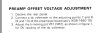
The speaker terminals *are* the test points specified in the manual. Are you getting the output offset confused with the Preamp offset adjustment?
Screenshot 2023-04-20 162958.jpg
 
Yes I believe so. Thank you

And a big bummer.

The face plate needs to be removed to adjust the bias. Whats the likely hood of getting the levers pulled off the switches with out them breaking :(

Wonder if this is one reason so many have multiple broken switches.

The power switch is the only one broken, but the others arent exactly straight. sigh
 
Last edited:
Back
Top Bottom