• The move to the new server is done. There are some software and database maintenance updates in process. This has us passing the hat around to help out. We appreciate any donations. Seriously, even a dollar helps. The payment page may be found here - https://www.audiokarma.org/support.html

Amplifier/receiver switch

Correct me if I am wrong... But generally if someone is using a sub from the pre outs then don't they also use a Y cable to loop the signal back into the main ins? Then one half of the Y goes to the sub and the other half goes to main in...

In this scenario couldn't a person just use an RCA switch from the two preouts for the sub? 2 in 1 out... Then on the other end use another switch for the speakers...
 
Correct me if I am wrong... But generally if someone is using a sub from the pre outs then don't they also use a Y cable to loop the signal back into the main ins? (...)

Depends on the model or respectively the particular implementation of the pre-out/main-in loop. In case of the most usual implementation, with external jumpers establishing the pre-out to main-in connections, one would indeed replace the jumpers with y-adaptors/y-cables for branching off to a subwoofer (or to an additional power-amp or pair of active/powered speakers or whatever...). But there also are switched pre-out/main-in loops (which also goes for the Yamaha R-2000, which even sports the coupler switch conveniently at its front) and "automatic" pre-out/main-in loops (as for example sported by quite a few Marantz models), which use switching jacks on the main-in side, so that inserting RCA plugs into the main-ins will automatically disconnect the internal coupling connections - hence no y-adaptors/y-cables required for hooking something to the pre-outs.

Greetings from Munich!

Manfred / lini
 
Depends on the model or respectively the particular implementation of the pre-out/main-in loop. In case of the most usual implementation, with external jumpers establishing the pre-out to main-in connections, one would indeed replace the jumpers with y-adaptors/y-cables for branching off to a subwoofer (or to an additional power-amp or pair of active/powered speakers or whatever...). But there also are switched pre-out/main-in loops (which also goes for the Yamaha R-2000, which even sports the coupler switch conveniently at its front) and "automatic" pre-out/main-in loops (as for example sported by quite a few Marantz models), which use switching jacks on the main-in side, so that inserting RCA plugs into the main-ins will automatically disconnect the internal coupling connections - hence no y-adaptors/y-cables required for hooking something to the pre-outs.

Greetings from Munich!

Manfred / lini
Either way. It would seem that the sub could still be run from the pre-outs of the two receivers using an A/B switch. If using receiver A then set the switch to that one. Same goes for receiver B...
 
Either way. It would seem that the sub could still be run from the pre-outs of the two receivers using an A/B switch. If using receiver A then set the switch to that one. Same goes for receiver B...
Ok.We are saying:
- Current switch 1 as is, to switch between sources.
- Switch 2 (after switch 1 out) switches between receivers A and B.
- Switch 3 after the pre outs of receiver A and B and before the sub.

If the above holds up, are there any risks that evolved? And is there a solution where I can get away with two switch devices instead of three?

Thank you!
 
If the above holds up, are there any risks that evolved?

If you use a foolproof switchbox like the Solupeak P2, there should be no problem.

And is there a solution where I can get away with two switch devices instead of three?

I'm not aware of a priceworthy switchbox, that would switch between two speaker-level inputs and two low-level inputs at the same time - but you could follow whoaru99's suggestion from post #11 and hook up a speaker-to-line-level converter (like for example the Russound ADP-1.2) in parallel to the loudspeakers at the output of the speaker-level switchbox, which would then downconvert the speaker-level signal to a low-level signal for the sub (via a pair of simple voltage dividers in case of the ADP-1.2). Such a simple converter with voltage dividers should work no problemo with your two receivers.

Greetings from Munich!

Manfred / lini
 
I think you forgot switch #4 which is the switch for the speakers. Because you can't just hook up two sets of speaker wires from two different receivers to the same set of speakers. Also I just don't see any advantage from running the sub from speaker level. Seems that just adds in one more thing.

Switch #2 maybe would not be needed if you run an RCA cable from tape out on receiver A to tape in on receiver B.

Wow, this is quite complicated...
 
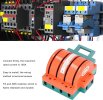
Get your self a 4 pole double throw knife switch that camn handle the amount of current your amp and speakers are capable of plus a peaking factor Lets say you use 3 amps most of the time, but for peaks you use 12 amps. 12 x 12 x 4 = 600 watts more or less. While most of the time you are using 3 X 3 x 4= 36 watts. Look on Amazon. I kind of like this one. No chance of any one getting shocked.71Z53gfocVL._AC_SX679_.jpg
 
Do you use so many sources that an extra switch box was needed before the receiver?
Sources:,TT, CD and sometimes tape — I need to switch between these before the Wiim Pro+ —except for streaming services which are sourced directly by the Pro+.

From the Pro+ the signal goes out wirelessly to the remote speakers and wired to the receiver which feeds the wired passive main speakers and the active sub.
That way I always have the receiver’s sound signature on the mains, and I can do room and delay correction between mains and remotes via the Wiims.
In addition, I use the Pro+ as an alarm clock in the morning, for the source of my choice (an IOT relay triggers the receiver which does not have a trigger built in).

This works great. But I’d be happy to skip one of the switches if there’s a simpler way or if there’s one device to do most of the picking/switching. I did not plan for so many devices. I did not expect for this to become that complicated.

I could get a newer all-in-one receiver or modern separates and put this madness to rest for good, but I really like my receivers a lot, and for a similar sound signature, power and serviceable longevity I’d have to spend a fortune. Also, all the new tech, streaming and WiFi capabilities, DACs and all are still evolving. An all-in-one may be outdated tomorrow and not allow for upgrading those components alone.
 
Get your self a 4 pole double throw knife switch that camn handle the amount of current your amp and speakers are capable of plus a peaking factor Lets say you use 3 amps most of the time, but for peaks you use 12 amps. 12 x 12 x 4 = 600 watts more or less. While most of the time you are using 3 X 3 x 4= 36 watts. Look on Amazon. I kind of like this one. No chance of any one getting shocked.View attachment 3545579
Yeah, man! How about I hire an electrician and a HiFi and smart home specialist team up and rewire the house. That’d be fun!
 
Wow, this is quite complicated...

In my view the OP could do with two switchboxes: Sources -> already existing line-level switchbox -> Wiim -> y-cables (2x RCA 1 male to 2 males) -> both receivers in parallel -> speaker-level switchbox (2 in to one 1 out) -> loudspeakers and speaker/high-to-line/low-level converter in parallel -> from the latter to sub. That should work.

Greetings from Munich!

Manfred / lini
 
Do you use so many sources that an extra switch box was needed before the receiver?
The switch box is to switch between sources (mainly CD and TT, sometimes tape), before the Wiim Pro+.
From the Pro+ the sourced signal goes to the receiver to feed the wired main speakers and the sub; at the same time, the Pro+ sends it to the wireless remote speakers (active, with Wiim Minis as the receivers) — except for streaming services of course, which come in to the Pro+ directly, via WiFi.
That allows me to always have the signature sound of my receiver for the mains, and I can do latency and room correction with the Pro+ for mains and remotes. Additionally, with an IoT relay, I can use the Pro+ alarm clock function, as the IoT triggers the receiver (which does not have a trigger output) to power up when the Pro+ is activated.

I vaguely remember getting the switch because I was having trouble switching between sources before the Pro+ (perhaps auto-sensing wasn't working as desired; I can't recall right now).

I'd be happy to lose that switch if there were an elegant way to accomplish all of the above without it; if you can point me to it, I'd appreciate it. I prefer fewer gadgets.
 
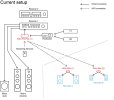
With some more details and a visual representation, do you guys still think some of the above-suggested solutions may work?
 
I will take a stab at it. From tape outs on receiver 1 to tape ins on receiver 2. That way anything selected on receiver 1 will get to receiver 2. Then Y cables if needed at the pre outs of both receivers (only needed if the pre-outs need to loop back into the main ins). Anyway, the two pre-outs that feed the sub go to a switch box. If receiver 1 is on A then select that to get the sub to work with receiver 1. If receiver 2 is on B then select that to get the sub to work with receiver 2. For the mains you need a speaker/amp switch box.

If the amp part of the receiver works without a feed from the pre-out then there is no need for a Y cable for that receiver...

If anyone else would like to chime in on this please do so.
 
I will take a stab at it. From tape outs on receiver 1 to tape ins on receiver 2. That way anything selected on receiver 1 will get to receiver 2. Then Y cables if needed at the pre outs of both receivers (only needed if the pre-outs need to loop back into the main ins). Anyway, the two pre-outs that feed the sub go to a switch box. If receiver 1 is on A then select that to get the sub to work with receiver 1. If receiver 2 is on B then select that to get the sub to work with receiver 2. For the mains you need a speaker/amp switch box.

If the amp part of the receiver works without a feed from the pre-out then there is no need for a Y cable for that receiver...

If anyone else would like to chime in on this please do so.
Thank you, coonmanx!
Sounds like this could work. I’ll think that through a bit more.
Meanwhile we may get some other folks to add to it.

Thanks everyone!
 
I will take a stab at it. From tape outs on receiver 1 to tape ins on receiver 2. That way anything selected on receiver 1 will get to receiver 2. Then Y cables if needed at the pre outs of both receivers (only needed if the pre-outs need to loop back into the main ins). Anyway, the two pre-outs that feed the sub go to a switch box. If receiver 1 is on A then select that to get the sub to work with receiver 1. If receiver 2 is on B then select that to get the sub to work with receiver 2. For the mains you need a speaker/amp switch box.

If the amp part of the receiver works without a feed from the pre-out then there is no need for a Y cable for that receiver...

If anyone else would like to chime in on this please do so.
I’m not sure if I need a Y cable?
Both receivers have pre-out and main in (the R-2000 even has an on/off pre-main push switch, conveniently placed on the front plate).
The sub has L/R line in LFE only.
 
coonmanx mentioned: “Then Y cables if needed at the pre outs of both receivers (only needed if the pre-outs need to loop back into the main ins).”

I’m still not sure if I need the Y cables at the pre outs of the receivers, or not. I’m leaning towards not needed, as the sub doesn’t have outputs and I don’t loop back with the current, single receiver (R-2000) setup.
But can anyone please confirm?
I don’t want anything to blow up.

As I detailed above, if relevant:
Both receivers have pre-out and main in (the R-2000 even has an on/off pre-main push switch).
The sub has L/R line in LFE only.
 
Back
Top Bottom