• The move to the new server is done. There are some software and database maintenance updates in process. This has us passing the hat around to help out. We appreciate any donations. Seriously, even a dollar helps. The payment page may be found here - https://www.audiokarma.org/support.html

AU-D907 LIMITED vs 919

I have no dought that those driver transistors contributed greatly to the improvement of the sound.
If you guys can locate some more of these Sanyo driver transistors or something that is close in specs that you can make work then I suggest getting them for your 919.
 
I have no dought that those driver transistors contributed greatly to the improvement of the sound.
If you guys can locate some more of these Sanyo driver transistors or something that is close in specs that you can make work then I suggest getting them for your 919.
When I installed those Sanyos in my AU 717
The amp transformed , almost equal to Leestereo upgrade/update vs stock condition .
 
Must have missed something, although the long discussion over pre-drivers was interesting what happened to the originals? Would be unusual to have a damaged set if the original outputs were in good shape.
Also, I stay well away from Styrene caps unless one is damaged from glue contamination from nearby components.
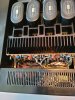
Have you checked the oval cap esr values?
Finally, not sure if it was in this thread or others however the use of sacrificial MJE outputs during the rebuild/test phase is brilliant :)
 
Must have missed something, although the long discussion over pre-drivers was interesting what happened to the originals? Would be unusual to have a damaged set if the original outputs were in good shape.
Also, I stay well away from Styrene caps unless one is damaged from glue contamination from nearby components.
Have you checked the oval cap esr values?
Finally, not sure if it was in this thread or others however the use of sacrificial MJE outputs during the rebuild/test phase is brilliant :)
Yes, some of the drivers and outputs were blown because of a mindless mistake of unplugging one of the inputs while it was on. I just can't figure out who would be stupid enough to do that!:rolleyes:
 
Based on comments from some of you the on semi transistors are not as good as the originals.
Because On-Semi are a semiconductor manufacturer and the comments about On Semi transistors would almost certainly have been aimed at the drop-in TO-3 replacement MJ2119x series for the original OP transistors which ARE generally regarded as inferior for use in truly 'fast' amplifiers. However the transistors in the link you posted are from 'ST Microelectronics' hence the '2ST' type prefix, these transistors are probably better than the originals.

There are TO-3P Transistors (made by On Semi and probably others), which although suitable are definitely NOT drop in replacements, but nevertheless might be considered as better than either of the OP transistor choices above.
 
Last edited:
2nd that - definitely the good-old 'expectation bias' syndrome may have kicked in during the listening test (?)

There's probably a good few of us who have fallen prey to this (?) in the past and maybe in the future to come!
 
Last edited:
Been reading the thread with interest.

Lots to learn.

So basically the major difference between AU 919 and AU D907 Limited are :

1. Toshiba drivers at place of NEC drivers
2. 2SA1068N 2SC2493N outputs at place of NMA1012/NMc1012 outputs.

please enlighten me.
 
Been reading the thread with interest.

Lots to learn.

So basically the major difference between AU 919 and AU D907 Limited are :

1. Toshiba drivers at place of NEC drivers
2. 2SA1068N 2SC2493N outputs at place of NMA1012/NMc1012 outputs.

please enlighten me.

For the driverboard this is the difference in transistors used, you go from drivers fT 30 MHz to 100 MHz and outputs from (supposed) 25 MHz to 50-70 MHz.
On the driverboard the compensation capacitors C23-26,53-56 ( polystyrene) are smaller, from 3pF (AU-919/D907) to 1pF in the D907 Limited. Further there are bypass film capacitors C57-60 for the decoupling capacitors C01-04. Although they are in the schematic of the AU-919 they are not always there ( they are in my AU-D907) in all the AU-D907 Limited I have they are.
There are more small differences, I will post them when I get to restoring one.
 
For the driverboard this is the difference in transistors used, you go from drivers fT 30 MHz to 100 MHz and outputs from (supposed) 25 MHz to 50-70 MHz.
On the driverboard the compensation capacitors C23-26,53-56 ( polystyrene) are smaller, from 3pF (AU-919/D907) to 1pF in the D907 Limited. Further there are bypass film capacitors C57-60 for the decoupling capacitors C01-04. Although they are in the schematic of the AU-919 they are not always there ( they are in my AU-D907) in all the AU-D907 Limited I have they are.
There are more small differences, I will post them when I get to restoring one.

This is getting exciting.

It rubs the eternal itch of upgrading in a right way.

If the changes are subtle and are limited to only components ( transistors, capacitors ) One can try this upgrades on a AU919 which will be going for a recap anyway.

So that will be the contribution of AK to take an already superb sounding amp to the next level.

Few mods and you can have a gem of an amp of your own baking (pun intended ;)) .
 
Back
Top Bottom