

You are using an out of date browser. It may not display this or other websites correctly.
You should upgrade or use an alternative browser.
You should upgrade or use an alternative browser.
AU-D907 LIMITED vs 919
- Thread starter ghamilton
- Start date

ghamilton
Super Member
To avoid all these '200 Capacitor Questions or Bust' - why don't you follow Leestereo's choices to the letter? - he gives the value/voltage and exact type (often giving the 'why' as well), of each component in his excellently documented restores.


I don't think arranged like the filtered frequencies go anywhere, what I think does happen is that they make the positive and negative rails look equal noise-wise, thus cancelling it out. IIRC Sansui design documents mention prevention/elimination of undesirable earth currents, this may be one of those tweaks.This is something I still am not sure about, there function. On the schematic of the AU-819 they are placed between positive and negative rail. So if they filter, where to does it go? ( the filtered frequencies)
Last edited:
ghamilton
Super Member
The reason for all the questions was because I am not the only one to be concerned about changing the values of caps from what the factory put in there.
And the only reason I went back in there is because of the newest debate about those driver transistors. A very kind member offered a free set of those Sanyos. I just hope I don't regret doing this.
And the only reason I went back in there is because of the newest debate about those driver transistors. A very kind member offered a free set of those Sanyos. I just hope I don't regret doing this.
That's because people unfamiliar with electronics, and audio amplifier circuitry in particular shouldn't do it - EVER. Unless it has been recommended by one of the more knowledgeable members who have this skill.The reason for all the questions was because I am not the only one to be concerned about changing the values of caps from what the factory put in there.
The @Leestereo AU-919 reconditioning thread has been used many times by AK members, and nobody has reported odd or undesirable behaviour, or damage of any kind when using his component values. I for one have witnessed first hand the amazing difference it made to my own fully reconditioned (using stock values) AU-919. I was a bit wary, and upgraded sections one at a time (with some small variations of my own), carefully checking the functioning of each section as I went - and found no problems at all. I also applied the upgrades to another AU-919 I had previously restored (after asking the owner's permission), with the same stunning results.
I think the consensus here is that the difference you might be able to hear with the replacement driver transistors in place will be subtle. At least you will know that the amplifier has these transistors installed that are as close to the originals as possible.
Last edited:
ghamilton
Super Member
After reading Dorian's statements (below) on the Noble clear plastic caps not holding their values I am going to replace them with Murata COG caps.
I would replace them with the same type that Hyperion likes but they are no longer made.
Still waiting on those driver transistors to arrive. I can now start replacing those caps until then.
https://audiokarma.org/forums/index.php?threads/au-919-complete-restoration.1001451/#post-15741496
I would replace them with the same type that Hyperion likes but they are no longer made.
Still waiting on those driver transistors to arrive. I can now start replacing those caps until then.
https://audiokarma.org/forums/index.php?threads/au-919-complete-restoration.1001451/#post-15741496
So you are going to 'downgrade' those capacitors then?I am going to replace them with Murata COG caps.
Wouldn't it be better to find out if any of the Noble capacitors are faulty first?

GrisPato
Super Member
I was worried about that too. Of course polystyrene film capacitors also can go bad, and they will, as the story of Dorian ( and bumpalump would mention this to, although he would not change them out wholesale) is evidence of.So you are going to 'downgrade' those capacitors then?
Wouldn't it be better to find out if any of the Noble capacitors are faulty first?
The fact that the polystyrene is really heat sensitive means not many restorers will take them out to check there capacitance with the risk you caused yourself the destruction you're measuring
 .
.What is also evident is they don't have the reputation to go bad ( except for the "black flags") so I would be really reluctant to just change them out for something definitely not better ( maybe worse).
If you can make sure you won't heat them to much ( using a heatsink on the leads) and have equipment capable of measuring such low values ( 3-33pF) you could take them out and test them to be sure. I will not take that risk.
On the other hand, we change the "black flags" for C0G ceremics !
PS
Choices, choices
But I admire your desire to get your AU-919 at the best it can be!
That's because we KNOW the Black Flags are bad actors, and because of their construction (tiny, radial, stable dielecric), the C0G ceramics are the best replacements available under the circumstances.On the other hand, we change the "black flags" for C0G ceremics !
Nice ^^post^^ Gris.
Last edited:
ghamilton
Super Member
We will see. Thanks Dorion!Best not waste your time with the driver transistors then.

Sui-Yogi
Super Member
Add to that and as I’m known as an “Indian with a screwdriver “ I have found out that using aIf you can make sure you won't heat them to much ( using a heatsink on the leads)
heatsink and wrapping around the lead of the polystyrene a cotton deep in alcohol , no heat is “climbing “ to the body of the capacitor !
PS: @ghamilton i feel you , I have already Google more than ones “GaAs” …. hard to get

ghamilton
Super Member
Daaaaa what does that mean??Add to that and as I’m known as an “Indian with a screwdriver “ I have found out that using a
heatsink and wrapping around the lead of the polystyrene a cotton deep in alcohol , no heat is “climbing “ to the body of the capacitor !
PS: @ghamilton i feel you , I have already Google more than ones “GaAs” …. hard to get
Sui-Yogi
Super Member
About the cotton and the alcohol part ?Daaaaa what does that mean??
I know it’s a little unorthodox method but it keeps the capacitor “dead cold “ , I suggest if you go through the replacement or measuring the actual cap out of the circuit , apply the method .
About the other part with Dorian’s approach to restoration , I suppose I’m stunned and exited as you and I’m Googling “staff” he said or propose to see what I can learn and why not, purchase and replace components , to “ better” my already “best” sounding Sansui’s
Hope I haven’t been miss understood ? Or ?
ghamilton
Super Member
I dont think I have a way of testing pf values. I am just replacing them so I don't have to worry about it.About the cotton and the alcohol part ?
I know it’s a little unorthodox method but it keeps the capacitor “dead cold “ , I suggest if you go through the replacement or measuring the actual cap out of the circuit , apply the method .
About the other part with Dorian’s approach to restoration , I suppose I’m stunned and exited as you and I’m Googling “staff” he said or propose to see what I can learn and why not, purchase and replace components , to “ better” my already “best” sounding Sansui’s
Hope I haven’t been miss understood ? Or ?
ghamilton
Super Member
Special thanks to Grispato & Hyperion and others for taking the time to give me your input. Sometimes even the best advisors disagree and we each have to make a personal choice for each recap.
As Dorian said "you don't have to worry about a change in the sound due to the compensation positions" of those pf value caps.
As Dorian said "you don't have to worry about a change in the sound due to the compensation positions" of those pf value caps.
ghamilton
Super Member
Well,...I got those driver transistors installed. I also recapped it while I was in there. All electrolytics are now Panasonic FR (same as FM).
Replaced those noble plastic pf value caps with multilayer ceramic COG caps.
Everything dialed in just right.
The sound? Is it better?
Yes!
I am sure it will improve as I play it over time.
Am I glad I went through with it?
You bet!
I hear more information in the music.
Because I did the recap at the same time that I changed those driver transistors it may be impossible to tell which contributed the most.
It just sounds better!
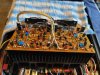
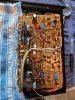
Replaced those noble plastic pf value caps with multilayer ceramic COG caps.
Everything dialed in just right.
The sound? Is it better?
Yes!
I am sure it will improve as I play it over time.
Am I glad I went through with it?
You bet!
I hear more information in the music.
Because I did the recap at the same time that I changed those driver transistors it may be impossible to tell which contributed the most.
It just sounds better!
Last edited:
Sui-Yogi
Super Member
Defiantly!!!I'll bet it's the transistors
Similar threads
- Replies
- 14
- Views
- 1K


