• The move to the new server is done. There are some software and database maintenance updates in process. This has us passing the hat around to help out. We appreciate any donations. Seriously, even a dollar helps. The payment page may be found here - https://www.audiokarma.org/support.html

B2

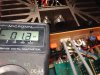
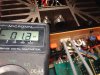
Yes, yes, oui, oui. Damn those VR101's are sensitive and hard to get the micro adjustment. Anyway, after settling for half an hour, results pictured (hand model thanks to my son, just to show correct pot used).

Right. . . IMG_1844.jpg
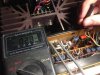
Left. . . IMG_1845.jpg

I can't do better than this as those pots only needs a gnats whisker of touch to make the reading swing wildly. Needs the delicacy and precision of a spiders arse-hole! However, I believe we have a good result? I do note that the meter value does fluctuate, constantly. But not by much and very well within tolerance.
 

Attachments
  • IMG_1845.jpg
    IMG_1845.jpg
    89.2 KB · Views: 4
Last edited:
Clinique Audio (B-2 expert) phoned me yesterday and described, at some length, how to calibrate the power supply output, without fitting the driver boards. Also, I now have the correct meter probes and am waiting delivery of a suitable resistor for discharging the power caps. Gosh! Learning a lot.

I use an incandescent light bulb. Makes it easy to see when the power is used up.

Enjoy the B2!
 
Last edited:
Ok, so, I want to triple check everything and make sure all is within spec before re-assembly. Which leads me to the Yamaha C-2. It works fine except the RCA inputs are dodgy. Sometimes a channel dies. A wiggle fixes it but over the years, I have destroyed many NS1000 tweeter in doing so. Ouch, expensive. Any tips, please?

I'm not even sure its the best pre-amp for the B-2? I recently bought a Little Dot MkIII to replace the Meridian 101 pre-amp for the Meridian 105 power amps. Wow, what a difference. The thing holding me back is I would require some kind of multi input switcher in order to plug in to the B-2. However, that might be no good for the B&O Beogram 4002 or the Manticore Mantra turntables. The Sony CDP-502-ES CD player worked lovely plugged directly into input 2 of the B-2.
 
Last edited:
Hello David

So , this B2 is working or not ?

You can use CD player directly to your B2 in input 1 or 2 by using gain control on the front panel
 
Right then, cleaned multi connector 'thingy' internally, for the RCA's on the C-2, put the system together. I am still somewhere in heaven as I write this. Awesome! Clinique-Audio, Je t'aime, Ich leibe Dich, Jeg elsker dig etc, etc. Just sounds brand new. Played Joan Armatrading, Show Some Emotion album on CD as a first test. Sounds like it should. Perhaps a little bass light? Bypassing the C-2, straight into B-2 input 2. Well, Joan was never a bass freak. So, probably as it should be. I like a wide array of music except, middle of the road. I have over a thousand CD's, nearly as many vinyl and 40,000 tunes in my Mac's iTunes, most at 320 bit rate but, many SACD, too. Life is too short to cram it all in.

BIG SHOUT OUT TO CLINIQUE-AUDIO. Merci beaucoup, monsieur! Your turn around sucks but, you put in many more hours than you charged me and most important of all, you made sure I'm happy.

Some pic's. . . .

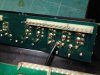
C-2 RCA pins, this has yet to be tested;

IMG_1846.jpg

The biz;

IMG_1846.jpg IMG_1848.jpg IMG_1850.jpg IMG_1851.jpg IMG_1852.jpg
 
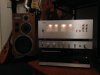
PS, I bought the Yammi combo in 1990 for £250. The Jimi Hendrix poster in 1974.

omg, the C-2 works perfect. Still like to try the Little Dot, though. Happy days are here again. . .
 
Last edited:
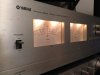
Since we're on the subject, here's a picture of another fine example of a beautiful B-2. It's been doing backup duty for the past couple of years with only the occasional periodic power up to keep the cap juices alive. It's been reconditioned except for the main caps and the semi's.

When I powered it on this morning the bias was spot on to where I like to set it and the DC balance only needed a little tweak.

Backup B-2 01.jpg
 
Since the recent "David Thread" concluded happily....I have some basic questions about the White Thermal Paste under the Vfets.

The sole purpose of the paste is to allow better transfer of heat from Vfets to the heat sinks. When applying the paste with silica pads, you should apply the least amount necessary to thinly coat both sides of the Silica Pad? Silica Pads prevent the base of the Vfet from conducting with the heat sinks directly but with the B2 models that have the blue insulation on the heat sinks then silica pads are not necessary just the thermal paste?

Also, since the thermal paste is non-conductive, how important is it to not get any on the pins of the Vfets or in the pin jacks of the Fet Boards and if you do clean it before installing Vfets?
 
Last edited:
Since the recent "David Thread" concluded happily....I have some basic questions about the White Thermal Paste under the Vfets.
As I understand it no paste is required when using silica pads; they act as both insulators and paste. They downside is they're single use.

My B-2's only need paste. My preference is still mica and paste over sil pads when it comes to the B-2 but YMMV.
 
Right then, cleaned multi connector 'thingy' internally, for the RCA's on the C-2, put the system together. I am still somewhere in heaven as I write this. Awesome! Clinique-Audio, Je t'aime, Ich leibe Dich, Jeg elsker dig etc, etc. Just sounds brand new. Played Joan Armatrading, Show Some Emotion album on CD as a first test. Sounds like it should. Perhaps a little bass light? Bypassing the C-2, straight into B-2 input 2. Well, Joan was never a bass freak. So, probably as it should be. I like a wide array of music except, middle of the road. I have over a thousand CD's, nearly as many vinyl and 40,000 tunes in my Mac's iTunes, most at 320 bit rate but, many SACD, too. Life is too short to cram it all in.

BIG SHOUT OUT TO CLINIQUE-AUDIO. Merci beaucoup, monsieur! Your turn around sucks but, you put in many more hours than you charged me and most important of all, you made sure I'm happy.

Some pic's. . . .

C-2 RCA pins, this has yet to be tested;

View attachment 1477431

The biz;

View attachment 1477431 View attachment 1477434 View attachment 1477435 View attachment 1477436 View attachment 1477438

Looks killer in silver face! Bet it sounds killer with the NS-1000's as well.
 
What a timely comment. I think I will try some 808 State, 12", 45's I have. Actually played Romantic Warrior / Return to Forever on vinyl (jazz-rock version) today. Oh my, there is no shortage of bass. The C-2 sounds great. I'm sure the clean up helped, those pins were black. It all sits next to my telly. I'm looking at the setup more that the telly. Lovely!
 
Since we're on the subject, here's a picture of another fine example of a beautiful B-2. It's been doing backup duty for the past couple of years with only the occasional periodic power up to keep the cap juices alive. It's been reconditioned except for the main caps and the semi's.

When I powered it on this morning the bias was spot on to where I like to set it and the DC balance only needed a little tweak.

View attachment 1477945
:trebon:
 
The static induction transistor was responsible for getting Yamaha into semiconductor manufacturing.


Invented by a professor at Tohoku University, Jun’ichi Nishizawa, SITs had the advantage over other transistors in that, when used as audio amplifiers, they didn’t tend to deliver tinny output at higher frequencies.

The SITs performed very like vacuum tubes but, as with a lot of Japanese-invented technology, the Japanese were suspicious of it because it wasn’t invented abroad.


Yamaha, however, took an interest but realised they’d have to develop and manufacture SITs themselves if they wanted to use them.

To get funding, Yamaha did a deal with the newly-formed Japan Research and Development Corporation.

If the development succeeded, Yamaha would pay back all the money invested plus a small royalty on sales. If the venture failed, JRDC would write off the investment.

As it was Yamaha’s first foray into semiconductors, with SITs their very first semiconductor product, JRDC wasn’t all that confident of getting its money back.

But Yamaha succeeded in developing and manufacturing SITs, and the SITs went into delivering superior sound reproduction for Yamaha’s products.
 
Back
Top Bottom