I replaced all the OP transistors. I still need to go back through and look at all my connections. But can you tell me, what would it mean if the DBT flashes? Dims then brightens, then dims, etc. ? This IS with 20 &21 connected to the board. Something is happeningThat looks nasty, - yes it could be 'it'
More for the missing mica washer (cause) than the bubble of black stuff next to the transistor leg (effect).


You are using an out of date browser. It may not display this or other websites correctly.
You should upgrade or use an alternative browser.
You should upgrade or use an alternative browser.
Barn find Sansui AU-7900
- Thread starter Kylek1443
- Start date

What would my next step be? I thought the DBT was a way to plug the amp in and make sure it works without damaging it? But now instead of an immediate bright bulb, it brights, dims then flashes. Is that good or bad?At least it is not a full short. Just hope you're not putting a load on the amplifier while on DBT. DBT is only used for checking for shorts and checking if your voltages are ball park ok.

Bias set too high or something that would mimic this condition.But can you tell me, what would it mean if the DBT flashes?
What should I do? I shouldn’t plug it strait into the wall yet should I? The relay does not click on when connected to the DBT with 20 &21 connected. Just brights, dims, and then flickers. Should I recap it now? The caps are all original and look horrible. They are all bulged at the tops. I have all replacement caps for it. Nichicon golds and such.Bias set too high or something that would mimic this condition.
Turn the bias down.What should I do?
Definitely not.I shouldn’t plug it strait into the wall yet should I?
turn these down?Turn the bias down.
Definitely not.
Attachments

We know it’s not the transformer, rectifier bridge, or filter caps. All 8 OP and 4 power transistors have been replaced. Where as before the bulb was automatically lighting up bright, now with 20&21 attached it dims and flickers. Adjusting the bias changes the way the bulb lights. What should be the next move? Again thank everyone for their help. This has to s fixable, right?Turn the bias down.
Definitely not.

GrisPato
Super Member
This is fixable. What your seeing is a normal effect of an incandescent bulb. The resistance of the wire ( tungsten often) goes up when heating from current. So you have a situation where some part of the circuit is still pulling to much current what makes the light go brighter, this makes the resistance go up making the current go down ( and the light go dim) and it starts oscillating around that point. This can be caused by a bias current running away. Or something else ofcourse but this is the first thing to check and sometimes easily corrected.
For that Hyperion advised you to check and try to set the bias current to the appropriate value.
For that Hyperion advised you to check and try to set the bias current to the appropriate value.
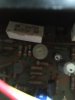
This is where I adjust the bias, correct? How would I measure that on my MM? Moving them slightly from side to side changes how the bulb dims or stays on fully or flickers.This is fixable. What your seeing is a normal effect of an incandescent bulb. The resistance of the wire ( tungsten often) goes up when heating from current. So you have a situation where some part of the circuit is still pulling to much current what makes the light go brighter, this makes the resistance go up making the current go down ( and the light go dim) and it starts oscillating around that point. This can be caused by a bias current running away. Or something else ofcourse but this is the first thing to check and sometimes easily corrected.
For that Hyperion advised you to check and try to set the bias current to the appropriate value.
Attachments

GrisPato
Super Member

Bias adjustment procedure is in the service manual. Be sure to understand what you are going to do before starting!
By turning the pot you change the resistor value, depending on the network increase or decrease will give a higher voltage at the base of each transistor. This will activate your output transistors and let a current ( quiescent current) run through the emitter resistors which you measure by measuring the voltage drop ( difference in potential over them ) the higher the voltage the more current is going through the resistors. Voltage is DC. Be careful with turning the pots, sometimes a turn that you almost do not register can raise the current with 10s of mA which you will measure in this case like an increase of around 10 mV for each 10s mA ( Because I= V/R and R is here 0.94 Ohm).
Good luck and tread lightly.
GrisPato
Super Member
If the voltage you measure is moving in big steps ( more then 3-4 mV every second or two) switch it of and check working of variable resistor cold (no voltage). Do this with noting the position they have now, either in place or resistance value, so you can revert back to that.
I have adjusted the bias. VR01 is at 18. But VR02 only goes to 10. It won’t adjust higher. And sometimes it will bounce between 9 and 10. Maybe I’m doing something wrong. The bulb still flickers when turned on and the relay for the amp won’t kick on.If the voltage you measure is moving in big steps ( more then 3-4 mV every second or two) switch it of and check working of variable resistor cold (no voltage). Do this with noting the position they have now, either in place or resistance value, so you can revert back to that.
I found R44 but I can’t find R46. You want me to measure the voltage of each resistor? Is it possible or just very unlikely that a cap could be causing the issue?Can you compare voltage over r44 and r46 between the 2 channels?
Last edited:
GrisPato
Super Member
R46 is on the other side of the vr2 above tr14.
It is certainly possible that a capacitor somewhere on the deiverboard is leaking current. Is also possible it's a pre-driver transistor (tr12-14).
It can also be that one or more of the emitter or base resistors (r44-46-48-50-56-58-60-62-64-66) overloaded and is not good anymore ( resistance going up under load).
This can also be a reason for the low bias current.
So ideally you have to check all those components. Transistors preferably of board, resistors with one leg lifted if you get a weird reading ( lower then spec) and if they measure good preferably under load.
Be really care full not to short anything out.
It is certainly possible that a capacitor somewhere on the deiverboard is leaking current. Is also possible it's a pre-driver transistor (tr12-14).
It can also be that one or more of the emitter or base resistors (r44-46-48-50-56-58-60-62-64-66) overloaded and is not good anymore ( resistance going up under load).
This can also be a reason for the low bias current.
So ideally you have to check all those components. Transistors preferably of board, resistors with one leg lifted if you get a weird reading ( lower then spec) and if they measure good preferably under load.
Be really care full not to short anything out.
Put the black lead of the MM on R44 and the red lead on R46 set to voltage on the MM with the amp turned on in the DBT? Just making sure.R46 is on the other side of the vr2 above tr14.
It is certainly possible that a capacitor somewhere on the deiverboard is leaking current. Is also possible it's a pre-driver transistor (tr12-14).
It can also be that one or more of the emitter or base resistors (r44-46-48-50-56-58-60-62-64-66) overloaded and is not good anymore ( resistance going up under load).
This can also be a reason for the low bias current.
So ideally you have to check all those components. Transistors preferably of board, resistors with one leg lifted if you get a weird reading ( lower then spec) and if they measure good preferably under load.
Be really care full not to short anything out.
Not sure if I’m doing it right but the voltage numbers are jumping all over the place. I measured R44 and the numbers were changing constantly. The bulb is continuously flashingJust measure one resistor at a time. And compare with other channel, R43-45. DMM on volt and on DBT.