• Check out the Annual AK Secret Santa exchange Program, signup before November 23rd in the AK Charities & Christmas forum!

Best midrange ever? Worst?!

Well, I certainly never expected to get involved in a personal attack, in a discussion like this...

Sorry for ruining your online experience, apparently...

That said, dynamics are not only a loud-volume thing. The ability to resolve between levels (and the ability to do the transitions well) is the thing. I don't care what size your speaker is, if it can't do those transitions properly, it won't be worth much as a true reproducer... that's my take on it.

Regards,
Gordon.
 
jeez,dnewma04! take a chill pill already!! actually, i see the uppercasing simply as a way to emphisise certain points. i think it's rather effective, too. but appearently it pisses some people off...:dunno:
 
It's all so subjective -- beauty is in the ear of the beholder. :) For me, any size Heil has sounded beautiful, as well as any flavour of Altec horn. My current KEF 105s have lovely midrange, as well. The worst? There have just been too many candidates to list on the 'worst' side...
 
Pretty interesting to see not many instruments extend below 40hz.. :scratch2:


Actually, correct.

Even with instruments that go below, say, 60 hz, you still hear mostly the overtones, not the fundamental. I have MP3 of bass saxophone here that the lowest note played has a fundamental of about 58 hz. And this low note is clearly heard on the tiny 3/4" speakers on my laptop. Well, not the fundamental, but the overtones. It still sounds low.

This is not to say the bass region is not needed, not saying that at all. But bass under 40 hz is less important than one would think. Many confuse loud bass in the 60-100 hz range with low bass. It is common to hear DJ speakers that simply don't go much below 60 hz booming away, and thought of to be "strong bass". Maybe loud, but not low. Some speakers that actually do extend low are perceived to have weak bass, because it is not predominant.

It is commonly accepted that for a musical instrument to sound "right" you need to reproduce the fundamental and the first 10 overtones. I will point that that when your ears are tested by an audiologist, they only test up to about 5000 hz. That is because the audible range up to there is what is necessary for clear understanding of human speech. But anyone who has good speakers, and reasonably good ears knows that is not enough. For most music, good, flat reproduction up to about 12,000 hz is certainly good and would certainly satisfy 98% of listeners. And good response to 15,000 hz is outstanding. 20,000 hz is just the icing on the cake.

Let me suggest you pull out the old 10 band equalizer and play with it, listen to what the various sliders actually do to the sound. See what these frequencies really sound like.
 
Thanks, that goes along with what I have found pretty consistently. Typical ribbons have high levels of 3rd harmonics at low freq that tail off as the freq rises. 3rd order being the most objectionable, it's probably why i've had best lucking crossing over ribbons a good bit higher then the recommended crossover frequency from the mfg. 2nd harmonics tend to either rise slightly with freq or stay fairly flat as freq rises but aren't objectionable sounding. In the case of the review, I assume the speaker used a large ribbon driver, therefore minimizing distortion and probably crossed over high enough to get out of any potential trouble zones.

That said, if you have a small ribbon tweeter that you cross over the typical 1 octave over where it starts to rolloff and compared it to a dome tweeter (or planar magnetic) crossed over similarly, I'd put my money on the latter having lower distortion. Crossover 2 octaves above and things start to get a lot closer in distortion measurements. Large line source ribbons are an interesting lot that is hard to measure and should address some of the issues i've mentioned. But, I would hold to my comment that low inductance and in some cases, the dipolar arrangement of many, is the reason for their magic, not low distortion measurements or a light diaphragm. YMMV, IMHO, No Offense, to each his own, USE LE14s and BMS!, econowaveguide, et all.


The area where the highest distortion was recorded is present in the woofer section of the speaker, while being driven at pretty high levels, I might add, and many people consider it planar-magnetic(not a true ribbon). Above the area of the crossover point the readings are among the best I've seen in review (ESL's exceed this). Plus we are talking about a true ribbon at that point (the Duetta is a 2-way design). Most of the other designs are quite small in comparison, as the Duetta MR/T is about 60" long, roughly 1" wide and held at the ends only. It's a pretty different animal.
Any reports on dome distortion readings?? Most I've seen put them in the 10% range, unless you get into fairly esoteric drivers.
(love the discussion BTW :thmbsp:)


Oh, and yes the midrange is to die for.
 
I think the AR-11 and 10 Pi have an amazing very well dispersed midrange. I have never heard a speaker do a more realistic reproduction of the sound and feel of a concert hall. They have none of that narrow dispersion sweet spot effect that many confuse for "good midrange" They sound the same on axis and just about anywhere in the room.
 
Sure thing, Zaphaudio is one of the most recent sites to post harmonic distortion tests of various drivers.

Vifa D26NC55 for example

D26NC55-1tone-96db-.5m-2k.gif


Compared to the Aurum Cantus:

G3Si-1tone-96db-.5m-2k.gif


compared to the BG Neo 3:

Neo3PDR-1tone-96db-.5m-2k.gif
 
Someone needs to do that same distortion test with some good horn drivers... say the JBL PT waveguide with a BMS neo horn driver, and/or the tweeter in a typical Tannoy dual-concentric. It'd be even more fair, if the horn driver was equipped with a proper EQ network, to flatten the native-falling-response of all horn drivers (compare flat response to flat response of dome tweeters)...

I'd bet it'd be less than half the distortion of the domes or ribbons... on average, at least... for good horns. For a mathematical representation as to why this is the case, remember that the native response of a driver in a horn FALLS at about 3 dB/octave, for many horns (some even more, closer to 6 dB/oct)... so, each octave is HALF as loud (3 dB== half power) as the octave below it. So, the second harmonic (compared to a similar driver "dome" used as a direct radiator) would be attenuated by 3 db, the third harmonic 6 dB... and so on...

Regards,
Gordon.
 
I wouldn't be surprised to see lower distortion in any hornloaded driver, whether compression, dome, ribbon, etc. It's one of those inherent advantages that a horn or waveguide has.
 
Speaking of horn-loaded ribbon... I always wanted to play around with one of those ATC ribbon-horn drivers. That could be simply amazing. A ribbon with ~104 dB sensitivity?!

Of course, being somewhere near $1000 each (IIRC)... that always put a damper on things...

Regards,
Gordon.
 
The pro version of the fountek 5" Ribbon is 101 or 102dB and can be had for reasonable prices through madisound. Maybe a line array of hornloaded founteks? Should make the actual horn construction trivial.
 
Someone needs to do that same distortion test with some good horn drivers... say the JBL PT waveguide with a BMS neo horn driver, and/or the tweeter in a typical Tannoy dual-concentric. It'd be even more fair, if the horn driver was equipped with a proper EQ network, to flatten the native-falling-response of all horn drivers (compare flat response to flat response of dome tweeters)....
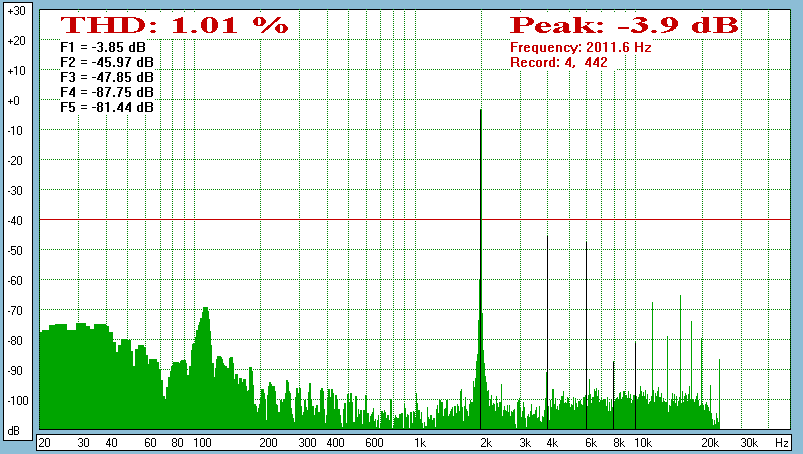
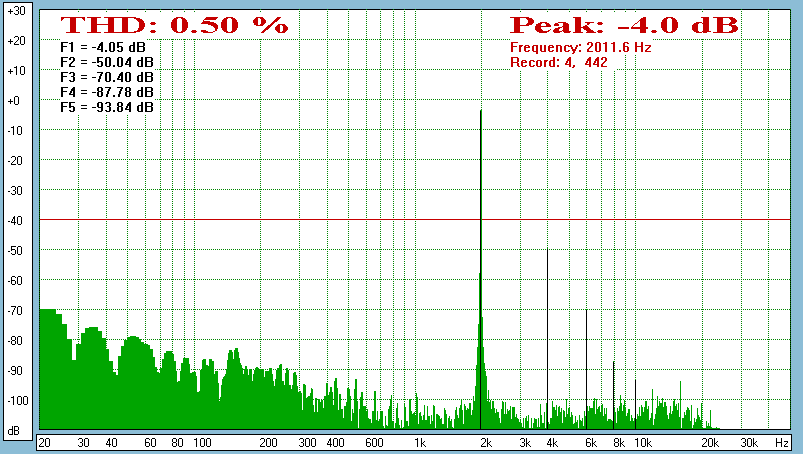
I'm going to have to read up on how Zaph is testing for comparison, but @ ~90 dB/1M yesterday, JBL 2452H-SL was down 60 dB (0.0001% THD) and BMS 4555 down 50 dB (0.001%) uncompensated on PT-D95HF in KLH-6.

From 1.2 kHz upward, they're both down at least 40 dB (0.01% THD).

THD raised +30 dB:

attachment.php


I don't know if that sucks by comparison or not, but Geddes says I can't hear it anyway.

I should crank 'em up, maybe.... ;)
 

Attachments

  • 4555 THD.jpg
    4555 THD.jpg
    51.4 KB · Views: 373
As a DIYr for 40 years, I've tried an endless variety of mids. Some of the ones that stand out are:

Philips 7060M. 7" version of the famous Rectilinear and DQ10 5" mid. That old paper was magical. Used them from 1968 to 1972. Still have them on a shelf in my basement.

Isophon BPSX 130 Another 5" paper driver from a very old German manufacturer that sounded better than it measured. Regret having sold them.

Audax HD13B25H4. A knockoff of the KEF B110 with bexterene cone. The lower mids had incredible texture, if the upper mids were a bit nasal

Audax 4.5" TPX cone driver. Best upper mids bar none. Lower end somewhat constricted. Too bad Audax gave up developing this material. Others such as Seas and Vienna Acoustics have tried to revive it.

Vifa P13WH. Can yield a near perfect 4th order function with 2nd order components at both ends. Very realistic sound. Not the most popular with the distortion measuring crowd. Currently use 2 of these in 3.5 way. Both drivers cross over electronically at 230 Hz (4th order acoustic 2nd order electrical with Q customized to match the driver's rolloff). Upper end crossed at 3 KHz (4th order acoustic). Lower driver has added first order rolloff at about 500 Hz. After years of refining the network, they would be tought to replace.

Worst

Siare 12VR 5" fiberglass. Could not tame the top end. Also construction fit and finish were substandard.

Fernando
 
I'm going to have to read up on how Zaph is testing for comparison, but @ ~90 dB/1M yesterday, JBL 2452H-SL was down 60 dB (0.0001% THD) and BMS 4555 down 50 dB (0.001%) uncompensated on PT-D95HF in KLH-6.

From 1.2 kHz upward, they're both down at least 40 dB (0.01% THD).

THD raised +30 dB:

attachment.php


I don't know if that sucks by comparison or not, but Geddes says I can't hear it anyway.

I should crank 'em up, maybe.... ;)

Curious, the review I posted said that -60db is .1%, were they wrong?
 
Comparisons of level (for amps, at least) can be done in one of two ways:

VOLTAGE, or POWER.

Voltage increases at the SQUARE ROOT of power... so a doubling of voltage would be four times the power.

So, .1% voltage would be 60 dB down. .1% power is 30 dB down...

In theory, the same relationship exists between acoustic sound PRESSURE and acoustic sound ENERGY. Doubling of pressure results in four times the energy... and so on.

Got to make sure you understand what's being compared...

Regards,
Gordon.
 
Okay, here's one opinion--given a choice between midranges of a HPM-100 or a Polk Monitor 7...

attachment.php


attachment.php


Clearly he's a nearfield, bevelled edge, silver dome, countersunk basket fan.

Cats can't hear below 40 Hz so I don't know what this means. Could be those passive diaphragms instead of Bass Reflex woofers...:D

Susurus
 

Attachments

  • PolkOrHPM-100s.JPG
    PolkOrHPM-100s.JPG
    78.8 KB · Views: 345
  • P1010003.JPG
    P1010003.JPG
    79 KB · Views: 341
:lmao::lmao::smoke::lmao:
That's so refreshing after the last two pages! Lot's of great info but, shesh, I thought I was reading a Stereophile letters column:D there's a note Oleta Adams hit's that always makes the dog tilt her head like WTF! I don't know how to interpret that but....

Craig
 
Back
Top Bottom