• The move to the new server is done. There are some software and database maintenance updates in process. This has us passing the hat around to help out. We appreciate any donations. Seriously, even a dollar helps. The payment page may be found here - https://www.audiokarma.org/support.html

Cap Coupled vs Direct Coupled

I'm reading a longish article by Martin Collums, in a 1985 Audio Amateur magazine, which showed that extremely low distortion specs don't correlate with good sound. We know that more certainly now, and that low or no feedback is often better - which Martin also mentioned in that old article.

Another surprising finding was that some SS amps actually benefitted from an output inductor and even the treble was improved. I don't know how true that is with today's high-end amps.
 
I think it's also good to note that something needs to protect the speakers from excess DC in case of failure in the amp. The big caps do it in cap coupled designs and transformers do it in some high end designs (I believe McIntosh uses this a lot). Marantz usually used a speaker protection circuit using a relay that would only pass the signal from amp to speakers if DC was below a certain threshold. That's why their cap coupled models ( 2215, 2220, 2230, etc.) don't have protection relays. They don't need it.
 
I'm reading a longish article by Martin Collums, in a 1985 Audio Amateur magazine, which showed that extremely low distortion specs don't correlate with good sound. We know that more certainly now, and that low or no feedback is often better - which Martin also mentioned in that old article.

Another surprising finding was that some SS amps actually benefitted from an output inductor and even the treble was improved. I don't know how true that is with today's high-end amps.


even that is questionable. The best sounding SS amp I've heard also happened to have extremely low distortion and a lot of feedback. One of the worst-sounding ones I've heard had slightly more distortion but also a lot of feedback but still "good" numbers. I've heard low feedback designs that sound good, and others that sound bad.

sad fact is its pretty hard to quantify if an amplifier is going to sound good just with a couple of specifications. Wish that were not so, it would make all this a lot less frustrating.
 
Yes, that's true, g73. That old article made no blanket statements of any superiority and actually agrees that good & poor designs exist of every ilk. Mr. Colloms was also frustrated that it became apparent that "good specs" was no guarantee, although there do exist measurement limits which should probably be avoided.
 
At some point i think manufacturers are 'spec racing', whoever has the most or the best or the least or whatever in some category "wins". Its right up there with the how many golf balls will a given toilet flush test. Thats not what I need it to do but its a somewhat difficult thing to measure in reality.
 
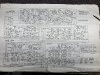
This is the schematic from a 1966 Airline console. The audio board in the lower right shows cap coupling for input and output and transformer’s in between (as phase splitter’s I think).
 

Attachments

  • DE05F311-B6CF-4957-A627-C56A4E64EE3D.jpeg
    DE05F311-B6CF-4957-A627-C56A4E64EE3D.jpeg
    184.4 KB · Views: 15
I have an old Realistic receiver with transformers instead of differential pairs.
An old design for the mid 70's.
 
I really find it funny how circuit designs largely abandoned in the 1930s enjoyed a rebirth in the early transistor days. I guess transformers were cheaper than transistors at one point.
 
When I first posted on this thread, I said I wanted to try a transformer coupled pre-amp.

Since then I have had two, and now I am evaluating a DC coupled power amp. The Kinki EX-M7. Its interesting.
 
Overall I prefer direct coupled SS power amplifiers. A good direct coupled amplifier just amplifies, and doesn't color the sound. If you like a certain overall tone, that's the job of the preamplifier.
 
interesting, my S-9500A which is some number of years older does not use transformers. Its cap-coupled on the output, typical of what you'd expect in 1966. All silicon too, which is not necessarily what you'd expect for that time. The 9500A was one of the US Sherwood models though, just looking at it the 7100 appears to be a Japanese model.
 
even that is questionable. The best sounding SS amp I've heard also happened to have extremely low distortion and a lot of feedback. One of the worst-sounding ones I've heard had slightly more distortion but also a lot of feedback but still "good" numbers. I've heard low feedback designs that sound good, and others that sound bad.

sad fact is its pretty hard to quantify if an amplifier is going to sound good just with a couple of specifications. Wish that were not so, it would make all this a lot less frustrating.
The relationship between distortion and "good sounding" has long been a subject of debate, and of considerable research.
Some understanding has, however, been achieved. I'll try to encapsulate this as best I can.
In a nutshell, high distortion amps with regularly decaying low order distortion 2nd, 3rd, 4th, fifth etc.) sound good- which generally means those with zero or very low levels of feedback. In particular high order odd distortion- 7th, 9th harmonic for example- is audibly unpleasant, especially at low signal levels. This is unfortunate as this is exactly the circumstance in which crossover distortion in a feedback amp is most apparent. The loss of quality peaks with 15dB of feedback, and then grows better as the level of feedback increases.
This is due to the ears self distortion- which approximates a half wave rectification. Anything that approximates the distortion characteristic of this sounds natural. Anything that does not, and is above the audibility threshold, does not sound natural.
The audibility threshold decreases at a rate which is much higher than the ratio of the harmonic, so 9th order harmonics need to be c. >100dB below the fundamental to not be unpleasant. This means that amps with negative feedback and moderate input non-linearity need to have high levels of feedback even up to 20kHz or so to suppress the "bad sound"
The other issue is that real music intermodulates with itself in an amp, and amps with low levels of feedback and poor open loop linearity cause "hash" that blurs the sound. Amps with decent open loop linearity and no feedback do this too, but are relatively benign, and amps that have high levels of negative feedback throughout the audio band and moderate non linearity are also good.

 
just looking at it the 7100 appears to be a Japanese model.

I would have sworn mine was made in America, but I just checked and you're right - Japan. I guess I didn't realize that by 1970 (the year of manufacture given by Hi Fi Engine) Sherwood was already farming stuff out to the Japanese. I've always wanted to hear the S7100 (transformer coupled) and the S7100A (capacitor coupled) back to back. It seems like it would be an interesting comparison as apart from output coupling there is little to no difference between the two.

Anyone here have both and want to enlighten me?
 
The Sherwood S7100 (no A) has transformer coupled outputs and gets a lot of love around here.

Won't quibble with the love part, but to me, "transformer coupled outputs" would imply that the speaker outputs come directly from an output transformer winding, like in most tube amplifiers and some McIntoshes.

In the Sherwood, the transformers couple the signal from the last class A stage of the power amp to a push-pull pair of output transistors. From there, the speaker output also goes through an output capacitor, needed to block DC.

I'm probably being pedantic - sorry!
 
right, driver transformers, not output coupling transformers. Most likely also serving as the phase inverter.

. I guess I didn't realize that by 1970 (the year of manufacture given by Hi Fi Engine) Sherwood was already farming stuff out to the Japanese.

I don't know the fine details of their history but my understanding is they basically shut down as a US manufacturer relatively early in the transistor era and had their stuff constructed in Japan. I know they had a first generation of solid state things when they were still headquartered in Chicago but I think that was it. Not sure if the ownership of the company changed around that time or what the deal was.
 
yeah it blocks DC but winding a transformer that can do broad response without phase shifting or frequency response problems is complicated (aka expensive). Its the bane of tube amplifier design.
 
yeah it blocks DC but winding a transformer that can do broad response without phase shifting or frequency response problems is complicated (aka expensive). Its the bane of tube amplifier design.
The expensive part is why I have always heard that since the 70's, the design has only been used by high end manufacturers like McIntosh. I assume they engineer circuitry around the transformer that minimize the frequency response problem. If you look at McIntosh's web site, under amplifiers, they really tout their "Unity Coupled Circuit Output Transformers" and their "Autoformers".
 
Back
Top Bottom