• The move to the new server is done. There are some software and database maintenance updates in process. This has us passing the hat around to help out. We appreciate any donations. Seriously, even a dollar helps. The payment page may be found here - https://www.audiokarma.org/support.html

CAT-5 interconnects - Anyone done it?

all were consistent with amounts of capacitance. The higher the capacitance, the more noticeable the degradation in sound.
So from that I can assume the cables I'm replacing are much higher capacitance than the Cat5. Thank You Howard for the Illuminating comparo.
All of the cable above were tested between a PL-630 turntable wired with RCA jacks and a Yamaha preamp. None of the shielded cable hummed at all. The unshielded Cat5e was so noisy...
So for this application, shielding the Cat5 would be a necessity.
 
Hey Howard, that's a nice listening test you did! It looks like there's a place for these simple, unshielded CAT-5 interconnects of mine in CDP based systems (where I happen to be using them), but the fact that they're unshielded is their Achilles heel in other applications. I'm still unclear about the difference between balanced and unbalanced circuits, so maybe some reading is in order on my part.

Thanks for playing! I appreciate you taking the time to do some objective tests.

EDIT: Aww, the frog beat me to it!
 
Redboy, it was a pleasure contributing, and since I had already compared the other cables, it was just a matter of testing the Cat5 against the Belden.

You might want to read the articles over at bluejeanscable.com. They are straightforward and easy to comprehend.
 
With what else? A capacitance tester. :D It's either a multimeter with a built-in capacitance testing function, or a separate unit for only capacitance.

They're on ebay or just google for online vendors.
 
Made my NS-1000 go quite bright, same with NS-300s.
Yes, I also notice the primary benefit is to the top end. Again, good for tweaking system response - the Cat5 speaker cables tend to do the same thing.

Since I mainly run older AR's (notoriously regarded as "rolled off" on top), the Cat5 is a good tweak for me. Makes the 2ax sing. :music: (Not that I didn't already like the speaker... :D )
 
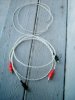
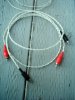
So, I finally got around to making a set of the very simple interconnects. They are baised upon the CAT5 stuff, but are made with materials that I happen to have lying around the house.

First, I always like the Kimber PBJ cable so I decided to use three wires in a braid. I started by using wire that I have from past fireworks shows. It is used to connect a control box to squibs that are in the firework, the squib is fired and ignites the firework so that it is able to blow in the sky and make a pretty. The cable is solidcore and pretty small, not sure of gauge or the insulator. It can carry a 12 volt charge over several hundred feet with enough juice to pop a squib.

In short, I have several thousand feet lying around. The plugs are cheap Radio Shack RCA plugs.

I fixed these up and have been running them for the evening. My first impression is that they are a little more detailed, especially on the top end than the Monster Cable they replaced. The MC is nothing special but it has worked well enough for me that I have not been looking to replace them. Bass seem to be there, maybe not as full but I have completly revamped my system, so the new amp may be partially responsible.

Below are a couple of pics, I also have a short lenth of the original wire so you can see what it looks like. Overall I am pleased with what I hear and am wondering what changes the sound will be as the are burned in.

attachment.php


attachment.php
 

Attachments

  • DIY interconects - pbj 001.jpg
    DIY interconects - pbj 001.jpg
    28.3 KB · Views: 249
  • DIY interconects - pbj 003.jpg
    DIY interconects - pbj 003.jpg
    35.5 KB · Views: 249
So, I finally got around to making a set of the very simple interconnects. They are baised upon the CAT5 stuff, but are made with materials that I happen to have lying around the house.

First, I always like the Kimber PBJ cable so I decided to use three wires in a braid.
How did you wire those....two wires tied together for signal and one for ground?
 
The PBJ has one for signal and two as return, so that is how I wired it. It was a little rough sounding through the frequency extremes at first but is starting to mellow a bit.

It really is too early to tell how it will end up sounding, but I must say that I do like that it seems to be a little more clear sounding. Also I have noticed that the silibance that I have had for a while has be nicely reduced. Vocals are much better rendered than with the previous interconnect.

Not sure if I mentioned it, but the wire is pure copper, soild core. So far so good! (so what!... for all you Megadeth fans :D )
 
hakaplan very generously sent me a set of his Belden cables so I could hear for myself. :)

Did quite a bit of listening today, and he is right - there is only a fine difference between these and the unshielded Cat5. You really need a "dense" recording to discern it at all. As soon as I can conjure up another pair of the shielded (mine are on their way to hakaplan for another comparison at his end :thmbsp: ) I'll do a little A/B with those.

Redboy, I will also compare the shielded/unshielded Cat5 at that time. I did not compare the two Cat5's before I shipped the set off to hakaplan. I did compare them to the (nice-looking but inexpensive) Phillips, and there was no comparison. Even the single twisted pair unshielded easily beats these cables.

I have to say if you are looking for an inexpensive tweak and do not have high-end cables already, the Cat5's are a nice project with audible results.

I also discovered I really like the Neutrik connectors - the plugs go on smoothly and grip like crazy! Just something very high-quality feeling about them when you slip them onto the jacks. :thmbsp:
 
Glad you mentioned connectors oz and for comparisons of the 2 styles it would be even more meaningful if you could use the same on both sets.

Some feel connector quality, design and material can all make subtle differences and when you think of the variables with a phono jack connection this makes sense. I agree with the notion that brass, steel, aluminum etc. should be avoided and if using silver wire, use silver connectors, copper wire, all copper or gold plated copper connectors. I actually carry this further and believe the small price premium makes it worth using this same concept for the jacks in components if modding or building.
 
Y'all might want to study/review a little basic electrochemistry (standard redox potentials of various metals) before mixing and matching metal wires and terminations too glibly... otherwise you may be unintentionally making a battery/corrosion generator.
 
I agree with the notion that brass, steel, aluminum etc. should be avoided and if using silver wire, use silver connectors, copper wire, all copper or gold plated copper connectors.
Gold-plate + copper wire is the path I'm on.
 
electrochemistry

Y'all might want to study/review a little basic electrochemistry (standard redox potentials of various metals) before mixing and matching metal wires and terminations too glibly... otherwise you may be unintentionally making a battery/corrosion generator.

Reminds me of one of the ?'s on a final exam back in grad school e-chem.. to wit:

You are on a desert island with enough zinc and copper to build a boat to escape, but not enough of either metal by itself. Would you:

1) Build the boat using larger pieces of copper connected by smaller zinc pieces, and why..

or:

2) Build the boat using larger pieces of zinc with copper connectors and why...:D

answers at 11:00 :banana:

John L
 
"Been reading this thread and while I don't want to rain on anyone's parade, I thought I'd correct a factual error I've seen mentioned a few times. With audio interconnects we are talking about unbalanced circuits, meaning a single signal traveling one direction and a ground. Twisted pairs will not reduce noise in unbalanced circuits." No cable will reduce noise unless it is faulty.
"On the other hand, when noise hits balanced circuits, which have a positive and negative signal, the twisted wires will enable the noise to cancel itself out." the twisted wires self shield partially and theoretically pick up the SAME amount of common mode noise which the balanced front end 'cancels' out.

I have found that for my line level connections (not turntables), unshielded cable works fine.
"But that just means I don't have EMI invading the cable--the twisting accomplishes nothing noisewise" This is plain wrong. You may have heaps of EMI up in the meg range overloading wide bandwidth preamps, upsetting amps and upsetting feedback loops. Twisting an unbalanced cable helps reduce massively the RF suseptibilty of a cable and associated equipment.

The ONLY reason you get away with untwisted unshielded cables is because the output impedance of your source is low enough to prevent truckloads of noise getting in. It is a BAD, BAD practice and has no basis whatsoever in good enginnering practice and certainly does not lead to a silent system.

 
Back
Top Bottom