

You are using an out of date browser. It may not display this or other websites correctly.
You should upgrade or use an alternative browser.
You should upgrade or use an alternative browser.
CAT-5 interconnects - Anyone done it?
- Thread starter Redboy
- Start date

mhardy6647
Lunatic Member
No, but it will reduce (eliminate) induced 60-Hz hum (buzz) in line-level applications. Try it and see."Twisted pairs will not reduce noise in unbalanced circuits"

hakaplan
Needs professional help
No cable will reduce noise unless it is faulty.
These two statements contradict each other. Also could you explain the theory behind the second statement.Twisting an unbalanced cable helps reduce massively the RF suseptibilty of a cable and associated equipment.
The ONLY reason you get away with untwisted unshielded cables is because the output impedance of your source is low enough to prevent truckloads of noise getting in. It is a BAD, BAD practice and has no basis whatsoever in good enginnering practice and certainly does not lead to a silent system.
If low impedance prevents truckloads of noise from getting in, then what's the problem?

restorer-john
Addicted Member
These two statements contradict each other. Also could you explain the theory behind the second statement.
OK here we go. The two statements in no way contradict themselves. A faulty cable can be shorted or open circuit. If it is shorted it WILL reduce noise in the system significantly. Have you ever noticed the shorting plugs across unused phono and other inputs on quality amps? They are not there to look pretty, they short the inputs to prevent NOISE getting in when unloaded. That noise can be anything from DC-daylight. If the cable is completely open circuit, it can also reduce noise as there is no connection to the hot (centre) input rca. Basically, a cable cannot reduce noise unless it is faulty. That being said, certain configurations of cable can and DO contribute to INCREASING the suseptibility of a system to noise. Again, that noise can be audible (from 20-20kHz) or above, and that is what I will address below.
The low impedance I am referring to is the source primarily. If your source has a low enough output impedance, you can 'get away with' dodgy shielding practices (untwisted interconnects) over a short run before EMI and LF and RF ingress gets out of hand. That being said, it is still a dumb idea. On the amplifier end, many amps in the late 80's and 90's used FET input differential amps in either single or dual complimentary topology and, by their very nature, parasitic oscillations, RF ingress and noise is a problem if your interconnects are badly designed, too long in length, or your source impedance is higher than a few hundred ohms. Bear in mind, amps can be oscillating at supersonic frequencies due to poor interconnects and you won't even know until your tweeters start smoking.If low impedance prevents truckloads of noise from getting in, then what's the problem?
As for twisting, look inside any decent amplifier and you will find neatly twisted PSU, signal and speaker cables. Why? Not because it looks pretty. Not because it may require 30-50% more cable length, but because it stops dead in its tracks, induced NOISE.
You may or may not remember AM RF breakthrough in the 1970s when the first wide bandwidth amplifiers came along. What caused it you may ask? The speaker leads. Why? Because they were nice parallel aerials and the RF was duly picked up and routed back through the feedback loop, detected by the front end and amplified so you heard a local AM station through your amp. Wow! What solved it? Twisting the speaker cables and reducing the RF ingress by mutual cancellation and self shielding.
Need any more convincing?

whyaskit
music.
While my knowledge base is not wide enough to jump into the current debate, I really only know what I see/hear.
I really liked the first pair of interconnects I made and hakaplan's question got me thinking. So I took one of the returns/ground wires and hooked it up to the signal and ran it that way for a while. Honestly, not a whole lot of difference. What I could kinda hear was a little less clarity and a little more bass. An interesting trade off to say the least.
Now to the point of this post. I really liked the first interconnect so I decided to make another with an upgrade in RCA plugs and more careful QC while making the cables. I measured all six wires to exactly the same lenth. The two signal wires (I liked the clarity, but I didn't nave to trade for it, stay tuned) are from the same piece of wire and are exactly the same lenth. And I got nice plugs that are very solid, gold and well built.
Well, After building them and hooking them up, the overall charcter of clarity is still intact and even with the top end sizzle (which rapidly is gone in a day or two) they sound pretty good. The biggest surprise between the 1st and the 2nd is the bass. The RCA plugs really help to bring the bass to a nice, solid, level. That was a surprise to me, I never really gave much thought to plugs, other than to see how they looked.
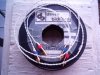
A pic to see the new cables. I placed them on the spool of wire that it came off of.

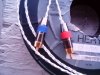
Close up of the RCA plugs

I really liked the first pair of interconnects I made and hakaplan's question got me thinking. So I took one of the returns/ground wires and hooked it up to the signal and ran it that way for a while. Honestly, not a whole lot of difference. What I could kinda hear was a little less clarity and a little more bass. An interesting trade off to say the least.
Now to the point of this post. I really liked the first interconnect so I decided to make another with an upgrade in RCA plugs and more careful QC while making the cables. I measured all six wires to exactly the same lenth. The two signal wires (I liked the clarity, but I didn't nave to trade for it, stay tuned) are from the same piece of wire and are exactly the same lenth. And I got nice plugs that are very solid, gold and well built.
Well, After building them and hooking them up, the overall charcter of clarity is still intact and even with the top end sizzle (which rapidly is gone in a day or two) they sound pretty good. The biggest surprise between the 1st and the 2nd is the bass. The RCA plugs really help to bring the bass to a nice, solid, level. That was a surprise to me, I never really gave much thought to plugs, other than to see how they looked.
A pic to see the new cables. I placed them on the spool of wire that it came off of.
Close up of the RCA plugs
Attachments

ozmoid
Lunatic Member
Well, After building them and hooking them up, the overall charcter of clarity is still intact and even with the top end sizzle (which rapidly is gone in a day or two) they sound pretty good. The biggest surprise between the 1st and the 2nd is the bass. The RCA plugs really help to bring the bass to a nice, solid, level. That was a surprise to me, I never really gave much thought to plugs, other than to see how they looked.
Great! Don't worry about the "knowledge base", that's why I like these discussions - I always learn something.

Can you measure the capacitance of the two cables, and see what the differences are?
whyaskit
music.
I never worry about what I do not know, I figure if it is important enough, I'll figure it out.
First pair, 0.5 ohms
second pair 0.2 ohm
Not a lot of difference, but it is measureable.
Edit - sorry, my meter is a cheapie, kinda like everything else I have, and does not measure capacitance. I got a ohm reading quickly not really thinking about what you were asking.
First pair, 0.5 ohms
second pair 0.2 ohm
Not a lot of difference, but it is measureable.
Edit - sorry, my meter is a cheapie, kinda like everything else I have, and does not measure capacitance. I got a ohm reading quickly not really thinking about what you were asking.

Billfort
Addicted Member
Interesting, thanks for sharing.Well, After building them and hooking them up, the overall charcter of clarity is still intact and even with the top end sizzle (which rapidly is gone in a day or two) they sound pretty good. The biggest surprise between the 1st and the 2nd is the bass. The RCA plugs really help to bring the bass to a nice, solid, level. That was a surprise to me, I never really gave much thought to plugs, other than to see how they looked.
That was the point I was trying to make, the design, mechanical connection quality and materials used in plugs and jacks can also make a difference (IMO) and should be considered and important element in cables.

auplater
"Mine goes to eleven!!"
resistance
You may be only measuring the probe contact points with the the cable...
http://www.users.qwest.net/~csconductor/Experiment_Guide/Four Point Probe.htm
John L.
I never worry about what I do not know, I figure if it is important enough, I'll figure it out.
First pair, 0.5 ohms
second pair 0.2 ohm
Not a lot of difference, but it is measureable.
Edit - sorry, my meter is a cheapie, kinda like everything else I have, and does not measure capacitance. I got a ohm reading quickly not really thinking about what you were asking.
You may be only measuring the probe contact points with the the cable...
http://www.users.qwest.net/~csconductor/Experiment_Guide/Four Point Probe.htm
John L.
hakaplan
Needs professional help
OK here we go. The two statements in no way contradict themselves. A faulty cable can be shorted or open circuit. If it is shorted it WILL reduce noise in the system significantly. Have you ever noticed the shorting plugs across unused phono and other inputs on quality amps? They are not there to look pretty, they short the inputs to prevent NOISE getting in when unloaded. That noise can be anything from DC-daylight. If the cable is completely open circuit, it can also reduce noise as there is no connection to the hot (centre) input rca. Basically, a cable cannot reduce noise unless it is faulty. That being said, certain configurations of cable can and DO contribute to INCREASING the suseptibility of a system to noise. Again, that noise can be audible (from 20-20kHz) or above, and that is what I will address below.
An intact shielded cable doesn't reduce noise?
As for twisting, look inside any decent amplifier and you will find neatly twisted PSU, signal and speaker cables. Why? Not because it looks pretty. Not because it may require 30-50% more cable length, but because it stops dead in its tracks, induced NOISE.
You may or may not remember AM RF breakthrough in the 1970s when the first wide bandwidth amplifiers came along. What caused it you may ask? The speaker leads. Why? Because they were nice parallel aerials and the RF was duly picked up and routed back through the feedback loop, detected by the front end and amplified so you heard a local AM station through your amp. Wow! What solved it? Twisting the speaker cables and reducing the RF ingress by mutual cancellation and self shielding.
Need any more convincing?
I was referring to unbalanced, phono and line level interconnects, not speaker circuits.
hakaplan
Needs professional help
The resistance (ohms) is insignificant in interconnects. The capacitance is what most affects sound quality. If you want a capacitance tester you can find cheapies on the internet for around $20.I never worry about what I do not know, I figure if it is important enough, I'll figure it out.
First pair, 0.5 ohms
second pair 0.2 ohm
Not a lot of difference, but it is measureable.
Edit - sorry, my meter is a cheapie, kinda like everything else I have, and does not measure capacitance. I got a ohm reading quickly not really thinking about what you were asking.

hakaplan
Needs professional help
I have a meter with capacitor checker ( with good batteries) and I get a O.L readings when checking a single solid wire in a Cat5, is this normal?
What is O.L ?


hakaplan
Needs professional help
From one end of a the wire to the next. It would be a short, but that's how I thought it is done. No?
Okay, we're talking about testing between two wires in a cat-5 cable? Put one probe on one wire, the other probe on the other wire. You should get a reading.