

You are using an out of date browser. It may not display this or other websites correctly.
You should upgrade or use an alternative browser.
You should upgrade or use an alternative browser.
damacman's new lair . . .
- Thread starter damacman
- Start date

I moved my Mc500 around to take some photos of it, the other day. It is much heavier than I remember, @ time of purchase!Progress!
Hey, I'm not 26 anymore ....


I moved my Mc500 around to take some photos of it, the other day. It is much heavier than I remember, @ time of purchase!
Gravity has definitely increased since I was in my 20s.
I'm shocked. I moved my '2300's at least a few times, without incident. Both of them.Gravity has definitely increased since I was in my 20s.
@ 72, the Mc500 might as well have been a Chevy V-8!

2 years ago I took my MC2500 to a McIntosh service tech for service - me and my wife hefted all 146 lbs. up and down stairs and into the car. I was 71 at the time.I'm shocked. I moved my '2300's at least a few times, without incident. Both of them.
@ 72, the Mc500 might as well have been a Chevy V-8!
I'm shocked. I moved my '2300's at least a few times, without incident. Both of them.
@ 72, the Mc500 might as well have been a Chevy V-8!
Last month I moved my MC602 into my office, and I put a Mopar 340 on the shelves in the garage (in pieces, including the block) by myself.
The engine block was easier to move.
I’m 66.

Anyone here ever have to flip their Mac amp over then lift it and vigorously shake it to get a dropped 1 1/4" sheetrock screw out of the innards? Lesson learned; always put a bath towel over the back when working around an open top Mac amp.

Bill Ferris
Lunatic Member
No shaking, but I had to flip over & back my 2 brand new 2006 purchased & just delivered MC-1201 mono blocks on the floor in my sunroom`s throw rug in order to to remove the bottom plates to rewire each for 240 V operation, with Mc`s blessing & purchased conversion kit, before 2 butch, & much younger friends were later requested to pick both them up and stack insert both in the sunroom`s audio rack.Anyone here ever have to flip their Mac amp over then lift it and vigorously shake it to get a dropped 1 1/4" sheetrock screw out of the innards? Lesson learned; always put a bath towel over the back when working around an open top Mac amp.
And with their each ~145 lb. weight, and with my use of one arm/hand only was adventurous enough for doing so in a carefully controlled manner then both flipping them back over after the conversions !
^^^^^Great idea to have a couple younger guys take care of the heavy lifting. In my case I didn't have anyone I would trust to hold the other side of my 1201 to help shake the screw out. That was a couple years ago and I'm thinking I'm probably not capable of doing that alone now at 70 yo.
Last year I sold my blacksmith anvil that was from the 1800's and blissfully heavy. But as heavy as that thing was it was much easier to move than a single 1201.
Last year I sold my blacksmith anvil that was from the 1800's and blissfully heavy. But as heavy as that thing was it was much easier to move than a single 1201.
I make covers for all of my audio gear, protected when not in use from dust & UV, I would think that inverting to shake out a screw would be beyond my capabilities.
I’d probably try it and hurt myself, … I do that just to give my wife the opportunity to say “I told you, …”.
I’d probably try it and hurt myself, … I do that just to give my wife the opportunity to say “I told you, …”.

damacman
Resident Psycho
Making some progress on the room. It'll be a while before I can get the ceiling speakers installed though - it's pretty toasty in the attic until about November in PHX. So for now, it's just 5.1. I used the 18" subs from my office system at the last home, converted them from ported to sealed, and have been playing with them a bit. I was able to find a nice location in the room which was conductive to both their physical location as well as them coupling well to the listening location.
The enclosures for each are 7.5ft^3 before displacement of the drivers, ports, and internal bracing. After I remove the ports (easily removed and swapped with plates - as I designed them that way), I'll gain about .55ft^3, so the net internal volume will be about 7.2ft^3. These drivers have an Fs right at 20Hz so perfect for this application. F3 is about 25Hz as they are now. I've used the DSP EQ in my Integra DHC-80.6 to smooth response as best as possible with pretty good results. [I should capture that with my RTA before proceeding.]
For now, the ports are simply stuffed with pillows. So, the plan is to remove and cap those, add arountd 8lbs of polyfil to each enclosure, and re-run the EQ.
I've been using my 7300 to power the subs with quite excellent results. Using them for music, the transition to the mains is so seamless you can't tell where the subs let off and the XRT22s begin. [I've got those set to Full Range, but the DSP in the Integra likes to high-pass them at 40Hz - ok.] On songs like Halos, from Alan Parsons DVD - From the New World, can only be described as breathtaking. The amount of first octave energy in the room (massive - I sit 20ft from the mains and 21ft from the subs) just has to be experienced. At first listen, you don't even realize how much energy the room contains, and then when you turn it down and leave the room, you can feel it on your ears. I don't even flicker the PG lamps on the 7300. Very impressive how well the system sounds as a whole.
However . . . the LFE track on Bluray True HD movie soundtracks is on a whole different level. That will, and without warning, flash the PG lamps on both channels, sometimes holding them ON for seconds at a time. No harm comes to the amp or subs when doing so, but a sure sign you're absolutely out of amplifier. And it just scares the living hell out of you when the entire room is pressurized like that in an instant. And that amp runs toasty serving LFE duty.
So, hopefully, I can make the cabs even more efficient with my short term plan to lessen the power required at 20-25Hz. Then, I'll swap to one of the 2500s which is at least fan cooled and has a few dB more output power. [The subs are a pretty benign load when I sweep the cabs with my impedance meter from 20-80Hz.] If that fails, then I have a Crown K2 in the wings. Either way, I will definitely have to employ the LFE limiter in the Integra to keep from damaging the woofers by overpowering them. A room this size would be better served by (6) 18" and a single 2500 . . .
News to follow.
The enclosures for each are 7.5ft^3 before displacement of the drivers, ports, and internal bracing. After I remove the ports (easily removed and swapped with plates - as I designed them that way), I'll gain about .55ft^3, so the net internal volume will be about 7.2ft^3. These drivers have an Fs right at 20Hz so perfect for this application. F3 is about 25Hz as they are now. I've used the DSP EQ in my Integra DHC-80.6 to smooth response as best as possible with pretty good results. [I should capture that with my RTA before proceeding.]
For now, the ports are simply stuffed with pillows. So, the plan is to remove and cap those, add arountd 8lbs of polyfil to each enclosure, and re-run the EQ.
I've been using my 7300 to power the subs with quite excellent results. Using them for music, the transition to the mains is so seamless you can't tell where the subs let off and the XRT22s begin. [I've got those set to Full Range, but the DSP in the Integra likes to high-pass them at 40Hz - ok.] On songs like Halos, from Alan Parsons DVD - From the New World, can only be described as breathtaking. The amount of first octave energy in the room (massive - I sit 20ft from the mains and 21ft from the subs) just has to be experienced. At first listen, you don't even realize how much energy the room contains, and then when you turn it down and leave the room, you can feel it on your ears. I don't even flicker the PG lamps on the 7300. Very impressive how well the system sounds as a whole.
However . . . the LFE track on Bluray True HD movie soundtracks is on a whole different level. That will, and without warning, flash the PG lamps on both channels, sometimes holding them ON for seconds at a time. No harm comes to the amp or subs when doing so, but a sure sign you're absolutely out of amplifier. And it just scares the living hell out of you when the entire room is pressurized like that in an instant. And that amp runs toasty serving LFE duty.
So, hopefully, I can make the cabs even more efficient with my short term plan to lessen the power required at 20-25Hz. Then, I'll swap to one of the 2500s which is at least fan cooled and has a few dB more output power. [The subs are a pretty benign load when I sweep the cabs with my impedance meter from 20-80Hz.] If that fails, then I have a Crown K2 in the wings. Either way, I will definitely have to employ the LFE limiter in the Integra to keep from damaging the woofers by overpowering them. A room this size would be better served by (6) 18" and a single 2500 . . .
News to follow.
damacman
Resident Psycho
Making progress. I removed the ports, covered the openings with block off plates, and added 6lb of loose polyfil to each enclosure. They say that adds 15-20% of net volume as the polyfil reduces the temperature of the air in the enclosure, making it more dense. So, if we go with 15%, that nets something like 8.3ft^3. The plots look to simply smooth the rolloff below 30Hz with continued increase in cabinet volume - up to about 12f^3 where you run into diminishing returns.
I ran a quick EQ on the room with the Integra and there is definitely more body in the 20-40Hz region with less amplifier power required. As of now, it feels a bit thick and it also feels as if there was more between 40 and 60Hz before and less now which reduces the impact on live music soundtracks. Unfortunately, I cannot lower the crossover point in the Integra on the subs below 80Hz and use the XRT22s to provide that. As typical, I was on a time crunch so I forgot to analyze the room with the 3055 before I made this change. I did also flip the cabs over, which places the subs nearer the corner and further - which I forgot to account for in the setup.
So I have work yet to do.
I ran a quick EQ on the room with the Integra and there is definitely more body in the 20-40Hz region with less amplifier power required. As of now, it feels a bit thick and it also feels as if there was more between 40 and 60Hz before and less now which reduces the impact on live music soundtracks. Unfortunately, I cannot lower the crossover point in the Integra on the subs below 80Hz and use the XRT22s to provide that. As typical, I was on a time crunch so I forgot to analyze the room with the 3055 before I made this change. I did also flip the cabs over, which places the subs nearer the corner and further - which I forgot to account for in the setup.
So I have work yet to do.
<<snip>> added 6lb of loose polyfil to each enclosure. They say that adds 15-20% of net volume as the polyfil reduces the temperature of the air in the enclosure, making it more dense. So, if we go with 15%, that nets something like 8.3ft^3. The plots look to simply smooth the rolloff below 30Hz with continued increase in cabinet volume - up to about 12f^3<<snip>>
Waaaait a minute. Adding mass inside the enclosure INCREASES internal volume? Doesn’t seem like that follows any law of physics, and it reduces the temperature of the air? It destroys heat? What about the laws of thermodynamics here?
If anything, air moving around filling would create more friction than moving in free space, and thus more heat. The only way it could reduce the temperature even in theory would be to remove filling, unless there’s something really revolutionary happening here.
Whatever is affecting your bass, possibly blocking the ports, dunno, but you have decreased the internal volume of the cabinet by the amount of polyfill (actual mass, not the uncompressed volume of the polyfill). Effective volume via damping is a completely different discussion.
damacman
Resident Psycho
No sir.Waaaait a minute. Adding mass inside the enclosure INCREASES internal volume? Doesn’t seem like that follows any law of physics, and it reduces the temperature of the air? It destroys heat? What about the laws of thermodynamics here?
If anything, air moving around filling would create more friction than moving in free space, and thus more heat. The only way it could reduce the temperature even in theory would be to remove filling, unless there’s something really revolutionary happening here.
Whatever is affecting your bass, possibly blocking the ports, dunno, but you have decreased the internal volume of the cabinet by the amount of polyfill (actual mass, not the uncompressed volume of the polyfill). Effective volume via damping is a completely different discussion.
damacman
Resident Psycho
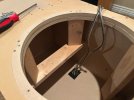
When we had the drivers out, I was reminded that I used to build incredibly strong enclosures. Over the years, I likely built 1,000 or more in my career in car audio.
Double thick 3/4" MDF baffles, several well placed 2x4 braces, and #14 2.5" long PPH screws to secure the drivers - 4 directly into the bracing. I migrated from T-nuts to that method in the '90s, when we moved from plywood to MDF, as T-Nuts were damn near impossible to properly secure.
These are the last enclosures I ever built.
Double thick 3/4" MDF baffles, several well placed 2x4 braces, and #14 2.5" long PPH screws to secure the drivers - 4 directly into the bracing. I migrated from T-nuts to that method in the '90s, when we moved from plywood to MDF, as T-Nuts were damn near impossible to properly secure.
These are the last enclosures I ever built.
Attachments


People have been stuffing speaker cabinets for decades. My understanding is that the stuffing becomes something like a higher-density "air" that lowers internal resonances as if the cabinet were larger than the physical dimensions. We used to use building isolation material. I don't remember anything about tempurature.
But I like to double-check my failing memory which this time does sorta matches AI - which is based on stuff on the Internet - but at least there is some agreement.
AI Overview
Polyfill (polyester fiberfill) is a popular, cost-effective sound dampening material used in loudspeaker enclosures to absorb internal sound reflections, reduce cabinet resonances, and sometimes trick a driver into "seeing" a slightly larger cabinet volume. It is commonly found in DIY craft projects, pillows, and specific audio-grade varieties like Parts Express Acousta-Stuf.
Why Use Polyfill?
Reduces Standing Waves: Sound bounces around inside the hard walls of a speaker box. Polyfill absorbs this acoustic energy, preventing it from reflecting back through the speaker cone and muddying your sound.
Lowers Resonant Frequency:
By slowing down the speed of sound inside the enclosure through thermodynamics and gas flow resistance, the driver perceives the box as slightly larger. This can slightly lower the system's resonant frequency and deepen bass in sealed enclosures.
Better Midrange:
The fibers tighten and smooth out midrange frequencies by absorbing harsh internal reflections.
But I like to double-check my failing memory which this time does sorta matches AI - which is based on stuff on the Internet - but at least there is some agreement.
AI Overview
Polyfill (polyester fiberfill) is a popular, cost-effective sound dampening material used in loudspeaker enclosures to absorb internal sound reflections, reduce cabinet resonances, and sometimes trick a driver into "seeing" a slightly larger cabinet volume. It is commonly found in DIY craft projects, pillows, and specific audio-grade varieties like Parts Express Acousta-Stuf.
Why Use Polyfill?
Reduces Standing Waves: Sound bounces around inside the hard walls of a speaker box. Polyfill absorbs this acoustic energy, preventing it from reflecting back through the speaker cone and muddying your sound.
Lowers Resonant Frequency:
By slowing down the speed of sound inside the enclosure through thermodynamics and gas flow resistance, the driver perceives the box as slightly larger. This can slightly lower the system's resonant frequency and deepen bass in sealed enclosures.
Better Midrange:
The fibers tighten and smooth out midrange frequencies by absorbing harsh internal reflections.
damacman
Resident Psycho
Well, I had some time today and an empty house so I did some additional EQ takes and fine tuning.
I knew I was on the right track ... the bottom end os shaking the foundation now, and effortlessly. Absolutely standing the hair up on my arms ...
David Gilmour Live at Pompeii on Bluray is spectacular in every measure.
I knew I was on the right track ... the bottom end os shaking the foundation now, and effortlessly. Absolutely standing the hair up on my arms ...
David Gilmour Live at Pompeii on Bluray is spectacular in every measure.

The David Gilmore Blu-Ray is a visual treat and the music is pretty awesome in 5.1! You should check out the Joe Bonamassa, John Mayer and Dukes of September Blu-Rays as well.Well, I had some time today and an empty house so I did some additional EQ takes and fine tuning.
I knew I was on the right track ... the bottom end os shaking the foundation now, and effortlessly. Absolutely standing the hair up on my arms ...
David Gilmour Live at Pompeii on Bluray is spectacular in every measure.




damacman
Resident Psycho
MC2500 now serving duty on the subs. I also found a MINT pair of Polk RTA 11t, which now serve as the surrounds. I looked for a year for pair of Mcs to match the center before giving up.
Height speakers will come in the fall when it cools down. For now, I'm very pleased.
Long term, I may build some sonotube enclosures for the subs and downfire them. We'll see.
Height speakers will come in the fall when it cools down. For now, I'm very pleased.
Long term, I may build some sonotube enclosures for the subs and downfire them. We'll see.
