• Please note that Audiokarma will be offline briefly for updates early on Monday morning, September 28th.

De-Soldering Questions

What I thought you had that memorized. :idea:
Sorry to disappoint you, I only have the "common" values in Fender amps memorized.

Will you still like me?

d2f0364c-7544-4667-ad8c-0bc8f7b68e08.gif
 
When we take the advice of the wise, those who have been there, did that, and we buy quality tools when we are young we are thankful for the rest of our lives. If I could turn back the clock 30 years I'd have a really good de-soldering station but instead I make due with my old blue solder sucker and braid dipped in paste. My days of full re-caps and such are probably over-maybe...
 
When we take the advice of the wise, those who have been there, did that, and we buy quality tools.
Amen. I remember this amp tech (a kinda famous one) who excoriated previous tech's bad work that came across his bench — much like what a good auto body man says when he sees bad previous body work. I guess it's important to set a standard, even if it's a personal one. :idea:

I looked for pro-quality, used tools if I can't afford new ones. Many have outlasted new tools that I've bought later.
 
I buy quality screwdrivers, wrenches and sockets because they are wear items. I buy cheap soldering irons and solder suckers because they do the job and I have no issues with them. I buy new ones when needed because I don't feel pride of ownership in DIY tools.
My adjustable soldering station and my desolder iron are unused for the last couple of decades. I don't do surface mount devices or complicated circuit boards, so they're not needed.
For point to point on tube amps, a high-ish wattage soldering iron with a fine point works best. Heat the joint, apply the solder and don't move until it goes solid.
I try not to make things more complicated or expensive than necessary.
 
When I first had to desolder stuff for work, back in the early seventies, I used a blue Soldapullt and I thought it was great, instead of heating a joint with a soldering iron and finagling the lead out of the board. Then, we got some of the bulb irons and I used them for many years because it was a one-handed proposition instead of two. Great!

I thought about getting a trigger/vacuum unit but resisted, so to speak, until through age, I could no longer operate a bulb iron one-handed, so I bought a vacuum/trigger desolderer.

I wish I would have bought one years ago.

Doug
 
I have used solder wick and a number of spring-loaded trigger suction tubes of various sizes and types. I've never had much good to say about solder wick. I've successfully done restorations with the spring pumps, but they are tricky to use and even when I'm careful I occasionally lift or damage a trace with this method.

I recently got fed up with that and after a lot of humming and hawing I picked up an Ali Express T12A "special" by Handskit.

I had vacillated between this and the more prolific "pistol" style. One review of this device gave me pause when it suggested it had poor suction. I ended up going with it anyway, though, because the angled tip is so much better to get into tight spaces than the pistol type. I have a Realistic STA-120B restoration that had some tight squeezes, for example.

The suction is actually excellent on this device. The problem is that when it's shipped it is often completely uncalibrated. Mine was, at any rate, and other reviews make me think this is common. Calibration, however, is not difficult if you have any good thermometer that will work at 400+C. The ubiquitous multimeter thermocouples will work fine. Or, as I did, you can pick up a cheap dedicated soldering iron calibration thermometer. This worked quite well to calibrate my T12A, which was under-temp by a good 100C.

After calibration the display temp is quite accurate. And this tool makes short work of solder joints:

I love this device. Probably the best $100 I've spent on my restoration bench.

And if you're wondering why I'm pulling a transistor that had clearly just been installed.... did you ever turn on a restoration receiver to test a new part, and then think "it's ok, I can clip these leads carefully just this once without turning it off". No, of course, I never do that either. :oops:
 
Last edited:
Instead of reply to each post here, I'd like to say thanks for the fabulous info and guidance. I'm truly looking forward to this project and if it goes super smoothly, I may have to consider doing this as a hobby for the locals around here as I've found no one in S. Fl who works on the older stuff without heading to SW Miami which is a traffic nightmare so I stay North of that line if at all possible. 15 miles takes 60 minutes to traverse.

I do like the idea of using the bulb to save money but if I take this to doing repairs for others I will go the station route.
Right now I have the oscilloscope on order and will need to wait for the component tester.

I do recall those cards from Radio Shack and wish to hell they still had their stores. Nothing like walking in and finding all the components there to pick up and take home on the spot. In fact, I'm not a fan of online ordering simply because of the tangible absence that now is the norm. I enjoy touching something I'm going to own before buying it. Turning a knob to feel its resistance, pushing a button and hearing that 'click' etc...

There's so much good info on AK I am beyond grateful for its existence and all of you experts from the hobbyist to the retired electronics doctors, I will heed all your advice, utilize your knowledge and use all my skills to make this MK7 a sweet sounding machine once again.

@Mr. Boochie

Where does one get that type of station? I am sure I could open a shop and resell them quite efficiently.
 
Braid works well if there is a lot of solder to remove such as with a large tab through a board like on slide controls with the tabs anchoring the control.

Doug
 
Practice on a disposable board to develop your own style/ method and to pinpoint the correct temperature. Then try resoldering them back. Try a variety of tools. I prefer a couple of different sized solder suckers to a gun or braid. Sometimes, neither works and one has to get creative. But, like with anything, takes practice. Plenty of videos on utube.
 
Instead of reply to each post here, I'd like to say thanks for the fabulous info and guidance.

@Mr. Boochie

Where does one get that type of station? I am sure I could open a shop and resell them quite efficiently.
Thanks! And remember, whichever type of desolder tool you use, solder rosin flux is your friend! Apply a little dot, just before the heat and suction.

The station is available from the Dino's Bar and Grill website! Looks under "The Boys Are Back in Town" link. ;)
 
So I should bite the proverbial bullet and spend the 300 for the tool... well now, I see this hobby is FUNDS and games. lol

Of course, I am not opposed to borrowing one from someone... jk
My advice. If you are going to work on a lot of equipment, spring for the Hakko. Well worth it but you will need to empty and clean it frequently in my experience. Buy lots of filters and various tips.
 
My advice. If you are going to work on a lot of equipment, spring for the Hakko. Well worth it but you will need to empty and clean it frequently in my experience. Buy lots of filters and various tips.
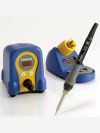
Hakko makes the best pencil soldering iron for fine circuit board work.

Hakko fx-888d-solder station.jpg
 
Yes they do. I had this unit and it worked very well. Until it didn’t. Over a hundred bucks for a new one. My son had a cheap one made in China. Cost under $10 and included a variety of tips. It works so well I couldn’t justify springing for a new Hakko.
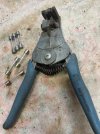
I also have a cheap Chinese soldering iron and it always works great.
 
Back
Top Bottom
