
Wonder if your older Ortofon TA's were made by Jelco? Many of the more modern Ortofon TAs are. Guess that is "were" since Jelco closed their doors this past spring.



Just because you are willing to cover problems with a bead-blast does not mean that Jelco (or others) will or did so.

I agree. The DA401 with a Stanton 881 or 981 is hard to beat without more invested.This may be a very subjective topic that may not have a definite answer. From what I've read, DA401 is a very good arm for high compliance cartridges with weight 4~10g, and it can compete very well with any tonearms costing up to $1,000.

What I didn't mention is that it is also about the cheapest way to finish parts. Does away with cleaning off small burrs, that is very labor intensive as well. After bead blasting it goes right into the anodizing shop.
I rather like the bead blasted finish and have used it myself on my latest project, my new armboards with interchangeable inserts for my JVC build.
But what I really like is the very finely machined tonearms, mostly from Japan. It shows off the incredible machine work that came out of their shops. My JVC tonearms and the Micro Seiki tonearm exhibit this very well. Makes a lot of other tonearms look rather crude. As a machinist I can spot high quality parts at a glance, now whether they hit the required tolerances when made, that should have been sorted out in final inspection.
That said, I do have a SME 3009 SII Improved with a detachable headshell mounted on a table that I haven't played with yet. And if a long arm Jelco came my way at the right price I would certainly give it a try. I kind of like tonearms. LOL


Very nice.Will add the 3010-R to my 10" tonearm search.

I had the same Mission arm (oddly, every model Mission made was called 774 even though the look and design principles totally changed). My version of the one you had was very well finished, so they cleaned up their act. It was impeccable in fact, though some parts (like the arm-lift, and trough for damping-fluid) seemed "tacked on" at the end, and not "designed into it" from the start.Obviously, when it comes to products of British cottage hi-fi industry, the quality can vary wildly. For example, I have a Mission 774 tonearm that has something of a cult following - it's a great sounding tonearm alright, but it looks absolutely horrible, it was clearly made by people who thought that "fit and finish" was an insult. E.g. no attempt was made to remove sprue from cast metal parts or sand machined parts before painting them. How they managed to sell them with such attention to detail is beyond my comprehension, but I guess many people in Britain would buy almost anything if it says "made in England"
Do you think Stanton 881 or 991 would outperform DL103R or DL303?I agree. The DA401 with a Stanton 881 or 981 is hard to beat without more invested.
The 103's are fantastic on a higher mass arm. The 303 would be good on the 401 arm. I don't remember the 303 I had but a 305 and the 981 both sounded great on the 401. The 305 being a touch better with a good step up transformer.Do you think Stanton 881 or 991 would outperform DL103R or DL303?

That is a very nice plinth and the DP80 is fantastic. I think you meant to say the plinth is a DK300 (or 2300 with two arms). A lot will depend on where the hole was cut on the existing arm board. You may need a new arm board or cut a new hole depending on the arm you choose. You can measure from the center of the hole in the arm board to the center spindle of the DP-80. For a DA-401 arm you want that distance to be 230mm. See attached. You would then adjust the cartridge so the stylus tip overhangs the spindle by 14mm. With the stock headshell you can then just set the stylus tip 38, 50 or 52 mm from the end of the headshell connector for perfect alignment ( I forgot that exact distance but it was n the manual). Instead of all that you can also us a protractor to align the cartridge.Hello sir, congratulations for this beautiful turntable, please, appreciate if you can solve some questions of mine, about assembly a turntable like this.
Please, let me ask you, how the motor and tonearms installation process works ? It's too much complicated for a beginner?
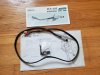
All the "pieces" you mention are pretty much "drop in, plug together & play" with some adjustment needed. If you have average mechanical/electronics aptitude, you will be fine.Please, let me ask you, how the motor and tonearms installation process works ? It's too much complicated for a beginner?
I have the opportunity the get an almost mint condition Denon DK-3000 plinth, DP-80 motor, and probably a Denon tonearm DA-401, or other Denon tone arms variations from the DA-300 series...
How the tonearm and turntable installation process works? It's very straight forward, or requires some more specific knowledge about electronics to install properly?
Any basic info about this will help me to understand this concept more.
Edit: I know there's a tool called Dr.Feickert Protactor, in order to install the tonearm and cartridge with the optimal position in relation to the motor.
This is all I need to start? There's any knowledge about electronics that must to be understood on the assemble process of this turntable?
Yes. Still need the step-down transformer to be safe. Something like this:For know I'm not have a system anymore, sold all my stuff, the technics turntables, mixer, speakers and etc, due the catastrophic economical crisis here in Brazil, but I'm glad that I managed to keep my vinyl collection, and I hope that will enjoy it again when the financial situation here start to get better, as I have a friend in Japan, I can get the plinth and the motor maybe next year, so I planning to build a new system step by step, still uncertain exactly when, so I not thinking about the amplification gears yet, just the turntable, and understand better how is the process of install the motor and the tonearm...
By the way, the electric grid here is 110V, so I will need a step-down transformer? as the turntable works at 100V?
Many thanks!!!!