• The move to the new server is done. There are some software and database maintenance updates in process. This has us passing the hat around to help out. We appreciate any donations. Seriously, even a dollar helps. The payment page may be found here - https://www.audiokarma.org/support.html

Denon DP80 & DP75 Owner's Thread

Looks like Micro CU-180. I know people who use this mat on Technics SP10 and are very happy with it.
Interesting seeing one on a DP-80 as the double platter and mat combination was a "system" design. In recent years I've ditched the original rubber mats on my various tables, but to date have felt no such urge with the DP-80.
 
Not sure that isn't a 'gun-metal' mat. They (and platters of same) were once the rage in Japan and tres-chic (and expensive) these days. I'll have to live with my stock mat or toss on a cork mat, should I be able to find it (some things can hide really well and this mat is one of them).
 
Can you post a pic or two of your 'plinth-less' DP-80? Would be interested in how you arrange your arm(s).

Phillip guesses the weight of his DP80/VPI plinth approaches 80#. Plinth is layers, which includes 1/8" steel plates.
Pics to follow. 80# sounds right for that VPI plinth; mine was much bigger, thus heavier. BTW, the steel plates (maybe 6 in all) were sandwiched with 1/8" layers of compliant gunk between each plate (like black silicon, sorbothane, or something). And the entire construct "floats" on 4 compressions springs. Very thorough.
Looks like Micro CU-180. I know people who use this mat on Technics SP10 and are very happy with it.
The DP-80 platter is in 2 parts, separated/joined by foam pads and 3 leaf-springs, to isolate the 2 parts from each other: essentially a "sprung suspension" in the platter itself. Very well thought out.*

Using the CU-180 (or similar) would defeat this design and turn it into a conventional one-piece platter, with its drawbacks, so it's not recommended.

I tried my SAEC SS-300 metal-mat on it (different metal but otherwise identical), heard no benefit or detriment, and went back to the original rubber mat. There is a way raise the 300 (or 180) so it kind of "floats": I use it like that on other platters and it reduces bearing-rumble to about – dB, as it creates a "cushion of air" between itself and the platter: no vibration can pass.

I could tweak it slightly for the DP-80 so it didn't interfere with the suspension, but I suspect it wouldn't matter much so haven't tried it.

BTW — You all probably know this already, but in case... Under the platter there's a 50-60Hz frequency switch for the incoming power supply. Of course here in US it should be 60Hz. But it's misleading: it looks like a slide-switch and looks like it's set right. But it's really a Push/Up/Down switch: its visual position means nothing. There's a legend beside it, saying which Hz is Up or Down. Worth checking, unless you're sure.

BTW-2 — This may not matter but it bothers me. Lifting the platter off can be a struggle, and the only grip (through the holes) puts your fingers right on the magnetic-speed-control strip, and puts them there with force. I can't imagine that's good (skin oils etc) so I always grip it by the sides of the holes. But it's awkward.

How do you guys do it?

* The LP rests on the inner platter, totally decoupled (theoretically) from the platter-bearing. Those bearings are the main cause of rumble in all TTs, and the main criticism (false) of direct-drive. So Denon addressed it, somewhat cleverly — I'm not a 'true believer' it fully works as intended, but it must help a bit.
 
Last edited:
Pics to follow. 80# sounds right for that one; mine was much bigger, thus heavier. BTW, the steel plates (maybe 6 in all) were sandwiched with 1/8" layers of compliant gunk between each plate (like black silicon, sorbothane, or something). And the entire construct "floats" on 4 compressions springs. Very thorough.
The DP-80 platter is in 2 parts, separated/joined by foam pads and 3 leaf-springs, to isolate the 2 parts from each other: essentially a "sprung suspension" in the platter itself.*

Using the CU-180 (or similar) would interfere with it in two ways, so it's not recommended.

I tried my SAEC SS-300 metal-mat on it (different metal but otherwise identical), heard no benefit or detriment, and went back to the original rubber mat. There is a way raise the 300 (or 180) so it kind of "floats": I use it like that on other platters and it reduces bearing-rumble to about – dB, as it creates a "cushion of air" between itself and the platter.

I could tweak it slightly for the DP-80 so it didn't interfere with the suspension, but I suspect it wouldn't matter so haven't tried it.

BTW — You all probably know this already, but in case... Under the platter there's a 50-60Hz frequency switch for the incoming power supply. Of course here in US it should be 60Hz. But it's misleading: it looks like a slide-switch and looks like it's set right. But it's really a Push/Up/Down switch: its visual position means nothing. There's a legend beside it, saying which Hz is Up or Down. Worth checking, unless you're sure.

BTW-2 — It may not matter but it bothers me. Lifting the platter off can be a struggle, and the only grip (through the holes) puts your fingers right on the magnetic-speed-control strip, and puts them there with force. I can't imagine that's good (skin oils etc) so I always grip it by the sides of the holes. But it's awkward.

How do you guys do it?

* The LP rests on the inner platter, totally decoupled (theoretically) from the platter-bearing. Those bearings are the main cause of rumble in all TTs, and the main criticism (false) of direct-drive. So Denon addressed it, somewhat cleverly — I'm not a 'true believer' it fully works as intended, but it must help a bit.
BTW 2 - I get my fingers on the inner sides of the openings and then wiggle, front to back so as not to endanger the magnetic strip. Just lifting never does the job, even if you've just dropped the platter on for a moment. I guess it says something about the tolerances involved!
 
BTW 2 - I get my fingers on the inner sides of the openings and then wiggle, front to back so as not to endanger the magnetic strip. Just lifting never does the job, even if you've just dropped the platter on for a moment. I guess it says something about the tolerances involved!
Wonder if adding a light coating of synthetic oil might help with this?

Just ran across Herb Reichert's review of the Jelco TK-850 on the Dr. Feichert Blackbird TT. He was quite positive on same. It looks like the armboard on the DK100 plinth offers plenty of room for a 12" TA, so may give it a try.
 
Last edited:
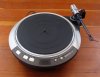
@MX117.MC7150 Plinth-less pic... Personally I like the look, Form = Function, but that's just me. The greatly reduced size can obviously be advantageous situating it.
aIMG_2533 copy.jpg

I made the armboard so I could compare to the VPI plinth. So I did it fast, just for an initial test.

For my first test I used wood. Not even real wood: MDF. I wanted an initial impression and I was impatient to use my great new toy.

Is it rigid enough? Does it resonate? Will it — many questions spring to mind.

Note the distance between armbase and TT — less than an inch, bolted tight. Will that short a length be rigid or floppy? Will less-than-an-inch be highly resonant — when the only source of resonance is the motor, which is silent running?

I was comparing 3/4" MDF to 6 layers of 1/8" steel with 5 layers of sorbothane between each layer — and I heard no difference. It even sounded, as I mentioned, a bit more airy and transparent.

My plan was, if the MDF test seemed OK, I'd switch to a better harder "real" wood — I had a 1-1/4-inch-thick piece of seasoned Walnut standing by. Never did it. Wasn't necessary.

Making the armboard was easy (I took a pic of armboard alone; I'll look for it.) 90% of it is hidden under the flange, only a bit of it can be seen in the pic. The hidden part follows the curve of the chassis, and bolts through 2 holes already drilled in the flange, no drilling needed. I can torque it so tight it's as one piece with the metal.

When I add 2 more arms, I'll make a new, bigger, wraparound board to handle all three.

You mention using metal for yours, but express concern about weight.

I also have a Micro DQX-1000 TT, with 3 posts to take 3 arms. The Micro armboards are metal (I think aluminum, and heavy). So metal seems right: Micro made few mistakes. But those boards are expensive and hard to find, and were only made for a few arms: they'd have to be re-machined to fit my arms (adding more expense). So I made some from wood — solid oak, not MDF.

They work fine, I hear no difference. As with the Denon, it was an experiment that succeeded, in my estimation. I thought they'd be temporary, but still using them.

PLINTHS — This is just my theory, and many will object — I think plinths are unnecessary and detrimental — all plinths. The detriment is intrinsic. The more engineered, elaborate, and expensive plinths — steel, granite, marble, obsidian; with damping layers or not; with springs, Mag-lev, hydraulic or not — only reduce the intrinsic detriment of all plinths.

 
Last edited:
Thx. Nice. But........... you know that looking good is 90% and a plinth can be made to look very nice. ;)
Seriously, I always enjoyed my Micro Seiki DDX-1000. But, once the bladders gave out I never got around to redoing and a more ambitious friend cut up some Sorbathane and recapped and now listens to it with a JMW-9Sig and a Jelco SA-250(?) arm and it is a terrific performer. But not a DP80.
I'll probably stay with the plinth for now for ease of use with a dustcover (another expense if going naked).
 
Maybe Mr Pig will drop in with his Denon.

Unless @Mister Pig has a 2nd one in his barnyard, probably not.

I bought his DP-75 motor/platter and installed it on an existing Denon DP-6700 plinth. Then I installed a Technics EPA-500 arm on. I have 3 "tubes" for the EPA. So far I've installed a Ortofon MC-3000 and a Miyajima Madake and have been more than happy with the results.

The EPA-500 did require a 2 step drilling process.

You could say I'm as "Happy as a pig in s**t"

20190428_221100.jpg 20190429_181958.jpg

:beerchug:
 
Thx. Nice. But........... you know that looking good is 90% and a plinth can be made to look very nice.
Total agreement! Nothing out-beauties a well-done Rosewood plinth — or complements the room decor more elegantly.
Seriously, I always enjoyed my Micro Seiki DDX-1000. But, once the bladders gave out I never got around to redoing and a more ambitious friend cut up some Sorbathane and recapped and now listens to it with a JMW-9Sig and a Jelco SA-250(?) arm and it is a terrific performer.
My bladders (is that what they're called?) also fell apart, they all do. I didn't replace them. Instead, I put the TT on a thick glass plate with four isolation-feet underneath. They're more compliant than the original feet, so maybe do a better job of decoupling. The TT is also more stable just resting on its solid-metal feet. I'll only replace the Micro feet if I sell it, which I'd hate to do.
But not a DP80.
Right! The Micro is very good and I'm glad I have it, but the DP80 is a separate league entirely. Fiddlefye and I discussed this at length a year or so ago. We threw descriptives back and forth, finally settling on "stately" and "regal", as I recall. On a more technical level, he praised its pitch stability; as a violinist, he knows better than I — but even with lesser ears I can hear a profound quality the DQX and most others lack, and rock-solid pitch is probably it. It's foundational to Music. Varying the pitch is an expressive technique, "rubato", best used sparingly or it's schmaltz — and definitely shouldn't be added by playback gear.

I only mentioned the Micro because you mentioned metal armboards, and the DQX uses them — that was my only comparison. If you thought I was equating them, sorry I wasn't clearer.
 
Last edited:
Fiddlefye and I discussed this at length a year or so ago. We threw descriptives back and forth, finally settling on "stately" and "regal", as I recall. On a more technical level, he praised its pitch stability; as a violinist, he knows better than I — but even with lesser ears I can hear a profound quality the DQX and most others lack, and rock-solid pitch is probably it. It's foundational to Music. Varying the pitch is an expressive technique, "rubato", best used sparingly or it's schmaltz — and definitely shouldn't be added by playback gear.
bimasta - sorry to edit your post, but I wanted to reprise that bit. The pitch stability is an important thing for me and my DP-80 has that in a way no other table I've heard has. That same ability also has huge side-effects in that it helps create a more stable image, allows small details to not only appear but also to flow as an integral part of the music. If I had to put my finger on one aspect in the end it would be that the drive allows every aspect to be integrated into the stream in a way that only really good RTR did for me previous to this.
 
Last edited:
Total agreement! Nothing out-beauties a well-done Rosewood plinth — or complements the room decor more elegantly.

I had been looking for many months and I am psyched to have found and ordered a DK-2300 double arm rosewood plinth this morning. Sold for $690 in the early 80's. Must be heavy. I can put my DK-2000 double arm plinth, in excellent condition, with a number of extra uncut boards on BT after I get it.
 
Not sure how my new comment got mixed up with original post
You've typed your reply in front of the [/Quote]. Edit your post by moving that to the end of the quoted message and you'll be good. You can delete your additional message should you wish.

Mark 1234 - Is the Rosewood the reason you went from the DK-2000 to the DK-2300? I would be interested in your DK-2000.
 
Last edited:
bimasta - sorry to edit your post, but I wanted to reprise that bit. The pitch stability is an important thing for me and my DP-80 has that in a way no other table I've heard has. That same ability also has huge side-effects in that it helps create a more stable image, allows small details to not only appear but also to flow as an integral part of the music. If I had to put my finger on one aspect in the end it would be that the drive allows every aspect to be integrated into the stream in a way that only really good RTR did for me previous to this.
You didn't 'edit' it, you expanded and enriched it.

Will you do all my writing for me in future?
 
You didn't 'edit' it, you expanded and enriched it.

Will you do all my writing for me in future?
Hah, hardly! You're a much more accomplished writer than I could ever hope to be. I had been thinking about our conversations about the drive and what makes it tick for us and realized how interlocked all of the things it does so well are to that one aspect. Other aspects are important, sure. That one just brings it all together. Listening to my old copy of Abraxas as I type and it really sounds quite glorious. Even the moments that are that teensy bit out of tune (there are a few and on most albums) sound "right".
 
Spot on. You may recall mine had a Syrinx. Somehow I lost a channel while soldering new cart-clips. It might be an easy fix, might not. Rather than troubleshoot and repair, very tedious on the Syrinx, I switched to the Micro, it was ready to play.

You've reminded me what I've given up. I'll put the Ittok on the DP-80 and recapture that indefinable dimension that nears perfection.

Thank you.
 
Spot on. You may recall mine had a Syrinx. Somehow I lost a channel while soldering new cart-clips. It might be an easy fix, might not. Rather than troubleshoot and repair, very tedious on the Syrinx, I switched to the Micro, it was ready to play.

You've reminded me what I've given up. I'll put the Ittok on the DP-80 and recapture that indefinable dimension that nears perfection.

Thank you.
The EPA 250 has been a real revelation on mine. The Audiocraft is really nice, but the EPA really seems to me to wring out even more of the potential. I'd never heard vinyl sound like that before...
 
I'm not surprised. I had the EPA-500, but only with low-mass armtube. Loved it, but frankly the 3009/II/imp suited my high-compli MMs better. Never had the right EPA tube for MC.

Meanwhile, @srs735 has all 3 (#28)!! ENVY!

The Ittok is a cut below the Syrinx. I may try the Odyssey — if it can fit the armboard. If the mounting-hole is big enough, almost any 9" arm can be made to work, with some improv.

Back to your description: "That same ability also has huge side-effects in that it ... allows small details not only to appear but also to flow as an integral part of the music."

That nails it. I'm as much a detail freak as anyone, but all too often it "jumps out", when it should "stay in" the Music.
 
I'm not surprised. I had the EPA-500, but only with low-mass armtube. Loved it, but frankly the 3009/II/imp suited my high-compli MMs better. Never had the right EPA tube for MC.

Meanwhile, @srs735 has all 3 (#28)!! ENVY!

The Ittok is a cut below the Syrinx. I may try the Odyssey — if it can fit the armboard. If the mounting-hole is big enough, almost any 9" arm can be made to work, with some improv.

Back to your description: "That same ability also has huge side-effects in that it ... allows small details not only to appear but also to flow as an integral part of the music."

That nails it. I'm as much a detail freak as anyone, but all too often it "jumps out", when it should "stay in" the Music.
As you know, I have the 250 which is different from the earlier system, though they use what I believe is the identical base.The 250 is an S wand and uses the standard Techincs/SME etc. shell, total 14g eff. mass with the original shell. Pretty dead centre medium mass. I'd like eventually to get one of the low-mass wands from the first series (they did make one of medium mass, but apparently they're as rare as hen's teeth). Then between the EPA and the Audiocraft I could run pretty much anything I wanted, all on the same table.
 
Back
Top Bottom