• The move to the new server is done. There are some software and database maintenance updates in process. This has us passing the hat around to help out. We appreciate any donations. Seriously, even a dollar helps. The payment page may be found here - https://www.audiokarma.org/support.html

Dirty Weekends vs JBL Studio 590

That's a relief! Took 'em long enough, who "nearly perfected" speaker design and when did this happen? Must've been a while ago and I missed it, if most people already hopped on that bandwagon. Do those people even know that what they own is "nearly perfect"? How can we check what we already own to find out?
las.png 024930982_1-91460eb9b8f0039bcac8563b26cf5d40.png

Depends on the type of speaker but we have been in the fine tuning stage for a long time.
 
Diminishing returns is a personal tipping point, as it depends on what a listener values, what kind of room they have to work with, and if they can pair up the speakers with appropriate equipment. Upper tier speakers are a two edged sword, as they are revealing at a myriad of levels. Which means you can make them sound terrible or average with the wrong equipment pairings. But if you get it right, then you get glorious sound that you don't hear with lesser speakers. So the point of "diminishing returns" or that last 10% can be difficult to tease out but worth it.

There is an old adage that the DNA make up between chimpanzee and human is 98% the same. They have revised that figure to 95%. So how important is that last 10%? Pretty important in many cases. In systems I have heard, it the difference to hearing music, and experiencing music.

Cheers
Mister Pig

Or... Maybe we're giving ourselves way too much credit for being that much more developed or different than chimps.

View attachment 1665035 View attachment 1665037

Depends on the type of speaker but we have been in the fine tuning stage for a long time.

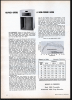
Are you holding those things up as the ultimate evolution of the loudspeaker? I'm sorry, but there are reasons horns are a minority of the speakers out there.
 
Physics doesn't care what you paid for it.....it treats all folks the same

Yes. Physics doesn't care. The cold, hard truth is you can't ask more money for the product in the marketplace than it's virtues justify. What it actually costs to develop and build the product is irrelevant. The values are what are for sale.
 
Depends on the type of speaker but we have been in the fine tuning stage for a long time.

Well, you're right that the Khorn designs have been merely fine-tuned for a very long time now.

Since "what most people own is good enough", are you saying that most people own Khorns or very similar designs?

If not, why not, since Khorns and similar are "nearly perfect"?
 
Last post on an enjoyable thread....We should be happy that most speakers made by most manufacturers today can be considered/measured as being excellent and the price of this excellence is dirt cheap. We are in a golden age of audio and I celebrate anyone who has interest in this hobby and their systems.
 
I have yet to hear a speaker do EVERYTHING perfected.
Couldn't resist....How the hell do you get what the 590 gives you for 1k without current speaker technology being "nearly perfected". The vehicle... a box with drivers is not perfect so no design outcome can be perfect.
 
Most speakers that are in a higher price class than the 590's will have finer cabinets, aesthetics and more exotic drivers but in terms of absolute performance....???
Yes, if the 590's had the cabinets, real wood veneers, and premium drivers found in speakers from JBL Synthesis I'd imagine they'd be about $8,000 a pair. I have a cabinet maker in my area offer to wrap the 590's in black walnut veneer for $1000 a side if I decided to get them. Instead I'm saving for a pair of 4429's.
 
It has horns - many people HATE horns. You can thank Klipsch for that. Andrew Jones is a great designer. He understands economy of scale and how to design to a price point. Many don't.

Zu speakers while efficient are not accurate, that is the issue with single drivers augmented with supertweeters. On the other hand, Horns are not accurate over a wide bandwidth either. It is hard to compare them since they are different types of speakers.

People who like JBL want the new L100's , which seem to be selling well.
People who like JBL like horns. L200, L300, 4429's, and 4367's.
 
Well there is no such thing as accuracy in a loudspeaker and regardless of what Toole thinks - speakers - including ALL of the ones under Harmon are not even REMOTELY close to absolute accuracy. The DBTs are built upon what some listeners happen to like better (a speaker frequency curve off axis). And tested against only a very few competitors under a test that doesn't follow "validity" (Range Rule) particularly well. So a heavily flawed test indicates that some people listening to ONE speaker in the center of a room happen to like speakers that exhibit certain frequency response results over some speakers that do not.

If you want an absolutely perfect speaker it would require some of the following - that no JBL or Revel even come REMOTELY close to meeting. Some of these parameters would be.
1) perfect phase
2) Zero % THD at all frequencies and all volume levels up to say 110dB
3) Perfect polar response - the same frequency response 360 degrees off axis
4) The sound would have to be a combination of a single point source and also omni-directional. Just as it would be listening to a real live musical instrument. A pianist plays a piano in the middle of the room - you walk around the piano - the piano emits sound in all directions.

A direct radiating loudspeaker has no chance at doing this.

Thus what you are choosing is a heavily compromised music delivery system and YOU must choose which compromises you can live with. Large speakers with many drivers are compromised because they move further and further away from the sonic ideal of a "point source - all sound should come from a single point in space" - A Revel Ultima Salon 2 is pretty atrocious at getting anywhere near that ideal. And speakers that size then must use a bunch of woofers and complex crossover networks to try and marry the bass drivers to the midrange and to the tweeter. And while it may do an admirable job - it doesn't get away from the fact that every driver material itself has a sonic signature - a ribbon tweeter, a silk dome tweeter, a BE tweeter and a Diamond tweeter may all reproduce a 2-3khz piece of music but their materials will make it sound different - even if on the graph it says they all reproduced a 2khz note at +1dB. Don't believe that - play the same note on a piano and a violin and tell me they both sound identical.

Measurements do not lead the listening and if the listening is to lead the measurements you need competent listeners.

If they had interest in doing this properly they would take two identical rooms - set up a stereo the way people normally listen to a stereo and the components are approved by the manufacturers.

So in room A you take speaker that has been deemed to measure well - A Revel or KEF etc and choose say a 2 way standmount model with the deepest bass the company offers. You partner that with the best measuring CD player and Solid state amplifier and which has been measured to be above reproach. You black out the system so no one can see what they are listening to.

In room B - of identical dimensions - you do the same thing - but in this room you place a 2 way standmount that is well regarded but that is deemed to measure poorly. And you compound that lesser measuring speaker by putting on say a Tubed CD player that is considered poor measuring and on top of that a tube or SET amplifier that is even more "poor measuring." System blacked out etc.

So in room A you have the penultimate in good measured response and in room B you have what could be described as a system with broken measurements (but that is well regarded) and you ensure that at the listening chair you have the exact same volume level to with 0.1dB at 1khz. Speakers always measure differently but in both rooms you have a 2 way standmount speaker which is arguably the most common speaker type sold.


Then you get 30 classically/Jazz trained musicians under the age of 40. People who play piano, sax, bass and know what these instruments are supposed to sound like. Each person is given a card. Both rooms have the same CD playing on repeat. There is no one in either room to talk to before or during the listening session - Hence double blind. The people who run the test and the testers never see each other. The listeners go into each room and can go back and forth as much as they like. They listen to a variety of music and place their card in the box outside of the room they though most resembled real music playback. No one can see into the box to know how many cards were put in - no "me too" bias.

30 people go through and you add up the cards.

This is the way to determine what is actually truly representative of what the best sound reproduction is. All the speakers measure inaccurately - some parameters indicate A may be more accurate than B but there are many factors.

When Medical and psychology DBT's are just copied over to audio - they need to really look at validity - and because they don't and because it is some company with a profit motive to sell you stuff - you have to go over it with a fine tooth comb. And when there are fairly obvious problems with the test methodology it's hard not to roll your eyes. One speaker center of a room? Statistical manipulation like adding 10 people's scores together - eesh.

Let us know when you set up this test. I will be interested in reading the results.

Cheers
Mister Pig
 
I said there is no loudspeaker that is accurate - the word accurate in math means 2+2=4 if your answer ain't that, it's wrong.

I said speakers are not accurate - and then I said Harmon speakers are not accurate - where is the contradiction?

Turn your speakers around and have them face the wall - play your music - let's see how omni-directional they are - a live piano may not be uniform in all directions but it is a lot more uniform than a direct radiating loudspeaker. And smaller instruments like Violins and Oboes certainly are more uniform.

And yes there are omni-directionals - I have heard several of the top MBLs - have you? They do a remarkable job of this in fact - better than any Harmon or any direct radiating horn and better than my speakers - but then again that is ONE parameter of excellence.

Driver materials - take a 6 inch paper woofer and a 6 inch plastic woofer and a 6 inch kevlar woofer - tap them. Listen to the difference. Not in a cabinet just by themselves. Though placing all of them each time in the same cabinet would probably be more instructive.

Loudspeaker woofers and tweeters have a signature - and both drivers crossover at various points both reproducing the same "notes" and there is often discord between the two. Ie; the woofer and tweeter are reproducing the same note of a cello. So ideally you would want the woofer and tweeter to have the same sonic signature (sound the same) while doing it. It's one reason I suspect is a complaint of the "metallic aftertaste" used to describe the KEF LS-50. It looks to be a quite good on the graph but it's not quite right and I suspect it is because the two drivers signatures create that slight mismatch in signature when recreating the same notes. There is a reason people like single drivers - the sound emanates from one driver material and with no crossover - like the MBLs they have advantages and indeed One parameter of excellence - absolute cohesion.

With regards to room size - the comparison would obviously include speakers designed for the same general room size. A 2 way standmount that is sold as a front speaker would be or should be designed for a normal living room say 13 by 17 by 9. You can't compare ANY loudspeaker to ANY loudspeaker - obviously if the maker says his speaker needs to be in a 10 X 12 X 8 room and no larger then you can only compare a competing manufacturer who also designs for that room. You would phone the manufacturer ahead of time and ask if the test room is fine for their speaker. My speakers have room sizes in mind and I believe it is stated in their manuals.

The rest of the system needs to be changed because some systems work better with some amplifiers.

Let's say you were using my Audio Note E as the 2 way speaker - well it is designed for the use of low powered Single Ended Tube amplifiers not 1000 watt SS amps - the idea is to put the speaker in their best possible light and you would certainly not want to put the 8 watt 300B on a 2 way Revel.

My test idea is to test complete systems not individual components. I want to see the test that compares elite measuring systems against a Shindo/Audio Note/Cary/Western electric/Line Magnetic/Decware Horn kind of set-ups so we can see how well the elite modern measuring systems do directly against the archaic stuff.

Lastly, Subjects are trained at Harmon/National Research Council - they are taught what to listen for and how to determine if something is good or not (which is an eye roller in itself). If you tell someone that frequency response is all important and here is how to hear flat response - then you are telling someone what is good and what is bad ahead of the test. I would need to see specifically what listeners and subjects are being told to listen for - how they are "trained" but if it is anything in the ballpark of this - it is a tainted test. Musicians can easily be taught these things ahead of time as well.

Lastly cumulative scoring has statistical problems. To meet Statistical Significance to the 0.5 level would need a subject to determine that A is chosen over B 9/10 times. Otherwise the subject is deemed a failure and that he can tell he difference between A and B no better than chance.

Thus - if he can select A from b 9/10 times the subject was able to to tell A from B not by chance. If you add 10 people together who got a combined score of 50/100 and three of those people scored 9/10 then you have ignored 3 people who correctly identified A from B. Declare that the group failed because the overall number was a fail. But worse is that you might throw away the individuals who scored 6/10, 7/10, 8/10. Why do they matter?

Because a person gets 6/10 is deemed a fail because 9/10 is the significance pass to the 0.5 level. But if this listener scored 6/10 ten times with a miss for a score of 59/100 then that is the SAME level of statistical significance to the 0.5 level as a single test of 9/10. In other words this person is deemed to be able to tell the difference from A and B to the SAME significance level and NOT by chance. I have yet to see any test that tests subjects in depth. It is cheaper faster and lazier to add scores together to get results they want and to sell whatever they're making.
 
Yes, if the 590's had the cabinets, real wood veneers, and premium drivers found in speakers from JBL Synthesis I'd imagine they'd be about $8,000 a pair. I have a cabinet maker in my area offer to wrap the 590's in black walnut veneer for $1000 a side if I decided to get them. Instead I'm saving for a pair of 4429's.

Wow....a $1000 a side? For that kind of money, I could build a new pair of cabinets and cover them in walnut before I'd strip them and re-veneer. Well, maybe. I'm assuming they are vinyl veneer? Their website doesn't really say. It's too bad they don't still offer the real wood veneer finish here in the states like they did overseas. I really want a pair of these; I think I could be quite content with a pair of them from what I've read. They could potentially end up replacing the Belle clones I built....who knows.
 
I feel like someone should edit this thread for useful info regarding the OPs requested comparison (and discard any character assassination and chest thumping).

I'm definitely thinking I should look at this $1k price point for speakers and help there would be useful.
 
I feel like someone should edit this thread for useful info regarding the OPs requested comparison (and discard any character assassination and chest thumping).

I'm definitely thinking I should look at this $1k price point for speakers and help there would be useful.
What kind of help? There are those here who have the speaker and those that do not. Those that do not either have not heard the speaker, or they heard it and did not like it, or liked it but cannot afford it. Those that have the speaker here, from what I've read so far, seem to like it. They think it's a good value, especially when it's offered occasionally at half price. It appears the price point is achieved by using other than premium components, cabinet materials, and construction techniques, such as used in JBL Synthesis Loudspeaker designs; but, the concept does not suffer sonically from its affordable material content.
 
What kind of help? There are those here who have the speaker and those that do not. Those that do not either have not heard the speaker, or they heard it and did not like it, or liked it but cannot afford it. Those that have the speaker here, from what I've read so far, seem to like it. They think it's a good value, especially when it's offered occasionally at half price. It appears the price point is achieved by using other than premium components, cabinet materials, and construction techniques, such as used in JBL Synthesis Loudspeaker designs; but, the concept does not suffer sonically from its affordable material content.
well said
 
index.php
 
They think it's a good value, especially when it's offered occasionally at half price. It appears the price point is achieved by using other than premium components, cabinet materials, and construction techniques, such as used in JBL Synthesis Loudspeaker designs; but, the concept does not suffer sonically from its affordable material content.

This is actually very helpful. I might have found this somewhere in the earlier posts but I gave up digging through them.

I’m worried only about construction techniques in the cost cutting. Still that can’t be very significant in a $2000 pair, or that’s what I’d assume. And to that price issue, how frequently do they appear at half price? I could not justify doubling my price point and I see them back up to full price on the JBL site.

Thanks for offering some good clear information Sterling.
 
Back
Top Bottom