• The move to the new server is done. There are some software and database maintenance updates in process. This has us passing the hat around to help out. We appreciate any donations. Seriously, even a dollar helps. The payment page may be found here - https://www.audiokarma.org/support.html

Do different vendor crossover caps really sound all that different?

Which speaker Crossover Capacitors do you prefer


  • Total voters
    78
Thanks, I think. :)


I did that on my AR90s. The woofer circuit uses a 350uF cap. I used a 330uF E-Cap and a 20uF Axon poly for that one.

And the larger the bypass cap, the more it influences the sound of the 2 caps. But many recommend the bypass to be 1% of the main cap.


Of what I've tried, the ClarityCaps were the warmest in tone. Very spacious. A friend feels they are very quiet too, and add no noise or distortion. Tony Gee recommends combining brands of capacitors, to mix flavors. He even says ClarityCaps and Mundorfs mix well together. Warmth and clarity.

Humble Homemade HiFi


You made me lose a notch or two of respect, by naming that Tony guy....(just kidding sorta)

What irks me, is he spends all kind of time with comparisons, and writing all that site up, but can not make any effort to make the comparisons blinded at all to cost or brand of cap being compared.
Now if he did the SAME but without knowing what cap was being used, I would put a LOT more value on the "Comparisons".
As of now, I see a guy basically saying "I am using a $300.00 cap and it sounds fantastic"

"When I try a $3.00 cap it sounds crappy, and when I use a $30.00 one it sounds okay"

Somewhat akin to doing the Pepsi Challenge but with the names of each right on the glass....
 
Blind tests can be difficult to do. Not that they're hard to implement, but that they can skew results.

When I worked in audio mastering, at Nimbus Records, we had to do an audio proof listening check on every incoming master. Most masters were 1630 U-Mactic tape. So, you'd que up a tape, grab a book, and relax and listen. If you heard an issue, you'd rewind the tape and note the issue and record the timecode of the noise.

When you were listening while relaxed, you could hear faults much easier. They stood out more in the mix. Sounds that seemed really loud, when you first heard them, sounded more subtle when you listened to them again. When doing a blind test, you're not relaxed. You're stressing to hear differences. That skews perceptions. It's harder to hear things, when listening under controlled conditions, using a system that you might not be familiar with. Listening on your own gear, where you can relax, and A/B between capacitors, can be more revealing, than a blind test.

Recently, I've been expanding my system. New to me amps, a preamp, and DACs. I've been comparing the DACs the most. Different designs in each. Just listening to see how they differ. Listening on my system, switching between DACs when I heard a song section, that I wanted to compare, the audible differences were easily heard. I'm not sure I could have heard a difference in a blind test. Too stressful. Not fun. Harder to do, than a simple A/B comparison.

Finally, I will say this about Tony Gee, when I've used caps that were reviewed by him, his descriptions of sound quality, closely matched what I heard too. Very closely in fact. Maybe his ears and methods are better than we think?
 
Blind tests can be difficult to do. Not that they're hard to implement, but that they can skew results.

When I worked in audio mastering, at Nimbus Records, we had to do an audio proof listening check on every incoming master. Most masters were 1630 U-Mactic tape. So, you'd que up a tape, grab a book, and relax and listen. If you heard an issue, you'd rewind the tape and note the issue and record the timecode of the noise.

When you were listening while relaxed, you could hear faults much easier. They stood out more in the mix. Sounds that seemed really loud, when you first heard them, sounded more subtle when you listened to them again. When doing a blind test, you're not relaxed. You're stressing to hear differences. That skews perceptions. It's harder to hear things, when listening under controlled conditions, using a system that you might not be familiar with. Listening on your own gear, where you can relax, and A/B between capacitors, can be more revealing, than a blind test.

Recently, I've been expanding my system. New to me amps, a preamp, and DACs. I've been comparing the DACs the most. Different designs in each. Just listening to see how they differ. Listening on my system, switching between DACs when I heard a song section, that I wanted to compare, the audible differences were easily heard. I'm not sure I could have heard a difference in a blind test. Too stressful. Not fun. Harder to do, than a simple A/B comparison.

Finally, I will say this about Tony Gee, when I've used caps that were reviewed by him, his descriptions of sound quality, closely matched what I heard too. Very closely in fact. Maybe his ears and methods are better than we think?


You may be misunderstanding my description of Blind. I am referring to what Tony G, "Could do".

Simply have someone hook up a random cap and listen. No stress, Then make your notes on how it sounds.

There may be stress of NOT knowing which is being used, and worrying over rating an expensive one as mediocre or a cheap one as good sounding though.....

Or, were you simply hearing what he said he heard, and expecting TO hear that type of sound?

A/B is fine, but if you still know what is being used, all those biases and expectations are still at play. Why not A/B, but not knowing WHICH is A or B?
 
Day 2...
Standard original tested electrolytic cap in one speaker and a Dayton Audio 4.7mfd 250v 1% Cap in the other... playing the hell out of it.
So far 12 hours of Smooth Jazz, Classical, and some Tom Petty sprinkled in. No contest... Dayton Audio is a Big improvement!
Brought my wife in... after she looked around... quizzing me on where did all this stuff come from? And complaining I need to get rid of some of it... clean the place up... etc... she sat down and listened to some of her favorites... (James Taylor)... she also picked the Dayton side. Stating it was cleaner... less muddy.
Waiting for the other caps to come in for additional tests... more to come
 
Last edited:
Day 2...
Standard original tested electrolytic cap in one speaker and a Dayton Audio 4.7mfd 250v 1% Cap in the other... playing the hell out of it. So far 12 hours of Smooth Jazz, Classical, and some Tom Petty sprinkled in. No contest... Dayton Audio is a Big improvement! Brought my wife in... after she looked around... quizzing me on where did all this stuff come from? And complaining I need to get rid of some of it... clean the place up... etc... she at down and listened to some of her favorites... (James Taylor)... she also picked the Dayton side. Stating it was cleaner... less muddy.

Shushhh...! Don't tell anyone, they won't believe. It'll be our secret...! ;)
 
The correct answer to the OPs question is NO!
Caps don’t make any sound unless you drop it on a hard surface. They are passive.


I know you are being sarcastic obviously, but made me think some.

Caps can either pass the signal (nearly) fully intact, or degrade it slightly, or to some small degree.

There is no ability to make the initial sound "Better", but to only pass it intact.

We should be asking, does a cap degrade the sound IN COMPARISON to there being NO cap in the circuit. And to what degree is the sound degraded.
The ultimate sound baseline would be no cap, and everything else would be slight degradation in comparison.
 
There was that Sonus Faber that used some complex arrangement with inductors (I think) to create a capacitorless crossover. Apparently sounded very good, but staggeringly inefficient since great gobs of power were being coverted to heat rather than sound.
 
There was that Sonus Faber that used some complex arrangement with inductors (I think) to create a capacitorless crossover. Apparently sounded very good, but staggeringly inefficient since great gobs of power were being coverted to heat rather than sound.
A pure inductor doesn't dissipate any power. It's only the (unwanted) resistance of the wire that dissipates power, which is why inductors use thicker wire as they get more expensive. Inductors shouldn't really be dissipating much power at all.
Having said that, I have seen smoke coming out of a speaker because the crossover was so hot it set fire to the acoustic wadding in the cabinet! :yikes:
It was a stage monitor being played at insane volume.
 
Don't forget the even MORE contentious idea of bypass caps. Using a smaller, usually film or foil, and 1:10 capacitance of the cap being bypassed, in parallel with a cheaper foil or electrolytic.
At one point I seem to remember people talking about JBL using bypass caps on bypass caps on caps!
Bypass..usually if you look at the network design it is to help with phasing or phase shift a driver not really to bypass filtering...My God speaker networks can be alot of Voodoo espy when your adding a tone pot with a copper foil on one swing to neg then a paper in oil to the other extreme swing then a phase canceling loop with a block resistor ..Try that for each driver above 800 hrz .in Marantz 4 way high end Mays speakers.. there is that custom butterworth all hand done..what a nightmare to recap....
 
Finally, I will say this about Tony Gee, when I've used caps that were reviewed by him, his descriptions of sound quality, closely matched what I heard too. Very closely in fact. Maybe his ears and methods are better than we think?
After years of playing around with better caps I stumbled upon Tony Gee's site. Lo and behold, I found as you did. There's a lot of good to be said about a man who knows and trusts what he hears in this hobby.
 
I’d be more concerned about getting a mate for that speaker than the audible differences between capacitors. You’re not going to be able to assess anything about soundstage with just one speaker.

Keep in mind there will be ESR differences when replacing NP electrolytic with film caps.
 
Last edited:
Yes, I am looking for a mate for the AR-28s.

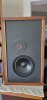
The testing is going on with other speakers in my workshop
20201008_124401.jpg

So now an update
The Dayton caps (as expected) blew the old electrolytic caps out of the park.
So the test subject speakers (Book Shelf) were reconfigured with Dayton 1% caps vs. Mundorf MCapS...
Burn-in and a week of heavy playing were surprising.

There was very little difference between the two speakers...I feel the Mundorf's are ever so slightly smoother, easier to listen to.
Is it because I know they cost more?, so I want to hear something to justify the investment? not sure.

The bottom line (SO FAR...) with the bookshelf speakers, I am just as happy with the Dayton caps.

Now I move on to a pair of BIGGER TEST SPEAKERs...

My EPI M150s that are currently configured with "Human Speaker" woofers (PN: PRO 0001) and Dayton 10mfd, 250V 1% Tol caps.

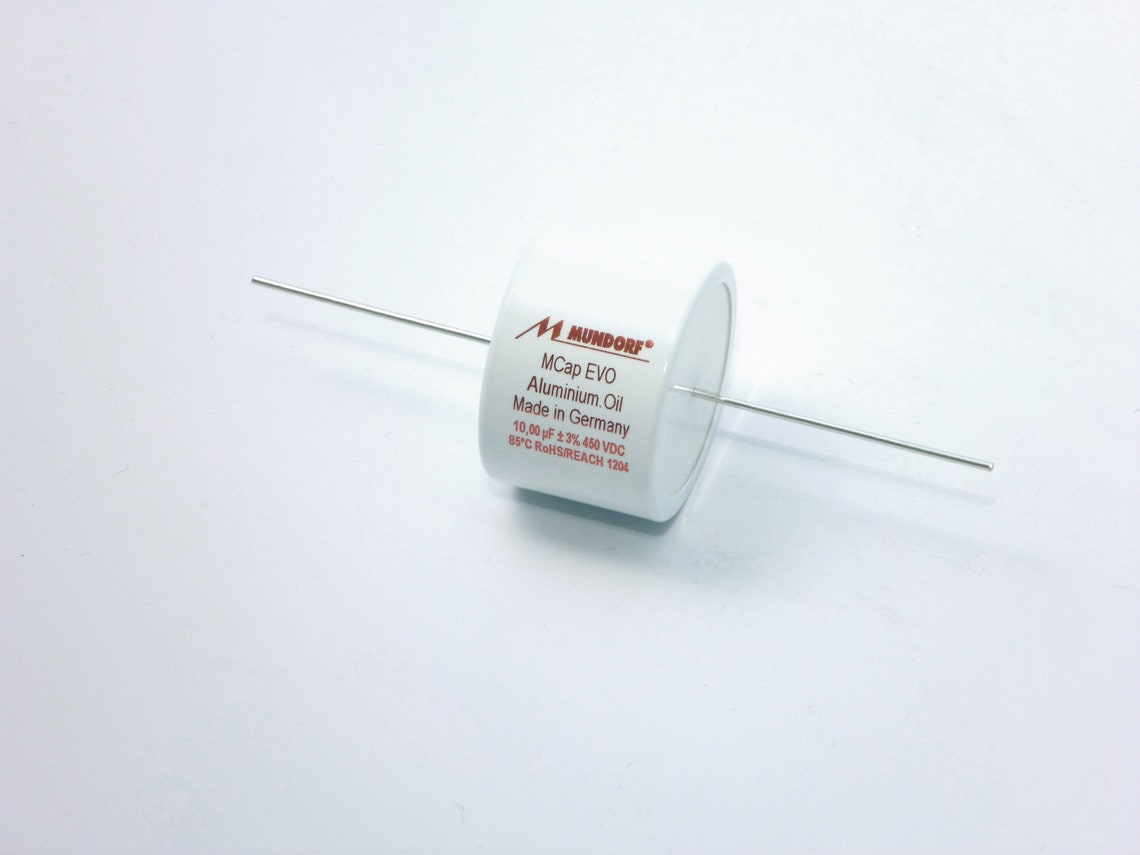
I have a Mundorf MCap Aluminum oil-filled 10mfd 450V 3% Tol capacitor
Hopefully, with a bigger speaker, the differences (if any) might be a bit easier to discern.

20200425_103057.jpg
il_1140xN.1592700830_ltoh.jpg
 
You won't get all of the differences such as soundstage, imaging or even tone by the way you're doing it.
 
What should he be doing differently?

Maybe this will help answer your question. Do you believe it's possible to accurately judge the sound of one brand of speakers using say the right speaker while using a different brand of speaker on the left?
 
You won't get all of the differences such as soundstage, imaging, or even tone by the way you're doing it.

Are you talking about using test equipment to insert tones and take readings?
With the tools at my disposal, I am using my hearing (for better or worst) and aiming for what sounds right. I trust my senses for what sounds right for me... BUT you have piqued my curiosity...
Do I need to build an acoustical listening room?
(my wife hates my hobby already, wait till I come home with acoustical wall panels and foam cones to stick on the walls)
 
Ahh but I am using only one brand of speaker that is set up with only a cap change and comparing channels using the test CD I mentioned earlier in this thread (see responses page 2 of 3). I then play music while spending time with each speaker and comparing what I am hearing. I have my music sources on Vinyl, SACD, DVD Audio, and CD. My room is such that I am able to hear both left and right nuances... (As I said... my wife hates this hobby).
 
Back
Top Bottom