• The move to the new server is done. There are some software and database maintenance updates in process. This has us passing the hat around to help out. We appreciate any donations. Seriously, even a dollar helps. The payment page may be found here - https://www.audiokarma.org/support.html

Do different vendor crossover caps really sound all that different?

Which speaker Crossover Capacitors do you prefer


  • Total voters
    78
You clearly have very high faith in audio memory. I don't. I've been fooled/fooled myself too many times to trust my ability to remember sounds. Taking notes might help, but only slightly - language is too imprecise, and fitting sound to available words dresses the actual sensation in prexisting categories.
I suggest one can record the sound in-room with a stereo digital recorder, and compare the sound with a different arrangement or tweak under test. Then compare the two recordings of what the differences are if any, with levels matched between the two cases, of course. That way personal bias is removed, especially if you randomize the recording playback, or name the recorded files with unrelated names to further avoid bias. Then one can say if the differences are real or imagined.

Note, this 'test' shows how strong preconceived-notion bias is.
https://ohmspeaker.com/news/sighted-vs-blind-evaluations-of-audio-gear-part-2/
 
I am not sure that this actually is a complete solution - it makes it easier to compare quickly, which is a real advance, and (I assume) to look at frequency response graphs, which ought to help identify differences. But there will be those who reject digitization (particularly if the results are not what they expected) and there is still the problem of correlating short term audio memory and long term satisfaction.
Amusing article...
 
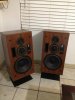
I have two pair of this speaker. MCS 8229 from the early 80s. One pair has Dayton precision 1% ones. 60uf, 18uf and a 2.2uf. The other pair has Clarity CSA caps for the 18uf and 2.2uf and a Solen 60uf. When A/B the pair I noticed that Clarity Caps have a little more detail and separation. Not night and day but noticeable on some excellent recordings. If I listen to one pair one day then wait a week then listen to the other pair, I can't say I would notice the difference as easily. After a long session I probably would. Anyway, my 2 pennies. Here's a stock photo of speakers...21244430.jpg
 
Yes, I am looking for a mate for the AR-28s.

The testing is going on with other speakers in my workshop
View attachment 2202630

So now an update
The Dayton caps (as expected) blew the old electrolytic caps out of the park.
So the test subject speakers (Book Shelf) were reconfigured with Dayton 1% caps vs. Mundorf MCapS...
Burn-in and a week of heavy playing were surprising.

There was very little difference between the two speakers...I feel the Mundorf's are ever so slightly smoother, easier to listen to.
Is it because I know they cost more?, so I want to hear something to justify the investment? not sure.

The bottom line (SO FAR...) with the bookshelf speakers, I am just as happy with the Dayton caps.

Now I move on to a pair of BIGGER TEST SPEAKERs...

My EPI M150s that are currently configured with "Human Speaker" woofers (PN: PRO 0001) and Dayton 10mfd, 250V 1% Tol caps.

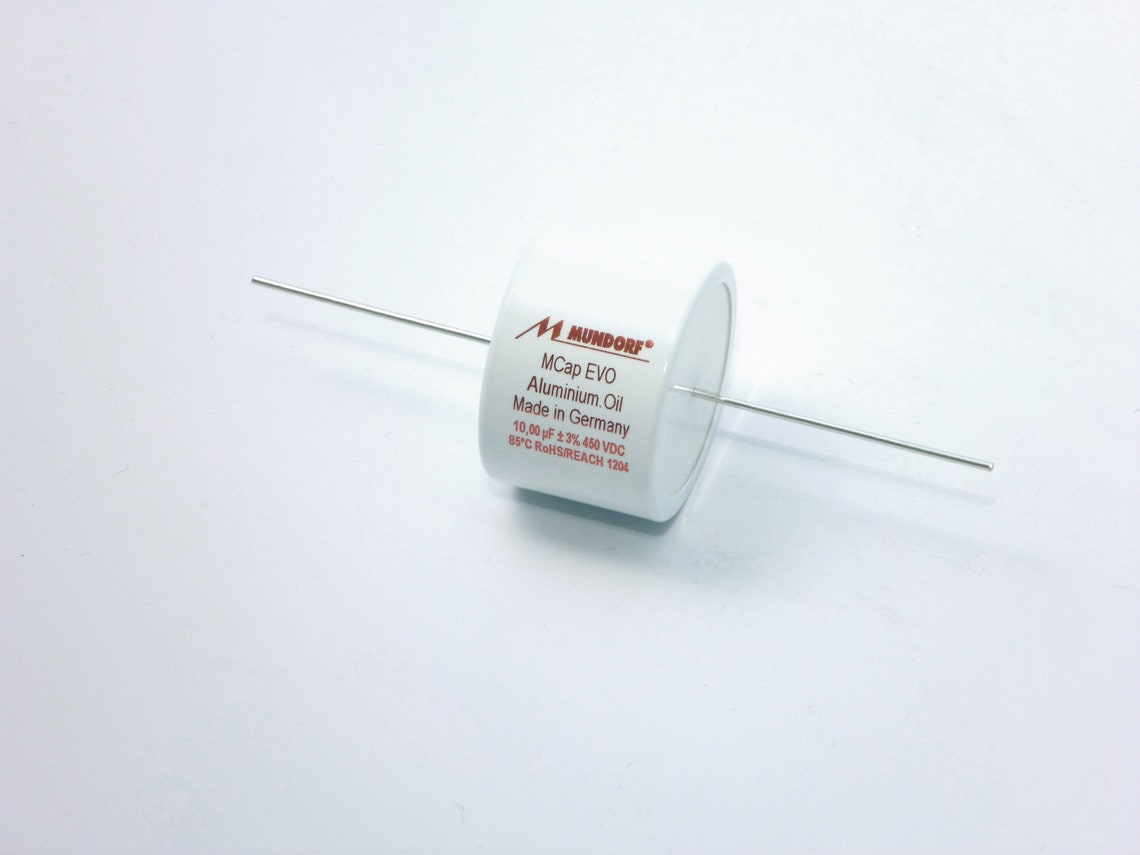
I have a Mundorf MCap Aluminum oil-filled 10mfd 450V 3% Tol capacitor
Hopefully, with a bigger speaker, the differences (if any) might be a bit easier to discern.

View attachment 2202698
il_1140xN.1592700830_ltoh.jpg
So I'm seeing this two years later while searching for different capacitor replacement reviews. In fact I'm re-placing the single 10 uF cap in EPI's also, which one would think would have the most direct change [if any] - as compared to a more complex crossover. Can you update the results using the Mundorf MCap Oils? Also any other caps that were tried in EPI crossovers? Thanks
 
Since different manufacturers use different materials and construction methods in their caps, even in their own lines, it is impossible for all of them to sound the same and in fact, they don't.
I’m still going with no.
Put severely sets of the same speakers side by side using different caps of the same value and listen for any difference. There may be slight differences that are completely unnoticeable to the human ear.
 
I’m still going with no.
Put severely sets of the same speakers side by side using different caps of the same value and listen for any difference. There may be slight differences that are completely unnoticeable to the human ear.
Your comments indicate you do not have any personal experience with different brands of caps.
 
I’m still going with no.
Put several sets of the same speakers side by side using different caps of the same value and listen for any difference. There may be slight differences that are completely unnoticeable to the human ear.

What can be heard is a variable that depends on several other variables. Differences between mediocre electrolytic caps and excellent poly caps should be plenty audible in a speaker crossover if you give it time and listen on a high resolution system...not night and day, but easily detectable. The differences between better caps gets more subtle, but should still be audible....it's just often harder to detect and you need to listen for a while.

It only takes one link in the system chain to mask subtle differences. If there are several links masking the differences, it's gets very difficult. The speakers themselves and the crossover design can hinder comparisons if either have issues. Source music is critical in comparisons like these too. If I may ask, what's in the rest of your system and what music are you playing when comparing?
 
Last edited:
Seems to me there is an important difference between 'is it audible?' and 'does it make enough of a difference to be worth the expense?'. Some of the fancy caps cost more than the speakers they are put into are worth - no idea how much a Mundorf MCap Oil costs, but I had a hard time selling a pair of (unrecapped) EPI 100s at an Audio Karma fest - I ended up selling them for thirty bucks. Granted, AKers are cheap - we already have more stuff than we need - but I paid much less than that for the pair (even with my refoaming them). So spending more than that on a cap isn't likely to make sense to me. I'd rather buy a better pair of used speakers with the money saved by using inexpensive caps.
F1nut and I often disagree, but I think he has a point in saying that different construction leads to different sound. We aren't on the same page as to the importance of that difference - clearly ultimate audio quality matters more to him than it does to me. And that is fine - each of us has a different calculus for for what matters, and how much it matters.
If you want to spend lots of money seeing how good a pair of speakers can sound given a DOD or NASA budget, please go ahead - it will be useful information for us cloth ears. But don't be surprised if we factor in confirmation bias in evaluating your reports.
 
IMHO, for older speakers I like the Evo oils. I have a pair of Wharfdale W70Ds that I originally recapped with Audyn Q4s, even after breaking them in they didn't sound much better than the caps I pulled out. I recapped them with the Evo Oils and some Russian KBG caps for the larger values. the difference was night and day. I have a pair Of KLH 6s that I need to do, and will probably use the Evo Oils. For newer speakers I like the Clarity PX caps. I've used them in a pair of Snell K IIs, Polk Monitor 7s and DCM TF350s, good results all around.
 
Do different vendor crossover caps really sound all that different?

Well, not so much, or not significantly to my ears - but there can be exceptions, as usual !

upload_2023-6-13_1-45-48.png

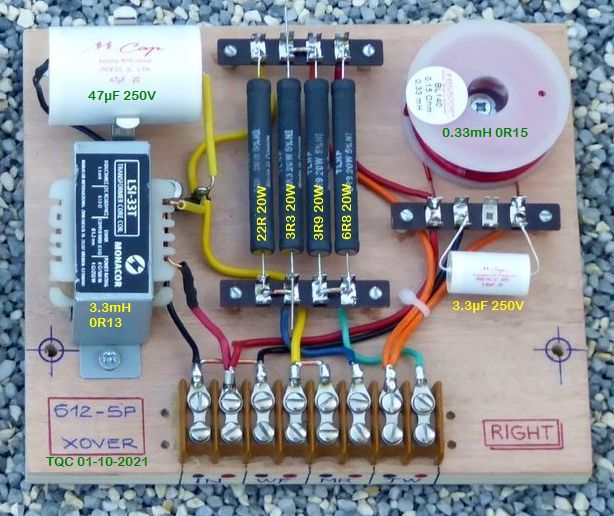
Usually, I use the basic MUNDORF M-CAP series : they are mighty fine enough for me...

rPz6Mb-FILTRE-6-12-S-P-01-10-2021-TQC.jpg


But it's me, OK ? :biggrin:;)

T
 
If you aren’t hearing a difference between different caps, you may need to buy better speaker cables. That will surely expose the sound differences. :biggrin:

All kidding and pot stirring aside, I have 3 sets of KLH Sixes. Each set has been recapped with different capacitors. 1- with Dayton poly caps, 1- with the Russian surplus poly caps (I can’t remember the series at the moment) and 1- with Auricap XO caps. I can say with 100% certainty that they all sound a bit different. I probably couldn’t pick which was which in a blind test, but they all have unique characteristics. My personal favorite (the one I listened to the longest) was the Auricap XO. They sounded amazing to me, and made me question the value of some very expensive speakers. Of course, this is my opinion only.
 
I have seen many make comments about caps altering the sound a lot, by some, AND consequently seen quite a few also claim they make very little to no difference in the actual sound.

What I have NOT seen, is anything Verifiable and/or documented about a listener actually showing or demonstrating "for sure" they can tell differences between cap brands and so on.

So we are into the realm of audio forum anecdotes and bickering.
Until I see more concrete evidence, my findings and most I read, simply do not back up the claims.
 
I have seen many make comments about caps altering the sound a lot, by some, AND consequently seen quite a few also claim they make very little to no difference in the actual sound.

What I have NOT seen, is anything Verifiable and/or documented about a listener actually showing or demonstrating "for sure" they can tell differences between cap brands and so on.

So we are into the realm of audio forum anecdotes and bickering.
Until I see more concrete evidence, my findings and most I read, simply do not back up the claims.
Do you have verifiable and/or documented evidence that a listener cannot tell the differences between cap brands?

I mean, you just saying you can't carries no weight according to you yourself.
 
Do you have verifiable and/or documented evidence that a listener cannot tell the differences between cap brands?

I mean, you just saying you can't carries no weight according to you yourself.
There is legend of a group that did a blind test at the end of a demonstration or such and listeners could not detect differences. I have read mentions of this test but no details as to which caps were compared, speakers involved, etc. Perhaps someone with direct knowledge will post here. In the mean time I will not hold my breath nor buy cheap caps for good speakers.
 
Back
Top Bottom