

You are using an out of date browser. It may not display this or other websites correctly.
You should upgrade or use an alternative browser.
You should upgrade or use an alternative browser.
Do two 6" woofers = one 12" woofer ?
- Thread starter hpm40
- Start date
Register to hide this ad
In short - No.
Cone area of 2 x 6" speakers is about 56.6 square inches.
Cone area of 1 x 12" speaker is about 113 square inches.
The 2 6" speakers will have to move twice as far in the same amount of time to match the 12" speaker with no overshoot.
That's why large diameter drivers tend to present a bass sound that is deep and relaxed.
Cone area of 2 x 6" speakers is about 56.6 square inches.
Cone area of 1 x 12" speaker is about 113 square inches.
The 2 6" speakers will have to move twice as far in the same amount of time to match the 12" speaker with no overshoot.
That's why large diameter drivers tend to present a bass sound that is deep and relaxed.

Edit: you need a pair of 8" to roughly match the area of a 12"
The cone surface area is about the same but most 12" woofers have frames that allow more Xmech making
them more capable of handling overload. But an 8" built with the same Xmax and Xmech and combined
T&S parameters should perform the same.
The typical HiFi 12" usually has lower Fs as compared to an 8" woofer but just about anything can be custom built.
The cone surface area is about the same but most 12" woofers have frames that allow more Xmech making
them more capable of handling overload. But an 8" built with the same Xmax and Xmech and combined
T&S parameters should perform the same.
The typical HiFi 12" usually has lower Fs as compared to an 8" woofer but just about anything can be custom built.

Sitka
Active Member
if you have small speakers ( anything under 12" IMO ) most likely you need a sub. My speakers are large, 15" - haven't used my sub for a long time. Everyone is different, and of course the room will dictate what works best.Thank you Pete B.
Generally speaking, do most folks get their bass from a subwoofer rather than larger drivers in their speakers... or the opposite ?

Displacement is bore X stroke. I see the ever wise Pete B has discussed the stroke thing and the ability of the larger driver to have more of it.

Lavane
Lunatic Member
Using multiple smaller midbass drivers with a passive radiator can produce some deep bass. I have a pair of Polk monitors with dual 6" midbass drivers and a passive radiator. They can dig down to 29hz. I've never felt the need for a sub with these speakers. The passive radiator delivers decent bass with good impact. The bass is tighter than any of my ported speakers with a larger single woofer. Kick drums especially can sound very realistic.
Adding a passive radiator does take more thought when designing the speaker though.
Adding a passive radiator does take more thought when designing the speaker though.
Attachments

Displacement is bore X stroke. I see the ever wise Pete B has discussed the stroke thing and the ability of the larger driver to have more of it.
Nice car analogy, in speaker talk we call it volume displacement (VD) and it is Xmax times SD (cone surface area).
Thank you Pete B.
Generally speaking, do most folks get their bass from a subwoofer rather than larger drivers in their speakers... or the opposite ?
It depends on your goals. If you requirement is to play pipe organ (16Hz), synth, or home theater (HT) effects
then you probably need a large and capable subwoofer. Otherwise, the lowest note on a grand piano is about
28 Hz and as people have noted there are reasonably sized systems that will reach that low. My favorite that
easily play 28 Hz at room shaking levels is the PSB Stratus Gold, 10" woofer in a big box, port tuned to 28 Hz.
I've compared these to a pair of Advents and the PSB s will play about 9 dB louder, fairly cleanly, than the
sealed Large Advents.
Some huge floor standers with a pair of big woofers act almost as good as a sub, not always.
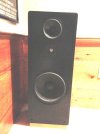
If I were designing a similar 3-way to the PSB s I'd use a 12" woofer just for a bit more headroom, in fact I have
done it in the past. Sorry, the friend I did it for took the not so good picture:
I've never documented this build that was done in the 1990s but I spoke to the friend who has them and he says
that he will never sell them. They're built in Madisound premade boxes. We copied the PSB crossover, with the
air core woofer inductor replaced with a low DCR Sledgehammer also from Madisound to make up for the less
efficient 12" woofer substitute and we put Lpads on the mid and tweeter to also compensate:
Attachments
Last edited:

Sgt Shultz
Addicted Member
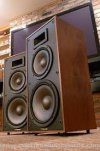
When I auditioned the Klipsch KG3.2 speakers for my brother in law there were two 12" subs in the room, he asked me to turn them off.......they weren't on lol. Passive radiators can be very effective.

My experience are subs reinforce the bass and extend it. Most importantly, subs fill the room more evenly. Actually, can make the rest of the spectrum sound in better focus.Thank you Pete B.
Generally speaking, do most folks get their bass from a subwoofer rather than larger drivers in their speakers... or the opposite ?
You know, with the subs on, and no other speakers --- the sound level is not that loud. I have my DIY crossover 6dB/octave around 100Hz.When I auditioned the Klipsch KG3.2 speakers for my brother in law there were two 12" subs in the room, he asked me to turn them off.......they weren't on lol. Passive radiators can be very effective.
View attachment 3015832
But, if you turn the subs off, with the rest of the speakers playing --- big difference. Especially, at mid to lower volumes.

It’s a tradeoff.
The smaller drivers might be able to produce the frequency, but not with enough room-filling dynamics to accurately reproduce the dynamics of some music, in some rooms. So, it depends (as someone above mentioned) a bit on the space you’re filling, it depends on the design of the speaker system, and it depends on the type of music you listen to. True that more small cones with the right Xmax can emulate a single large driver with similar results if done correctly.
Regarding which is better? Again it depends on the above, and there are other tradeoffs also such as producing a large range of sounds at the same time which interfere with each other; IM distortion / doppler distortion, where a cone moving as in a low-frequency (long-slow) excursion while producing higher frequency sounds concurrently will warp the sound much like a siren passing you on the street. This is a deeper discussion, if a 2-track direct mic’ed recording then the mics had this same effect imparted into the source material and a single full-range speaker would in theory decode this, ... but I digress.
The subwoofer OTOH, and multi-way passive crossovers create phase-shift and overlap, also potentially smearing the imaging. More crossovers means more possibilities for this to occur and where it is vs the particular instrument / voice will determine how significant the effect is. Also, it is difficult (and not extremely common) to properly set up a subwoofer without a way to high-pass the main speakers properly, so although the subwoofer usually adds bass, it is more of comfort food than real nutrition. The phase-shift at a crossover point where subwoofers reside is however really not significant in imaging (or anything else really). A well-integrated subwoofer does solve several problems.
I do agree that the Stratus Gold are surprising speakers and will produce bass beyond what is expected from them. Paul Barton did some excellent work on those.
The smaller drivers might be able to produce the frequency, but not with enough room-filling dynamics to accurately reproduce the dynamics of some music, in some rooms. So, it depends (as someone above mentioned) a bit on the space you’re filling, it depends on the design of the speaker system, and it depends on the type of music you listen to. True that more small cones with the right Xmax can emulate a single large driver with similar results if done correctly.
Regarding which is better? Again it depends on the above, and there are other tradeoffs also such as producing a large range of sounds at the same time which interfere with each other; IM distortion / doppler distortion, where a cone moving as in a low-frequency (long-slow) excursion while producing higher frequency sounds concurrently will warp the sound much like a siren passing you on the street. This is a deeper discussion, if a 2-track direct mic’ed recording then the mics had this same effect imparted into the source material and a single full-range speaker would in theory decode this, ... but I digress.
The subwoofer OTOH, and multi-way passive crossovers create phase-shift and overlap, also potentially smearing the imaging. More crossovers means more possibilities for this to occur and where it is vs the particular instrument / voice will determine how significant the effect is. Also, it is difficult (and not extremely common) to properly set up a subwoofer without a way to high-pass the main speakers properly, so although the subwoofer usually adds bass, it is more of comfort food than real nutrition. The phase-shift at a crossover point where subwoofers reside is however really not significant in imaging (or anything else really). A well-integrated subwoofer does solve several problems.
I do agree that the Stratus Gold are surprising speakers and will produce bass beyond what is expected from them. Paul Barton did some excellent work on those.

Quadman2
Lunatic Member
Would not two smaller cross-overs with the same innards produce the lowest frequency allotted to them, while as the larger sub woofer might have a lower range to draw upon? Pete B kinda hinted at this with his reference to "pipe organ" application.
With two smaller subs, the amplitude might be increased, more so than the one larger...but not sure of this.
Then there's the design of two different speakers, with one being more efficient than the other?
Above my pay-grade knowledge base!
Q
With two smaller subs, the amplitude might be increased, more so than the one larger...but not sure of this.
Then there's the design of two different speakers, with one being more efficient than the other?
Above my pay-grade knowledge base!
Q
Last edited:

JeffMackwood
Member
I agree completely.Also, it is difficult (and not extremely common) to properly set up a subwoofer without a way to high-pass the main speakers properly
I've been talking and posting about "proper bass management" for years. "Proper" includes the use of a HPF.
Not saying one can't get good results without its use; just that the results are almost always much better when one is used.
At least that's been my own experience with many systems, past and current, using one, two, or even four subs.
Jeff
Lavane
Lunatic Member
I've had people ask if my sub was on since its not booming. It's connected to a second pair of speakers. Once it's turned off it's very noticable.My experience are subs reinforce the bass and extend it. Most importantly, subs fill the room more evenly. Actually, can make the rest of the spectrum sound in better focus.
The trick is to get your sub to mesh with your mains at the right frequency and level. I have the sub in my Jeep Wrangler set the same way.
Sgt Shultz
Addicted Member
You know, with the subs on, and no other speakers --- the sound level is not that loud. I have my DIY crossover 6dB/octave around 100Hz.
But, if you turn the subs off, with the rest of the speakers playing --- big difference. Especially, at mid to lower volumes.
I have 5 subwoofers, I'm a fan, been incorporating them for around 5 decades lol.
My comments were concerning the effectiveness of passive radiators with smaller bass, mid/bass drivers.
That helps a lot. Seamless. You do not want boomy bass. Subs or no subs.I've had people ask if my sub was on since its not booming. It's connected to a second pair of speakers. Once it's turned off it's very noticable.
The trick is to get your sub to mesh with your mains at the right frequency and level. I have the sub in my Jeep Wrangler set the same way.
I'm using the same JBL woofers (136A) in my subs as in my main speakers. So, their sonic signature is pretty similar. All four recently had new surrounds, re-magnetized. Crossovers checked and gone through.
Focal 12 subs are nice, modern made units.