
Setup correctly, I bet you never would know there are 5 woofers playing at the same time. It's kinda magical how the mid and high imaging is way better with subs.I have 5 subwoofers, I'm a fan, been incorporating them for around 5 decades lol.


Setup correctly, I bet you never would know there are 5 woofers playing at the same time. It's kinda magical how the mid and high imaging is way better with subs.I have 5 subwoofers, I'm a fan, been incorporating them for around 5 decades lol.

Setup correctly, I bet you never would know there are 5 woofers playing at the same time. It's kinda magical how the mid and high imaging is way better with subs.

Your right, the passive radiators can be very effective. Once you get used to the tighter bass, and it doesn't take long, ported speakers can sound kind of boom or flabby after in comparison.I have 5 subwoofers, I'm a fan, been incorporating them for around 5 decades lol.
My comments were concerning the effectiveness of passive radiators with smaller bass, mid/bass drivers.
I will add, I have read some concerning using multiple smaller midbass drivers. They can cause a combing effect in the midrange with them being horizontally mounted from what I've read. But I don't notice anything off myself with these Monitor 10's. But Polk did build crossovers that set the crossover points different between the two drivers in the Monitor 11's and bigger 12's that supposedly took care of this problem. So the speakers then had to be marked left and right.I have 5 subwoofers, I'm a fan, been incorporating them for around 5 decades lol.
My comments were concerning the effectiveness of passive radiators with smaller bass, mid/bass drivers.

I like one driver per frequency range. Monitor 7BI will add, I have read some concerning using multiple smaller midbass drivers. They can cause a combing effect in the midrange with them being horizontally mounted from what I've read. But I don't notice anything off myself with these Monitor 10's. But Polk did build crossovers that set the crossover points different between the two drivers in the Monitor 11's and bigger 12's that supposedly took care of this problem. So the speakers then had to be marked left and right.

The 7's are the the much better balanced speaker in the Monitor line.I like one driver per frequency range. View attachment 3015989g

Your right, the passive radiators can be very effective. Once you get used to the tighter bass, and it doesn't take long, ported speakers can sound kind of boom or flabby after in comparison.
I run two DIY's in the main. 2 Focals subs in one car.LOL, they're not all in the same room, I like running twin subs in stereo.

Only a single 10" sub in my Jeep. Its just so small of a cab and space and the space behind the rear seat is limited. Plus I need some room for some recovery gear like tow straps, tree straps, snatch block, etc. The little 300 watt sub amp I'm using is plenty big enough and doesn't take up much room at all.I run two DIY's in the main. 2 Focals subs in one car.
Thanks everyone for your input, this is a great discussion. I understand the bore and stroke analogy relating to the original question.
Am I reading correctly.... do some of you actually make your own speakers and subs ? I know there are many people who understand these things but it's always been over my head. But I find it very interesting.
Are passive radiators mostly in high-end speakers ?

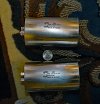

It's part of a crossover system. I have a passive crossover to filter out frequencies above 100Hz.I'm not understanding a capacitors function in a speaker or sub. I'm familiar with capacitors in an electric motor... in that it releases a large amount of energy to help get the armature turning especially under load.


I get really tired of the claim that any particular design is better or worse at bass, they are all good or bad based on how well executed the design is.
I have several ported that would be impossible to tell without either removing the grill (front ported) or turned around (rear ported), no flabby bass, it's all in the implementation.Your right, the passive radiators can be very effective. Once you get used to the tighter bass, and it doesn't take long, ported speakers can sound kind of boom or flabby after in comparison.


I have portend speakers that aren't boomy either. But so many were.I have several ported that would be impossible to tell without either removing the grill (front ported) or turned around (rear ported), no flabby bass, it's all in the implementation.
One of my favorite inexpensive smaller speakers I've given to several family members or friends (one of these days I'll keep a pair for myself) is front ported.
Infinity RS-325
View attachment 3016238
Very nice.I wish I had taken a picture- but once, I designed and assembled a giant cube sub- a 26" cube, with a JBL 2245H 18", a custom 18" passive radiator (with about 1.5" of excursion), and a 500 watt plate amp with parametric EQ.
It would make plate glass windows move so much at 20Hz, that one would start to worry about shattering the glass.
That's a passive radiator.
I also built this- and fortunately, DID take pictures:

The woofers in that, were TC Sounds 10" with 18mm X-max each.
On the rear, were THREE identical-looking drivers- 10" TC Sounds passive radiators of the same design, with 30mm max linear excursion, in each direction.
It also had a 500 watt plate amp in it.
Due to the higher X-max- each one of these, would do everything that JBL 18 with passive radiator sub would do, but all the way down to 16Hz. And remember- there's a STEREO PAIR of these...
Regards,
Gordon.
