• Please note that Audiokarma will be offline briefly for updates early on Monday morning, September 28th.

Do two 6" woofers = one 12" woofer ?

There is a right sized driver for an ideal efficient frequency response.
1. 2inches and under=tweeter
2. 3-4 inches=midrange.
3. 5-8 inches=mid-bass
4. 10inches and up=woofer bass/sub bass.

Two 6inch woofers=a lot of "MIDBASS" as that is there ideal frequency response at which they are the most efficient. Although they can play lower into the bass range they will be less efficient then a 12inch driver of equal quality.
 
A generalization, and only sometimes accurate.

As I’ve owned multiple examples of every type of speaker except plasma in my many years of audioholicism, I can say that there are plenty of “one-note-bass” examples in every type of cone-in-box design, and also plenty of excellent and accurate bass.

Since there is no spec for “tight bass” nor “flabby bass”, it is hard to quantify claims, and usually they’re either a bad design or a bad amplifier-speaker pairing.

I get really tired of the claim that any particular design is better or worse at bass, they are all good or bad based on how well executed the design is.

Agreed, regarding execution of the design being the key.

IMHO, the best sounding two sets of speakers I've heard, IMHO, are the Von Schweikert Audio Ultra 11, and the new Ultra 7.

The Ultra 11 is a totally sealed design, with very large woofers (15"), in a huge cabinet.

The Ultra 7 has a multitude of smaller woofers (9"), in a more moderate size vented cabinet (albeit, not tuned in a "textbook" vented alignment- they are a vented design, which uses the output of the port to extend the low bass response, like almost all other vented designs).

In this case- it's the EXACT SAME company, using two different designs, to reach the same goal- state-of-the-art levels of sound quality. And both do!

Regards,
Gordon.
 
There is a right sized driver for an ideal efficient frequency response.
1. 2inches and under=tweeter
2. 3-4 inches=midrange.
3. 5-8 inches=mid-bass
4. 10inches and up=woofer bass/sub bass.

Two 6inch woofers=a lot of "MIDBASS" as that is there ideal frequency response at which they are the most efficient. Although they can play lower into the bass range they will be less efficient then a 12inch driver of equal quality.

The VSA E5 had four 7" woofers- and would play with very low distortion, into the low 20s. A very well done vented design, that could fill up ANY residential space, pretty much. It would be difficult to find a domestic room, that would be TOO big for them to drive with great dynamic response- and without requiring absurdly large amps, either.

The older EPI M200 would, in room (I've measured it!)- with a single 8" woofer and a 12" passive radiator- would play into the LOW 20s, again, with great dynamics.

I just got a chance to hear the new Acoustic Signature AE520 speakers- triple 5.5" woofers. I was astonished at how MUCH OUTPUT this system could play, and how low it could go. Into the high 20s (probably about 28Hz in room!), at concert levels (to volume levels that made it difficult to talk to someone in the same room), in a room that was 15x22 feet, with an 11 foot ceiling, open to other rooms on three sides. On an amp, that is only rated at 85 watts per channel (VAC Sigma 170iQ).

As a final example- in my truck- I have a small bandpass subwoofer enclosure, with a SINGLE 6.5" driver, that I custom built. In that space, it's FLAT down to 22Hz, and has almost flat response down to 16Hz. And will do that at levels, that will literally make the mirrors and windows shake, if desired. On an amp, that is only about 120 watts. In that small space, it's enough for any driving conditions.

As was mentioned before- drivers can be custom-ordered and engineered to do whatever is needed. Once you get enough of them to reach the cone area and excursion needed (volume displacement), it really doesn't matter whether it's one big woofer, or multiple smaller ones...

Regards,
Gordon.

 
I have several ported that would be impossible to tell without either removing the grill (front ported) or turned around (rear ported), no flabby bass, it's all in the implementation.

One of my favorite inexpensive smaller speakers I've given to several family members or friends (one of these days I'll keep a pair for myself) is front ported.

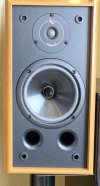
Infinity RS-325
View attachment 3016238

I completely agree about the Infinity RS-325.
Ported, but not boomy or flabby bass. I provided a stereo to my baby sister with a pair of these. They fill her large living room with great sound. I also maintain a pair for myself...freshly re-foamed.

I also employ a 12" inch sub...but very happy with the 6.5" implementation in the 325's.

Attachment-1.jpeg
.
 
I completely agree about the Infinity RS-325.
Ported, but not boomy or flabby bass. I provided a stereo to my baby sister with a pair of these. They fill her large living room with great sound. I also maintain a pair for myself...freshly re-foamed.

I also employ a 12" inch sub...but very happy with the 6.5" implementation in the 325's.

View attachment 3016566
.

The blonde oak cabinets are really nice, the black ashe vinyl not so much.

The last pair I purchased about 6yrs ago blonde oak new in box still sealed, $130, my middle son has them.
 
I've noticed that some companies still make large floor speakers with 12-15" woofers... JBL and Cerwin Vega to name a couple. Generally speaking, can a tower speaker with two 6" woofers make as much bass sound and feel as one 12" woofer ?
Nope. Two 6-inch circles do not have as much area as one 12-inch circle has, and all other things being equal, the larger area can generate more output for the same excursion. Also, the 12-inch driver will usually have a large Xmax than a 6 incher does.
 
Nope. Two 6-inch circles do not have as much area as one 12-inch circle has, and all other things being equal, the larger area can generate more output for the same excursion. Also, the 12-inch driver will usually have a large Xmax than a 6 incher does.
It all about moving air, in phase with the music. Blending it and enhancing. Not overwhelming.

Many ways to skin this cat. I like big speakers. :thumbsup:
 
The VSA E5 had four 7" woofers- and would play with very low distortion, into the low 20s. A very well done vented design, that could fill up ANY residential space, pretty much. It would be difficult to find a domestic room, that would be TOO big for them to drive with great dynamic response- and without requiring absurdly large amps, either.

The older EPI M200 would, in room (I've measured it!)- with a single 8" woofer and a 12" passive radiator- would play into the LOW 20s, again, with great dynamics.

I just got a chance to hear the new Acoustic Signature AE520 speakers- triple 5.5" woofers. I was astonished at how MUCH OUTPUT this system could play, and how low it could go. Into the high 20s (probably about 28Hz in room!), at concert levels (to volume levels that made it difficult to talk to someone in the same room), in a room that was 15x22 feet, with an 11 foot ceiling, open to other rooms on three sides. On an amp, that is only rated at 85 watts per channel (VAC Sigma 170iQ).

As a final example- in my truck- I have a small bandpass subwoofer enclosure, with a SINGLE 6.5" driver, that I custom built. In that space, it's FLAT down to 22Hz, and has almost flat response down to 16Hz. And will do that at levels, that will literally make the mirrors and windows shake, if desired. On an amp, that is only about 120 watts. In that small space, it's enough for any driving conditions.

As was mentioned before- drivers can be custom-ordered and engineered to do whatever is needed. Once you get enough of them to reach the cone area and excursion needed (volume displacement), it really doesn't matter whether it's one big woofer, or multiple smaller ones...

Regards,
Gordon.
You just proved my whole point. No single 6inch driver will be as efficient as a single 12 inch driver when it comes to low end extension and output because that is not there ideal frequency range. I never said multiple small drivers cant reach down low but it wont be as efficient if you used multiple large drivers because once again large drivers ideal frequency response is to be able to play lower with more efficiency then smaller drivers. Pound for pound when comparing drivers of equal quality a single small driver cannot beat a single large driver in terms of low frequency response and output. For a smaller driver to equal a larger driver in LF you would have to COMPENSATE and use multiple smaller drivers just to equal a larger driver. This just proves a small driver is not ideal for LF.

Imagine if all the speakers you mentioned above were replaced with a larger driver and or multiple larger drivers they would be able to extend even lower with higher efficiency and output.

If you look at flag ship models of most hi end audio speakers most of them are using multiple LARGE drivers because once again multiple large drivers will beat multiple small drivers.

If you look at old school speakers they used big drivers as large as 15inch was common. The reason the drivers got smaller as time went by is not because they are better its because of aesthetics and people living in smaller homes/apartments. This is why the satellite/subwoofer combo became popular.

Again there is an ideal sized driver for an ideal frequency response.
 
Last edited:
It's all in the implementation. I auditioned a pair in 1991 and they rattled the stores plate glass windows and everything on the shelves, their flagship at the time.

Definitive Technlogy BP-20 bi-polar floor stand tower speaker pair

Specifications:

Recommended Amplifier Power: 20 - 500 watts/channel
Frequency Response: 18 Hz - 28 kHz
Efficiency: 90 dB
Nominal Impedance: 6 ohms
Drivers: a) Four 6.5” Cast-Magnesium Basket Bass-Midrange Drivers (two front-side/two on back-side)

b) Two 1" Silk Fabric Dome Tweeters (one on front-side/one on back-side)

Finish: Piano Gloss Black with Wraparound Black Grill Cloth
Magnetically Shielded
Cabinet: Solid Non-Resonant, Monocoque, Low-Diffraction
Bi-wireable
Dimensions: 9" W x 15" D x 46" H
 
Last edited:
You just proved my whole point. No single 6inch driver will be as efficient as a single 12 inch driver when it comes to low end extension and output because that is not there ideal frequency range. I never said multiple small drivers cant reach down low but it wont be as efficient if you used multiple large drivers because once again large drivers ideal frequency response is to be able to play lower with more efficiency then smaller drivers. Pound for pound when comparing drivers of equal quality a single small driver cannot beat a single large driver in terms of low frequency response and output. For a smaller driver to equal a larger driver in LF you would have to COMPENSATE and use multiple smaller drivers just to equal a larger driver. This just proves a small driver is not ideal for LF.

Imagine if all the speakers you mentioned above were replaced with a larger driver and or multiple larger drivers they would be able to extend even lower with higher efficiency and output.

If you look at flag ship models of most hi end audio speakers most of them are using multiple LARGE drivers because once again multiple large drivers will beat multiple small drivers.

If you look at old school speakers they used big drivers as large as 15inch was common. The reason the drivers got smaller as time went by is not because they are better its because of aesthetics and people living in smaller homes/apartments. This is why the satellite/subwoofer combo became popular.

Again there is an ideal sized driver for an ideal frequency response.

Small drivers do allow narrower source width, and narrower baffles.- which has improved imaging, especially at high off-axis angles.

There are many speakers today, to where you can listen OUTSIDE of the speaker pair- to the left of the left speaker, or to the right of the right speaker- and the image will STILL be between the speakers. That was RARELY true- if it really happened at all- with most conventional speaker setups with larger drivers. The exception is things like the Tannoy dual-concentrics- but that's a special case, due to the high frequencies coming out of the center of the woofer- not offset considerably on the baffle. And even those- the larger dual-concentrics- don't quite keep the image between the speakers at high off-axis angles, as well as speakers with narrower baffles and driver array widrh...

Regards,
Gordon.
 
It's all in the implementation. I auditioned a pair in 1991 and they rattled the stores plate glass windows and everything on the shelves, their flagship at the time.

Definitive Technlogy BP-20 bi-polar floor stand tower speaker pair

Specifications:

Recommended Amplifier Power: 20 - 500 watts/channel
Frequency Response: 18 Hz - 28 kHz
Efficiency: 90 dB
Nominal Impedance: 6 ohms
Drivers: a) Four 6.5” Cast-Magnesium Basket Bass-Midrange Drivers (two front-side/two on back-side)

b) Two 1" Silk Fabric Dome Tweeters (one on front-side/one on back-side)

Finish: Piano Gloss Black with Wraparound Black Grill Cloth
Magnetically Shielded
Cabinet: Solid Non-Resonant, Monocoque, Low-Diffraction
Bi-wireable
Dimensions: 9" W x 15" D x 46" H
Then they made the Def Tech model with the built in powered (large driver) subwoofer with passive radiator.
 
Different implementation, things change, the Heresy is now ported.
I am sure there is a reason why the Heresy is now ported. There is a reason why one would use a different implementation. Its because something was lacking in the previous design.
 
I am sure there is a reason why the Heresy is now ported. There is a reason why one would use a different implementation. Its because something was lacking in the previous design.

Or the market went in a different direction, built in powered subs had become popular at the time they made the change, NHT etc.

Either way it doesn't change the fact the BP20 legitimately had subsonic output at levels high enough to rattle commercial plate glass windows with small drivers. And this was the discussion.
 
Last edited:
Or the market went in a different direction, built in powered subs had become popular at the time they made the change, NHT etc.

Either way it doesn't change the fact they BP20 legitimately went to subsonic levels.
It went in that direction because it actually worked. The reason why most manufacturers went away from the built in powered subs is because the AMP would fail way before the drivers.

If that was all what was needed in the BP20 to reach subsonic levels they wouldnt have implemented the built in powered sub with passive radiator.
 
There have been a lot of discussions on many audio forums about the accuracy of Def Techs specs.

And every owner states the BP20 has outstanding deep bass you can feel, shakes their house, the owners that also own models with the built in subs say they compete if not go deeper.

Go read some owner reviews.

I've auditioned them so know from experience not "something I read about a companies general specs" not pertaining to a specific model.

If you have test results showing different please present them.

Done, you have nothing but conjecture, enjoy.


Last edited:
And every owner states the BP20 has outstanding deep bass you can feel, the owners that also own models with the built in subs say they compete if not go deeper.

Go read some owner reviews.

I've auditioned them so know from experience not "something I read about a companies general specs" not pertaining to a specific model.

If you have test results showing different please present them.

Done, you have nothing but conjecture.
Are you assuming I havent heard them? I've auditioned them also so I know from experience.

I personally do not have any test results but others on other forums have tested it and the results show there specs are not accurate and or misleading.

Are you claiming that your experience trumps my experience? Talk about conjecture. :rolleyes: :rflmao:
 
Back
Top Bottom