• The move to the new server is done. There are some software and database maintenance updates in process. This has us passing the hat around to help out. We appreciate any donations. Seriously, even a dollar helps. The payment page may be found here - https://www.audiokarma.org/support.html

Does adding weight to headshell increase tonearm effective mass?

reydelaplaya

Super Member
Ok, first off, I think I made a mistake. Not 100% sure yet, but I do know I misunderstood the tonearm effective mass calculator thing over at VE.

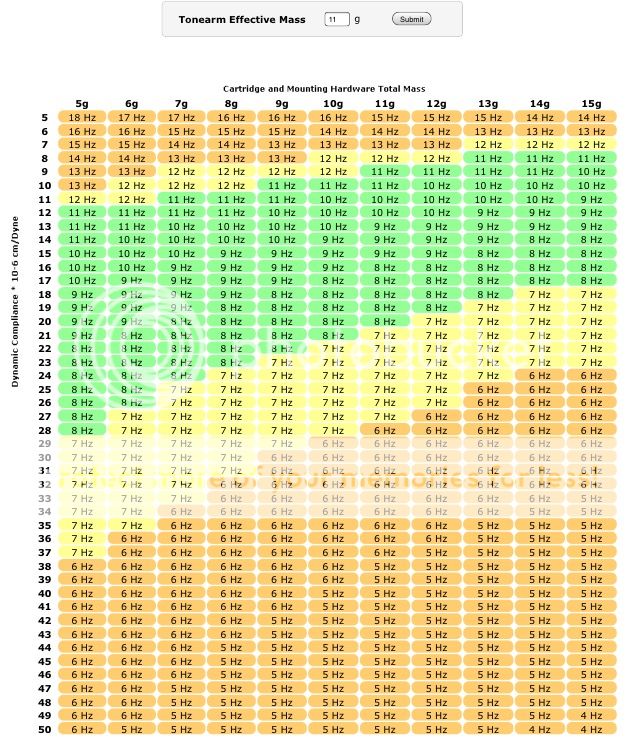
When I was trying to see if the AT95E would work well with the 11g tonearm of the Yamaha P-20 (P-550) I sent my parents for Christmas, I misunderstood what the numbers meant on the left hand, vertical, side of the chart.

Here's a screenshot of the chart for my tonearm, courtesy of VinylEngine.

2021CB69-C3C0-4A98-AB24-CE57B2AEBA6C_zpsk18p6t8i.jpg


The Cartridge weight of the AT95E is 6.5g, and the dynamic compliance is also 6.5 (*10-6...). The tonearm for this line of Yamaha TTs is 11g.

It's already been suggested, and I'm starting to think that, yeah, the Yamaha tonearm may be too light to have the AT95E operate to its potential and may be why my parents are telling me that it seems to mistrack sometimes for no reason - and this is on brand new vinyl. I do know that the table is level, and was set up exactly as it should be, since I was walking my sister's husband through the set-up process over the telephone. And since he does something engineering related in the military, and from having known him for the last 20 years, I know I could count on him to be an OCD perfectionist about it.

So,

I'm exploring options while waiting for Audio Technica to respond to my email I sent yesterday about what tonearm effective mass is best suited for that cart.

If it turns out that the cartridge would be more cooperative with a heavier tonearm, would adding a shim-style headshell weight, then rebalancing, be a viable alternative?

Or am I just going to have to get a different cartridge altogether, and have him send me his headshell so I can mount/align it?

Thanks!
 
Register to hide this ad
Add weight to the headshell. Just adding let's say 3g won't mean the eff mass will be 3g heavier, mabey 2/3 of a g. Add 5 or 6g. You may have to add weight to the rear to get the arm to balance.
 
Add weight to the headshell. Just adding let's say 3g won't mean the eff mass will be 3g heavier, mabey 2/3 of a g. Add 5 or 6g. You may have to add weight to the rear to get the arm to balance.

Thank you, mkane.

Ok, so this is going to be complicated.

I suppose the other thing I can do is just send him my Sonus as a temporary, which is already mounted and aligned on the headshell I have for my P-751. It's the same headshell and tonearm, so the only set-up would be to just re-balance and set VTF. That Sonus works best on light tonearms, and has been working perfectly on mine - never skips, nor distorts. Great sound, too!

You know, I even thought about picking up one of those NOS Sonus to put on it when I was getting it all set up here. But I was reaching the end of my budget, considering shipping costs, and at ~$300, it was just too beaucoup. Especially since all the great reviews of that AT - I thought it was a sure thing. And when I mounted it and tested it here, it sounded great, and didn't mistrack on anything I played to test it.

What I don't get is that the original cartridge on these was a "Yamaha" AT3450. Why should this AT be so vastly different?

I've already ruled out all other environmental factors. Their house has no basement. Their ground floor, where the LR is, is carpeting on padding over a concrete slab. The TT is on a heavy, stable wood cabinet - vibration's not the issue here. Level? It's level - I'm sure of it. I've told dad to use that AT damp velvet brush to make sure that there's nothing on the record that's causing the skipping.

Dammit! Am I going to have to buy a round trip ticket for a 24hour visit to freezing cold DC to go fix this myself?

I hate flying.
 
Adding weight to the headshell does not increase the effective mass of the 'arm, but it does increase the total mass of cartridge+mounting hardware.

The other thing you have to be aware of is that Audio Technica reports compliance at 100 Hz instead of the more common 10 Hz. Although there is no straight conversion factor, a general rule of thumb is to multiply the 100 Hz compliance by 1.5-2 to estimate the 10 Hz compliance. In the case of your AT-95E, the 10 Hz compliance is in the range of 9.75 - 13. You should be perfectly fine running the AT-95E on that Yamaha 'table without adding any additional weight. However, adding a 2 or 3 gram headshell weight would not cause any problems.

Mistracking may be an alignment issue as much as anything else. How was the cartridge aligned ?

Thank you Tedrick.

I aligned the cartridge here before I sent it off. I first used the Yamaha alignment tool to square it up in the headshell. Pictured here, from when I was using it on my Sonus:
48629095-3082-4DED-AB6A-21F61B2282D2_zpslteerawc.jpg


Then checked it with my printed protractor to finish it off. That Yamaha tool, on its own, aligns perfectly with the Loefgren from VE. It's the same alignment I use with my Sonus and my DL-110 and have had great results.

I tested it out here, and it was fine. In fact, it sounded so nice, I've considered ordering another AT95E to put into rotation on my own tables.

I've been thinking while checking around, and I might just go ahead and get another DL-110. I've got an extra headshell for these Yamahas, and I know from many play hours of experience that the Denon plays nicely with this tonearm. I may just order one, mount it here to my spare headshell, send it off to them, and have them send me theirs.

I know I could figure this out in 20 minutes if I was there at their house.

PS: Folks, I apologise if I sound a little annoyed in my posts here. You guys know how excited I was to be sending off this whole set-up to my parents. I'm just disappointed to be hearing from them that it's not working like it should.
 
Tonearm cue lever not descending all the way down on their table all the time? It's silly but sometimes it happens with old cue levers, or if they are not adjusted well (where that is possible). Too little tracking force?
 
Adding weight to the headshell does not increase the effective mass of the 'arm, but it does increase the total mass of cartridge+mounting hardware.

Uhm - what? Actually the weight of the headshell does increase effective mass.

At least it does to a very high percentage, as it's on the front end of the arm - hence headshell, cart and mounting hardware typically simply go into the equation with 100 % of their weight (or weight difference, in case the effective mass would be specified including the stock headshell and possibly also a certain cartridge - Dual for example used to do the latter for a while...). So there usually is already a bit of an error margin due to that. Another, smaller error margin is due to the different counterweight position usually not being considered, either...

Anyway, for those calculators it doesn't really matter, where you put the masses. I.e., if we were using the calculator on VE and had a total effective mass of 15 g, consisting of 2.5 g for the cart, 1 g for screws and stuff, 6.5 g for the headshell and 5 g for the rest of the arm, we could just as well enter 0 g for the effective tonearm mass and look at the 15 g column, enter 10 g for the effective tonearm mass and look at the 5 g column or enter 8 g and look at the 7 g column (or whatever else combination that makes sense for the available 11 columns...). But originally for the VE calculator the total effective mass is intended to be split up into effective tonearm mass (including headshell weight) and cart plus fastener weight. However, the VE calculator can also be used for carts (plus screws...) lighter than 5 g or heavier than 15 g by adding or subtracting its difference from the column one would like to refer to to/from the effective tonearm mass instead.

Greetings from Munich!

Manfred / lini
 
The greatest misconception about effective mass is in it's name. It's not mass at all! It's inertia. It's the tendency of an object to resist changes in its state of motion which varies with mass. Speaking turntables - it's the amount of resistance a tonearm applies to the movements of the stylus in the groove. Ideally, we wouldn't want any of this resistance at all - but in practice somebody just got to keep the stylus in place while the record spins under it. That's the job of the tonearm and just by this simple fact alone we introduce a whole bunch of undesired phenomenons into the equation - one of which is inertia (a.k.a effective mass).

See... The stylus 'wants' to travel (say) to the right b/c the groove takes it there - but, unfortunately, the top of it is attached to the heavy tonearm and it has to drag the entire cumbersome mechanism with it in order to be able to go right. Even more unfortunate is the fact that in relation to the mass of the stylus, the tonearm is a damn tank. Furthermore, by the time the stylus manages to move the 'tank' with it, it now 'wants' to go to the left, becuase that's where the modulation in the groove takes it. But now, it has to fight off the mass of the tonearm that it barely managed to move to the right just a millisecond ago and to overcome the tendency of the tonearm to 'want' to keep moving right. It's a constant battle and the tonearm's mass is translated into 'inertia' which is the force that resists the stylus desire to change direction. The stylus always wants to change directions - the tonearm always doesn't. By how much it doesn't - is called 'effective mass'.

So effective mass in not mass - it's inertia! In fact, even the common measurement (in metric grams) is a misconception. This is brought to you here, by the tonearm manufacturers, as a curtsey to the layman. Effective mass, like any inertia, is measured in Kg/m/s2 (that is kilograms per meter per second squared). Since we're talking very small mass here - everything is divided by 1000 and so we're actually dealing with grams per millimeters per second squared. The general em formula relationships are manipulated such that we're left with grams only - but nevertheless it's Inertia!!!. Keeping that in mind it's easier to regard effective mass for what it is.

Another misconception is the relationship between 'effective mass' and mass. If you add 1 gram to the tip of the tonearm you do not add 1 gram of effective mass to the tonearm No way Jose!. You do not add a 1/3 or a half - none of it catches here. So, how much do you add? Well, that cannot be described in English, it can only be described in a math equation. This is what it looks like:

M(kg) = m(r²/L²) + (Z/3)

m is the counter weight mass
r is the counter weight distance from the pivot
L is the effective length (pivot to stylus tip)
Z is equal to twice the mass of the front end of the tonearm at the effective length. Your headshell mass is part of 'Z'.

M is the effective mass and the whole thing is in kilograms but it doesn't matter. This is just to demonstrate why the relationship between mass and effective mass is not as straight forward as one might think. By now I got a headache from all this math, so lemme try to explain this in another way...

Suppose you got a sports car that weighs one ton. This is one of those real top notch cars where the centre of mass is also the centre of the chassis and it handles wonderfully and makes the babes spin their heads in your direction... Yeah! OK, for some odd reason, you got a date with your 200Kg home safety deposit box. You somehow manage to drag your date, using your kid's skateboard, to your hot shot car and buckle it tight to the passenger's sit, right next to you.

What you've done so far (other than being kinky), is you added 200Kg to your car's mass of one ton so you're handling 1200Kg of a lean mean power machine instead of the spec'ed 1000Kg. In effect, and unwittingly, what you've also done, is change the road handling characteristics of your car. If you now try to take that favourite right curve of yours doing 80mph like you always do, you may notice (with very high likelihood) that your car is not being it self any more, and that it might actually want to go to the left while all at the same time you want it to go to the right. That is because your heavy 'date' has it's 200Kg of inertia and it too wants to stay in the same direction. It does not want to go the right with you! In fact it's resisting your desires and more importantly, the change in motion direction. Now, since your sports car is designed correctly, this may not be as crucial as it seems and you may still survive that curve. However...

One day you just realize there are some things you cannot do with a safety deposit box (that are fun and legal at the same time) and you want a 'real' date. Having such a hot shot vehicle of lust you have no trouble finding a date after you own heart - but being the sentimental turntable type of guy, you sorta don't want to separate with your former love affair and you carry (don't ask me how - it's your car) the heavy box to the boot.

It is still the same 200Kg of steel, only now it's in a strategic location of your car's physics. Your real hot date is in the sit next to you and while driving down-town to that sheik restaurant, you pass that favourite curve of yours in the road and you just can't resist. Can you guess what happens now? I betcha but lemme tell you anyway... The back part of your car has more inertia than the center of mass (because the heavy metal box is in it). That specific part of your car, applies more resistance to the change in direction (centrifugal forces anyone?) than the fron or center of it, and the result is you find the back of your car in front of you. That is not a nice discovery at high speed while in a curve!!! Your car spins and you find your self in an embarrassing position stuck to the back of your date, which is stuck to the front of a tree, while that safety box, you love so dearly, is stuck to back of the both of you. This is not what you had in mind...

OK now... Anyone with a motorcycle and a nervous girlfriend who likes to move too much knows this. Inertia is a force not to mess with when it comes to high speeds, sport vehicles and sharp curves. It is also not a force to mess with when it comes to tonearms.

So what have you done? You've added the same 200Kg to different locations of your car and got totally different behaviours for the same 1200Kg. You changed the mass of your car by 200Kg (20%) - but you did not modify it's inerita (road handling) by the same ratio for both times. Mass matters more at the extremes when it comes to inertia. So when we're dealing with tonearms there's some things to keep in mind:

L (the leverage or effective length) will affect the importance of the real estate the most. In other words - the tip of the tonearm is the most strategic location where mass can affect inertia. Adding just a tiny amount of mass to that specific location might, just as well, be equivalent to the total effect the counterweight has on the effective mass of the tonearm. It's that important! This is where 'r' vs 'm' in the formula kicks in.

Having said that... movements of the counter weight back and forth across the back of the tonearm seldom changes effective mass by any significant amount. It's typically punched in and pre-calculated into the specs of the tonearm and it's a generic part of the given effective mass.

Just the same and more importantly, the effective mass given for a tonearm always comes with a range of recommended cart masses. That range is punched in the spec'ed effective mass. Of course changes in that mass affect the effective mass of the tonearm - that is always true, like lini said earlier. But, here comes the bottom line of this longer than expected post:

If you are exceeding or somehow coming short of the specified range of cartridge masses for a given tonearm you are not only changing mass (weight) and effective mass (inertia) your are also screwing with it! Change is OK and is factored in while screwing with effective mass is not.

Using a penny (1 gram) on a headshell like your daddy, or Thomas Alva Edison or whoever it was that told you to do, is, for all intents and purposes, screwing with effective mass. Cartridge weights, in general, are screwing with effective mass. Those items are reserved for the sole purpose of usage in tonearms with a back center of mass, where extremely light cartridges are the only way to go and you can't find one or don't, rightfully, want to pay for one. So if you don't want to end up stuck to an analog tree - please stay in range!

It is of course mass. And if one adds 1gram to the arm right above the needle, the eff mass increases with 1gram.
 
It is of course mass. And if one adds 1gram to the arm right above the needle, the eff mass increases with 1gram.

this is absolutely the truth-unless you want to quibble about the distribution of the gram in the small area at the effective END of the arm, in which case it might be .9723g or some other practically irrelevant number!
 
Tom: Sorry, but I think you misinterpret this formula by Luckydog you've used. Or in other words: That formula would only cover the contribution of the counterweight (simplified as lump-shaped mass rotating around an axis) and the arm tube (simplified as a thin rod rotating around an axis at one end - and omitting the part on the counterweight side) to the total effective mass. I.e. still missing are headshell (if removable), cart and mounting hardware weight, which would again be simplified as lump-shaped masses - so their moment of intertia would be m x l(eff)², and hence their contribution to effective mass would be (m x l(eff)²) / l(eff)², which simply leaves m. So the headshell mass would only be part of "Z/3", if you can't remove if for weighing the arm tube according to Luckydog's method.

Greetings from Munich!

Manfred / lini
 
First off gentlemen, let me start by thanking both of you for helping understand this whole effective mass thing. I very much appreciate you both taking time to really explain it - that's a lot of writing between the two of you! LOL


Uhm - what? Actually the weight of the headshell does increase effective mass.

[... (removed because exceeded max characters)]

Greetings from Munich!

Manfred / lini

lini, I think I see where you're going with this. Especially when it's added to tnsilver's physics lesson below.

The greatest misconception about effective mass is in it's name. It's not mass at all! It's inertia. It's the tendency of an object to resist changes in its state of motion which varies with mass.

[...(removed because exceeded max characters)]

So if you don't want to end up stuck to an analog tree - please stay in range!

tnsilver, thank you for talking to me in nerdspeak. Physics is one of my 'things', though I tended to focus more on the 'particle' side of it, I do love a nice equation! I'm getting this now, at least a little better than before.

So if I understand correctly, adding, let's say, a 3g shim weight at the headshell and then re-balancing the tonearm to accommodate isn't really going to solve this problem. In fact, it sounds as if, according to the equation, it will actually make things worse since it's already having a difficulties tracking at times anyway.

The only thing I'm still a little off on is why that would be the case since this is how I understand what a weight would do:

Along with the left/right forces the cartridge deals with, there's a vertical force as well. Leaving the adjustable vertical tracking force out of it for the moment, the suspension of the cantilever is designed in such a way to perform with X amount of weight above it, even if it's perfectly balanced weight, in order to prevent it from becoming so springy that it pops itself out of the groove. Adding weight in the headshell, then balancing, then adding the VTF, should give the cartridge enough weight above it to counteract the excessive spring of the cartridge that makes it want to jump up, out of the groove.

Or,

In car terms, why a big vintage Cadillac rides so smoothly on the road. Sure, part of it is a softer suspension, but the other is that it's so much sprung weight, that the suspension just absorbs the vertical forces.

I could be entirely wrong, though. But that is kind of how I understood it.

^
Wow. So well stated. Though my head hurts a little. Must get more coffee and re-read.
Thanks!

Tell me about it! LOL


So, what you all are really saying is that I should've just sent my parents a Teac CD-P650 with USB port like I have, so they can plug their iPads into it and be done with it.

Wow! Still absorbing that equation.

Thanks guys! I really do appreciate this help in understanding this. I'm starting to think that probably the best solution is to go with the Denon DL-110. I think that would cure this in the best way possible.
 
I think effective mass is an effective and technically eloquent way to describe what is going on with the cartridge/tonearm system from a moment of inertia perspective. I also think we can tend to focus a bit too much on measurable aspects that may or may not be affecting the sound. The compliance/effective mass relationship is my favorite in that I can play with the system's resonance point and observe what occurs. Then there's the silicon factor that further complicates this effective mass/compliance dynamic.
 
Last edited:
First off gentlemen, let me start by thanking both of you for helping understand this whole effective mass thing. I very much appreciate you both taking time to really explain it - that's a lot of writing between the two of you! LOL


lini, I think I see where you're going with this. Especially when it's added to tnsilver's physics lesson below.


tnsilver, thank you for talking to me in nerdspeak. Physics is one of my 'things', though I tended to focus more on the 'particle' side of it, I do love a nice equation! I'm getting this now, at least a little better than before.

So if I understand correctly, adding, let's say, a 3g shim weight at the headshell and then re-balancing the tonearm to accommodate isn't really going to solve this problem. In fact, it sounds as if, according to the equation, it will actually make things worse since it's already having a difficulties tracking at times anyway.

The only thing I'm still a little off on is why that would be the case since this is how I understand what a weight would do:

Along with the left/right forces the cartridge deals with, there's a vertical force as well. Leaving the adjustable vertical tracking force out of it for the moment, the suspension of the cantilever is designed in such a way to perform with X amount of weight above it, even if it's perfectly balanced weight, in order to prevent it from becoming so springy that it pops itself out of the groove. Adding weight in the headshell, then balancing, then adding the VTF, should give the cartridge enough weight above it to counteract the excessive spring of the cartridge that makes it want to jump up, out of the groove.

Or,

In car terms, why a big vintage Cadillac rides so smoothly on the road. Sure, part of it is a softer suspension, but the other is that it's so much sprung weight, that the suspension just absorbs the vertical forces.

I could be entirely wrong, though. But that is kind of how I understood it.


Tell me about it! LOL


So, what you all are really saying is that I should've just sent my parents a Teac CD-P650 with USB port like I have, so they can plug their iPads into it and be done with it.

Wow! Still absorbing that equation.

Thanks guys! I really do appreciate this help in understanding this. I'm starting to think that probably the best solution is to go with the Denon DL-110. I think that would cure this in the best way possible.

What adding 3grams of weight will do is just changing the resonant frequency of the arm; it will be slightly lower in frequency, not much else worth noticing.
 
Maybe not for the arm, but there is a marriage between the arm and the cartridge that can't be ignored. That would be compliance. Tnsilver's physics lesson was very good.

I am still in the air about the counterweight. Its on the other side of the pivots and some resonance guys say that it doesn't count in the mass (inertia) equation. I have one Excel spreadsheet that I downloaded from some freebie site that says to properly measure the mass of a tonearm, remove the cartridge, mounting screws and the counter weight. Then with a digital scale, weigh the arm. Tnsilver's explanation kind of dis-qualifies this guy's statements.

'ner (where the sky is always blue (even today)).

But colder then ****.
 
2021CB69-C3C0-4A98-AB24-CE57B2AEBA6C_zpsk18p6t8i.jpg


The Cartridge weight of the AT95E is 6.5g, and the dynamic compliance is also 6.5 (*10-6...). The tonearm for this line of Yamaha TTs is 11g.
Thanks!

Hi,
Don't know if this has been covered. I haven't read all the posts. The compliance of the AT95 is 6.5cu @ 100Hz. The 10Hz cu (for the calculator) is 15.
neo
 
Back
Top Bottom