
• The move to the new server is done. There are some software and database maintenance updates in process. This has us passing the hat around to help out. We appreciate any donations. Seriously, even a dollar helps. The payment page may be found here - https://www.audiokarma.org/support.html

Does NAD Gear Lack Soundstage?

What is sound stage in technical terms? If you have two channels that match in terms of phase, bandwidth and THD (no doubt I'm forgetting something), how can they display any significant difference in sound stage? Asking for a friend, so you don't think I'm a troublemaker. ;)

I have a nice NAD pe receiver, too arthritic to go see which one, and my complaint is that the switches were hard to clean and keep clean, plus it seemed to develop low level noise, for the second time, that I haven't had time to track down. Either a small signal transistor going bad or maybe the switches again. I like things that remain trouble-free for long periods of time and so far this has yet to prove itself. OTOH, I like the look and, working, I was pretty happy with it.
In the end that was one reason why I got away from NAD. My 7140 started to develop problems. The balance/slider control always had static. I would clean it and it would come back. The tuner never lined up properly with a station. Just seems to me like the quality control wasn't really there. Slight hum. Speaker relays needing attention. My other units don't seem to need all of that attention and they are just as old. My MCS 3842 (Technics) is from late 1983 and still works great without any major issues. Recently had to bypass the thermal fuse in the transformer but that was not hard at all. Also I just acquired a nice Technics SU-V707 and I am going to set that up one of these days if I can find a spot for it (it is a bigger unit).

I guess what I am saying is that I was sold on the NAD back in the day when I bought it. It was not cheap either. Over $400, which back in 1988 was quite a bit of cabbage. And now I can find other units that I prefer. The NAD was never a bad unit. I was always happy with it. Until I wasn't...
 
What you are saying is that you avoid the Audio Science Review Forum like a plague.
I don't avoid ASR or religiously follow them either. In the end, it is my ears that form my thoughts on how good an audio component sounds. I will say that reviews, sites like ASR, etc. help me to gather information when initially vetting something I am interested in. If the "herd" is moving toward a similar conclusion then I will take this into account regarding whether I will move forward or cut bait and go in a different direction. It doesn't help that these days it is very difficult to audition gear like it was in my younger days.
 
Last edited:
What is sound stage in technical terms? If you have two channels that match in terms of phase, bandwidth and THD (no doubt I'm forgetting something), how can they display any significant difference in sound stage? Asking for a friend, so you don't think I'm a troublemaker. ;)
Crosstalk and separation are two things you omit. A mono signal has no "stereo soundstage" so it stands to reason that the better the separation, the better the soundstage.
 
What you are saying is that you avoid the Audio Science Review Forum like a plague.
I don't avoid ASR or religiously follow them either. In the end, it is my ears that form my thoughts on how good an audio component sounds. I will say that reviews, sites like ASR, etc. help me to gather information when initially vetting something I am interested in. I the "herd" is moving toward a similar conclusion then I will take this into account regarding whether I will move forward or cut bait and go in a different direction. It doesn't help that these days it is very difficult to audition gear like it was in my younger days.

I've never been interested in specs because I grew up in audio in the the 1974 Amplifier Rule area where amps were very rigorously tested under exact criteria -- 20hz-20khz, full sustained power for something like 20 minutes, etc. Today, though, you do have to look carefully at specs for amps. If they're tested as they were back in the day -- (full spectrum, sustained power) -- they are likely to be good. If they are using full-spectrum or aren't sustained power -- or distortion is given without a power level and frequency range -- they're hiding something and the amp is likely crap, or at least far below what it's trying to make it look like it is (e.g. Yamaha's 100-watt receiver, I think Sony's too).

So today, I do care about specs. I have to, because some are cutting significant corners (e.g. Yamaha does this with their low-end receivers, but has legit specs for their better amps, which are excellent).

I used to use ASR as a data point, but realized they are using 1khz test tone for most of their testing. I think this is purposely done because it doesn't show the inherent weakness of D-class amps that -- if not designed very carefully -- have rolloff at very high frequencies (close to 20k) and very low frequencies (sub 40hz). I think it was actually stated that 1khz is used because those extreme highs and lows aren't important because they aren't audible to most people. In other words, it seems like they've biased testing to make all Class-D amps look better. Full 20-20khz would help sort the good from the bad in class D, but they've seemingly taken full frequency response out of the picgture. Whatever the reason ASR uses mostly 1khz testing, it seems crazy given that they are supposed to be the "science" reference -- when ASR's testing standards seem far worse than what legitimate manufacturers should be using (and were required to use back when the 1974 Amplifier rule was enforced). There is still a weakened amplifier rule in force today -- those standards are still good enough if actually followed -- but it doesn't seem like those standards are enforced today even though they exist.
 
Last edited:
Crosstalk and separation are two things you omit. A mono signal has no "stereo soundstage" so it stands to reason that the better the separation, the better the soundstage.
True, but I'd hope in any halfway competent design those things are way beyond what's needed. Consider that a good phono cartridge only has crosstalk in the 28 dB region, often worse, yet can have great soundstage. I'd expect any preamp/amplifier to be at least 40 or 50 dB. It's usually good enough that they don't even specify it. OTOH, I suppose it could be bad enough that they don't specify it!
 
I used to use ASR as a data point, but realized they are using 1khz test tone for most of their testing. I think this is purposely done because it doesn't show the inherent weakness of D-class amps that -- if not designed very carefully -- have rolloff at very high frequencies (close to 20k) and very low frequencies (sub 40hz). I think it was actually stated that 1khz is used because those extreme highs and lows aren't important because they aren't audible to most people. In other words, it seems like they've biased testing to make all Class-D amps look better. Full 20-20khz would help sort the good from the bad in class D, but they've seemingly taken full frequency response out of the picgture. Whatever the reason ASR uses mostly 1khz testing, it seems crazy given that they are supposed to be the "science" reference -- when ASR's testing standards seem far worse than what legitimate manufacturers should be using (and were required to use back when the 1974 Amplifier rule was enforced). There is still a weakened amplifier rule in force today -- those standards are still good enough if actually followed -- but it doesn't seem like those standards are enforced today even though they exist.
Actually, if you read Stereophile Magazine when they do their testing they will state that modern standards require testing at more than the 1kHz frequency, and they in fact do so.

e.g.: "The FTC's updated "Amplifier Rule" states that maximum power should also be assessed at frequencies other than 1kHz; therefore, I repeated the power test at 20kHz. The Telos 2800 clipped at the specified 300W into 8 ohms with this signal."
 
@peterp1
IMO, sometime around the late 1990s and early 2000s, say the beginning of the rise of AVRs, the "big guns" of audio components started manipulating their specs to deceive buyers. Brands like HK held out for a while but they eventually had to do the same to keep from becoming irrelevant. Today, I don't put nearly as much relevance on specs, especially manufacturers specs, as I used to. I rely mostly on user reviews from sites like AK, Facebook, YouTube, etc. I also don't impulse buy anything and wait for the user reviews to build up and form a consensus of sorts. With the ZA3, I watched and read reviews over a 2-3 month period before I bought one. I do the same with anything I buy these days. Especially anything new. This said, it still takes having what you buy in your personal listening space to know if you made the right decision.

The newer class D amps based on the TPA 3255 chips have been very well vetted over the past 2-3 years. Not just Fosi has been vetted but many other brands have been too. These newer class D amps have their limitations and are not for everyone's use case. IMO, they are great for those who don't use very inefficient speakers or play at ear damaging levels. I very rarely play at levels above 85db (at my ears) to preserve my hearing. In this use case these class D amps perform extremely well, IMO. They are dead silent, image very well, have very good detail and separation and, to my ears, play very flat from around 33-35hz to the limits of my upper frequency hearing ability. If one adds a sub with them then they can be part of a much more capable system than they are on their own. They can be part of a system that can reach surprisingly high output levels. Another thing that I find very attractive with them is that they are so small and lightweight. I will likely be able to manipulate the amps, DAC, very small mini ITX computer, etc. into my 80s if I live that long. Manipulating my current speakers not so much.

Also, I stopped chasing after higher and higher performing audio gear in the mid 1990s. I found my personal sweet spot regarding performance levels where I am satisfied and going higher took more money than I could justify spending. Plus, I really don't like the constant buying and selling required to rotate gear in and out of a system to do this. At this point, I am very content with my 2.0 system consisting of a ZD3 DAC, dual mono ZA3s and a Windows 11 PC as a source connected to the DAC via USB. I have done little improvements like using a linear, regulated power supply for the DAC, XLR connectors and some op-amp upgrades which really improves the sound quality of the overall system. In a few years I might upgrade as class D amps, DACs continue to improve but I doubt this will happen for at least 3-5 years. I am not trying to convince anyone to do what I have done. I am trying to make others aware that there are new options that have shown up in the last 2-3 years to consider.
 
Last edited:
Actually, if you read Stereophile Magazine when they do their testing they will state that modern standards require testing at more than the 1kHz frequency, and they in fact do so.

e.g.: "The FTC's updated "Amplifier Rule" states that maximum power should also be assessed at frequencies other than 1kHz; therefore, I repeated the power test at 20kHz. The Telos 2800 clipped at the specified 300W into 8 ohms with this signal."

Correct on all counts. The FTC's current version of the "Amplifier Rule" (Federal Register :: Request Access) is still pretty strict. It has been weakened from the 1974 version, but part of that weakening was actually a reasonable reduction of not requiring all channels to be driven simultaneously for 5.1/7.1 AVRs. This was reasonable because rarely do all channels have max output in actual 5.1/7.1 content.

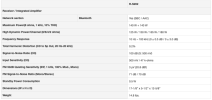
The current rule is still stringent enough -- it just doesn't seem to be enforced. For example, Yamaha's "100-watt" receiver (https://usa.yamaha.com/products/audio_visual/hifi_components/r-s202/specs.html#product-tabs) -- the specs are a joke (so is the performance of that receiver -- I had it very briefly). The higher level Yamaha 2-channel amps use valid specs and sound great -- but it seems like Yamaha isn't complying with the current amplifier rule for that receiver (so I think there is no actual enforcement -- Yamaha is not the only one).

Yes, Stereophile tests full frequency spectrum, so does Sound & Vision and virtually everyone else that does serious audio testing. The only one that uses 1khz that I've seen, is Audio Science Review (ASR) -- which has crowned itself as the objective "arbiter of science" in audio, when it uses a testing methodology that is the worst among almost everyone, and grossly insufficient. 1khz means nothing -- and it intentionally ignores the hardest part and the weak points for today's efficient amps (extreme frequencies aren't a challenge on pre-Class-D amps).

One thing that can't be contemplated until you experience it is that -- if you have a class-D that rolls off at 40hz or 30hz and you are using speaker-level to drive the subwoofer -- the sub won't fix the bass deficit because the amp isn't putting out those low frequencies for the sub to reproduce them. I saw this first-hand with the Yamaha -- you can use the sub to dial in boominess (e.g. overemphasis of 40hz -- as deep as the stereo amp will go), but you can't dial in proper extension of frequencies down to 20hz because the lowest frequencies aren't tin the signal.

To be clear, I'm not saying anything negative about Class-D -- they can be great, and I love my Fosi's that I use in many rooms in the house -- but the potential weak point of poorly designed Class D is rolloff at highest and lowest frequencies. ASR's testing avoids testing the one clear weak point of poorer Class-D amps -- yet ASR is somehow thought of as the science truth teller :wtf: . Almost everybody else uses 20-20khz, which is the only way to test -- which is also required in the current amplifier rule.

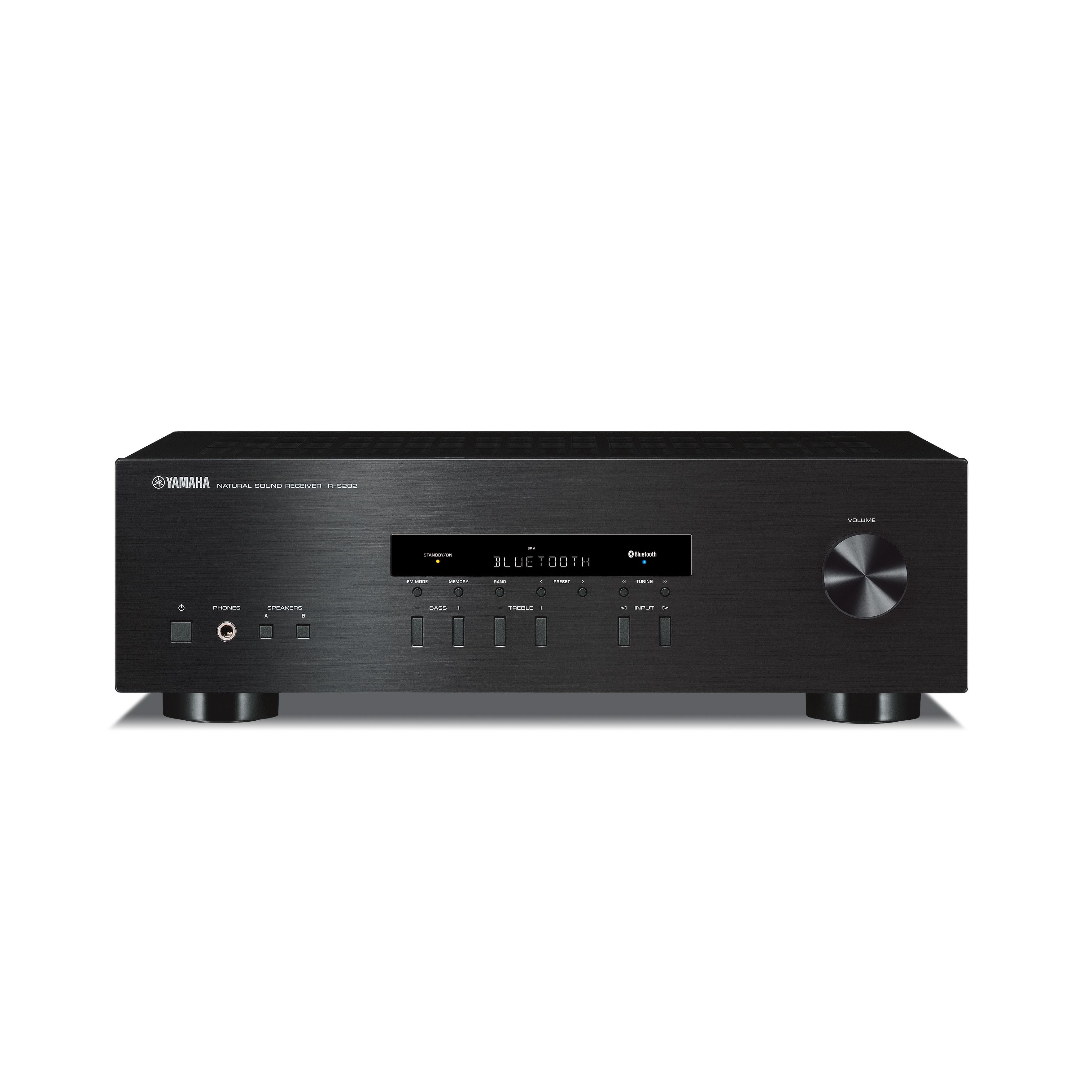

Current Amplifier Rule Ecxcerpt Below -- still plenty strict even though less than 1974 (Federal Register :: Request Access)
Screenshot 2026-04-15 at 5.29.46 PM.png


Yamaha "100 Watt" Receiver Specs (these are not Amplifier Rule compliant, and they are also useless)
Screenshot 2026-04-15 at 5.13.33 PM.png
 
Last edited:
I have a NAD T748.. I bought it new in 2011 or 2012. And honestly.. now that time has gone by and the money is long gone.. I kind of wish I didn't buy it. I had a new h/k AVR that was half the price and I think it sounded better.. maybe.. been awhile.. Even now, I have a couple of Adcom power amps that I did not have before, and I still cannot get it to sound good with music. I am using big Cerwin Vegas, they are pretty easy to drive.. The way it hacks up the frequency spectrum is just brutal. I cannot get it to sound like what I am using right now in my sig. I am using my computer as my main source for ~24 years. I am using an analogue connection to my preamp right now, I also have an optical connection to my SMSL D1 to my preamp. I have not tried an analogue connection on my T748 though.. but I did use HDMI instead. I don't know.. I was expecting awesome, but got disappointment instead. The stereo that I am running right now, since December or so is the best stereo that I have had in my life lol..
 
I used my two different NAD set ups with M&K speakers and though I found the amps to be very smooth they didn't have enough definition for me. If anything they had to much depth width and air. Things did improve when I softened the acoustics of the listening space. I'm basically a line array guy so having point source speakers can always compromise things if you sit to far away from point source speakers no matter how good they are. Thats why I even have issues with Magico speakers sitting more than 12 feet away no matter which electronics. Whether it be the very dry Accuphase or Krell. Some times older tube amps with suffucuent power get the lower reads , flutes and human voices better and Magico does have the best tweeters, even so they are not my favorites. So I woud be suspecting its the way your NADS interface with the loudspeakers you have chosen and not much the NADS them selves. NAD stuff works great with Magnaplanar, and other Paneled speakers if you have the necessary power. A lot of times when you are running electronics with out enough reserve available, headroom, the sound will be compromised in many different ways. Smothering the details in this case that you are after. If the NAD preamps doesn't have the head room to drive the separate amplifier that can also be the same issue. A lot of the time most air and reverb in a recording is centered from about 350 HZ to 1200 Hz and if their are compromises in that region of the audio spectrum your recording will loose that openness you are after.
I find NAD to have a relaxing sound as they do use a form of processing to keep the signal from clipping when pushed in any of the stages of the electronics. So that maybe an issue to. I never listen much louder than 103 db C weighted on the fast sensitivity setting. If you are listening louder than that a lot of things can become compromised with your system and with your hearing.
 
I have a NAD T748.. I bought it new in 2011 or 2012. And honestly.. now that time has gone by and the money is long gone.. I kind of wish I didn't buy it. I had a new h/k AVR that was half the price and I think it sounded better.. maybe.. been awhile.. Even now, I have a couple of Adcom power amps that I did not have before, and I still cannot get it to sound good with music. I am using big Cerwin Vegas, they are pretty easy to drive.. The way it hacks up the frequency spectrum is just brutal. I cannot get it to sound like what I am using right now in my sig. I am using my computer as my main source for ~24 years. I am using an analogue connection to my preamp right now, I also have an optical connection to my SMSL D1 to my preamp. I have not tried an analogue connection on my T748 though.. but I did use HDMI instead. I don't know.. I was expecting awesome, but got disappointment instead. The stereo that I am running n now, since December or so is the best stereo that I have had in my life lol..
I had a HK AVR around the time when they first had hdmi connections. It was a great AVR and it went to my son and he used it for many more years. It was one of HK's models when they were showing the specs honestly. I think that it was rated at 40w FL/FR and 30w for the center and rear speakers but I swear it put out a good bit more than this per channel. I replaced it with a Denon X2000 AVR and replaced it with a Denon X3500H AVR which I still use today. I bought them all used.
 
I used my two different NAD set ups with M&K speakers and though I found the amps to be very smooth they didn't have enough definition for me. If anything they had to much depth width and air. Things did improve when I softened the acoustics of the listening space. I'm basically a line array guy so having point source speakers can always compromise things if you sit to far away from point source speakers no matter how good they are. Thats why I even have issues with Magico speakers sitting more than 12 feet away no matter which electronics. Whether it be the very dry Accuphase or Krell. Some times older tube amps with suffucuent power get the lower reads , flutes and human voices better and Magico does have the best tweeters, even so they are not my favorites. So I woud be suspecting its the way your NADS interface with the loudspeakers you have chosen and not much the NADS them selves. NAD stuff works great with Magnaplanar, and other Paneled speakers if you have the necessary power. A lot of times when you are running electronics with out enough reserve available, headroom, the sound will be compromised in many different ways. Smothering the details in this case that you are after. If the NAD preamps doesn't have the head room to drive the separate amplifier that can also be the same issue. A lot of the time most air and reverb in a recording is centered from about 350 HZ to 1200 Hz and if their are compromises in that region of the audio spectrum your recording will loose that openness you are after.
I find NAD to have a relaxing sound as they do use a form of processing to keep the signal from clipping when pushed in any of the stages of the electronics. So that maybe an issue to. I never listen much louder than 103 db C weighted on the fast sensitivity setting. If you are listening louder than that a lot of things can become compromised with your system and with your hearing.
That was very cohesive and enjoyable to read! What great field notes and experience. Thanks!
 
@Lux Man
I am circling back to this thread because I had an old YouTube video show up in my feed. I watch a lot of Williston Audio Labs videos where he tests amps for output power. In the video below he tests a NAD 2200PE amp and the power output is insane. It shows the crazy amount of dynamic headroom the PE series amps can produce at 8/4/2 ohms. The amp's bridged performance is mind boggling to me.

 
@Lux Man
I am circling back to this thread because I had an old YouTube video show up in my feed. I watch a lot of Williston Audio Labs videos where he tests amps for output power. In the video below he tests a NAD 2200PE amp and the power output is insane. It shows the crazy amount of dynamic headroom the PE series amps can produce at 8/4/2 ohms. The amp's bridged performance is mind boggling to me.

Looked it up- those are impressive specs. A guy might want to try one some day....
 
Looked it up- those are impressive specs. A guy might want to try one some day....
YouTube sent me another video on a NAD 7140PE. This is a lower tier receiver in their line that NAD spec'ed at 40wpc but with 6db of dynamic headroom. I have a mint 3240PE which is their follow up model integrated amp version of the 7140PE.

 
@Lux Man
I am circling back to this thread because I had an old YouTube video show up in my feed. I watch a lot of Williston Audio Labs videos where he tests amps for output power. In the video below he tests a NAD 2200PE amp and the power output is insane. It shows the crazy amount of dynamic headroom the PE series amps can produce at 8/4/2 ohms. The amp's bridged performance is mind boggling to me.

I still have one of my old Power Envelope era NAD amps (2600A). It is a very stable amp.

:thumbsup:
 
Would you say the 2600A lacks soundstage, ok that's a tough call. Reason for asking is I have 2 x 2600 (THX?) waiting in the shed and I'm hopeful...
The 2600A is a strong amp. One of these days when I am really bored, I am going to drag out my NAD components and bypass their pre-amps using a a ZD3 DAC. I already Know that the pre-amps aren't as good as the ZD3 alomg with the dual mono ZA3s regarding overall sound quality. I am curious as to how good the amps are with detail, separation, imaging, etc.
 
Would you say the 2600A lacks soundstage, ok that's a tough call. Reason for asking is I have 2 x 2600 (THX?) waiting in the shed and I'm hopeful...
This is the point of the whole post! Hook them up and get back to us! Field investigations, NAD and Soundstage. I'm having a difficult time beleiveing they don't have it, or it's a weak point, but my limited field investigations comes up with NAD=flat soundstage. Thanks!
 
I have been using a NAD 1155 and NAD 2200 for a few years with various speakers. I enjoy it a lot. I never thought soundstage was an issue. I am in no way what I consider to be an Audiophile. So my opinion doesn’t really count. I think that combo can drive anything and sound really good. As I have said many times, I have not been exposed to any real High End stuff. Maybe, if I heard someone else’s gear I would be disappointed with mine. I do know the source is a key factor. There are times when I am totally blown away at how good it sounds. Then there are times when it sounds ok. So I know what it is capable of doing. Does a High End amp make any source no matter how bad, sound good? If not, then I’m good. If they do then I need to step up. I do have a little RCA tube amp that sounds 3 demensional and makes me smile, but I am not sure if a SS amp can do what that thing does. For me, I think it is more about source and speakers. Just my perspective.
 
Back
Top Bottom