• The move to the new server is done. There are some software and database maintenance updates in process. This has us passing the hat around to help out. We appreciate any donations. Seriously, even a dollar helps. The payment page may be found here - https://www.audiokarma.org/support.html

Does NAD Gear Lack Soundstage?


I don't really get the joke. I have no experience with the 200 -- if you do, it would be great if you'd share (and especially on the difference between the 200 and the later gray models). What I do know (from reading, didn't know of the 200 back when it was new) is that in the "200 era", NAD was building similar offerings to all the other silver-faced brands at that time -- then they had a philosophy shift on both looks and on amp design to specifically try to be different from Pioneer et al.

Are you saying the 200 was better than Pioneer and the others? Worse? How does the 200 compare to the later gray/black models?

Inquiring minds want to know :)
 
No, I have a strict limit on the knob, button, and switch count and it's way below that thing. :)
What I have learned over the past few years is that less is more when it comes to adjusting sound output with an abundance of knobs, switches, etc. for a 2.0 or 2.1 system. If your equipment is transparent and you have good speakers with a fairly flat response curve you don't need many controls.
 
FWIW, my original NAD 3020A integrated never lacked soundstage.
I am not saying that NAD components are bad. I have enjoyed them personally along with older Denon, Onkyo, HK and other brands. Then a couple of years ago I started investigating, and buying, new components and I quickly came to realize that some significant advances had been made regarding audio components in the past few years. These new components aren't just good but very good. So good that I have mothballed all my other gear. What I am saying isn't a diss to older audio components but an acknowledgement that there are some very good options to the older gear these days. Very affordable options.
 
Last edited:
I am not saying that NAD components are bad. I have enjoyed them personally along with older Denon, Onkyo, HK and other brands. Then a couple of years ago I started investigating, and buying, new components and I quickly came to realize that some significant advances had been made regarding audio components in the past few years. These new components aren't just good but very good. So good that I have mothballed all my other gear. What I am saying isn't a diss to older audio components but an acknowledgement that there are some very good options to the older gear these days. Very affordable options.

What are these significant advances you keep harping about?

I'd rather listen to my vintage gear that color the sound just right, and after restoration last for another 50 years, than a transparent D-box, that lasts perhaps 5 years.

Btw, I do agree that good sound has never been so cheap, thanks to Chinese manufacturing.
 
@JyriK
First, I am not trashing vintage gear, I expect everyone to use the components that sounds best to them that they can afford. If you find the gear you use fits you then by all means keep on using it. If by "D box" you mean the newer class D amps based on the TPA2355 chips then this is what I am referring to. If you are referring to something else, then let me know.

The advancements I am referring to is in how the implementation of using the TPA 3255 chip is being utilized. This occurred around 2-3 years ago. I owned a few class D amps prior to this for very specific use cases like auditioning speakers I was interested in buying to insure all the drivers were functional. Or to use in the garage as a minimal system to have sound in an area. They were never something I would use in a substantial system.

In general, I like keeping up with new electronics coming to market whether it be sound, computers, TVs, etc. I started seeing a lot of reviews on the Fosi V3 that were positive. I found them interesting because it seemed that the reviewers were saying this class D TPA3255 based amp was something out of the ordinary. I filed this information away because I had zero desire to investigate further. Then around a year later Fosi released the ZA3 as a follow up to the V3. This one got my attention. It used the TPA3255 chip but had a feature set that I found very interesting. It had the ability to run in a stereo or mono configuration. A sub out connection that scaled volume with the ZA3's volume knob along with fully balanced XLR connections. A 12V trigger along with the ability to replace op-amps. All this at a price point of $130 with a 48V5A power brick. When I say "significant advancements" I am referring to the feature set and implementation of the TPA3255 chip and not brand new build components.

The ZA3 got excellent reviews from a wide variety of people. This piqued my interest to the point I bought one. At this time I was using the NAD 7100PE receiver as a daily driver. I thought the ZA3 might be useful in a desktop or other limited system. When it arrived, I decided to have it replace the 7100 to really test it out. This system uses a pair of JBL L5s that I find to be a very good speaker. I fed the ZA3 with a SMSL C100 DAC I had laying around. The ZA3 stayed there for three weeks because I had a hard time coming to grips with just how good it sounded. I was a diehard vintage fan and I thought that I would tire of the ZA3 after awhile but this never happened. The clarity, separation, imaging, soundstage, transparency, dynamics etc. was just clearly better to my ears. Then the complete silence when there was no sound was another pleasant surprise. I added another ZA3 to run dual mono amps along with a Fosi ZD3 DAC when it came out. My source over 95% of the time is a Windows computer connected to the DAC via USB. The ZD3 has a great feature set of fully balanced XLR outputs, ARC HDMI connection, ESS Sabre ES9039Q2M paired with XMOS XU316 USB processor, volume control with defeat, in/out 12V triggers and remote control for input switching and volume, among a few other features. The ZD3 comes at a price of $150 when on sale.

I have been using this basic system for over two years now (with the ZD3 a little less) and still love its output. I am not one to listen at high levels and around 85-90db is my absolute max and even then it is for transients in the music. When I say advancements it mostly means advancements in the implementation of existing technology. I am not an electrical wizard but it appears that these newer lower end amps, DACs, pre-amps etc., that mostly originate in China, have cracked a code to get much better performance from electronic components that have been around for a while. While at price points that haven't been seen before.

I am not a one-off regarding my recent experiences. Many here at AK, and elsewhere, have had very similar experiences where vintage components have been replaced with these newer budget friendly ones. I am not trying to convince people to dump their vintage gear. I am just telling my experiences and letting people know that there is another alternative to vintage that doesn't cost an arm and a leg to use. I spent more repairing my NAD 7400PE receiver than I have on my ZA3s, ZD3, op-amp upgrade, XLR cables, etc. As for longevity, I expect these new components to last a long time. I have fifteen year old class D amps that are still perfectly fine today and they aren't nearly as well built as my current components. Even if something breaks, buying a replacement is far less costly and easier than repairing a vintage component, if this is even possible or viable.

The competition in the lower end components these days is very stiff. New iterations of lower cost amps, DACs, pre-amps, CD transports and even turntables are coming out faster than I can keep up with them. All this is very good news to those that have limited budgets and/or don't want to, or can't, keep vintage gear running. IMO, we are living in a new golden age of audio where incredible sound quality is available to more people than ever before.

 
Last edited:
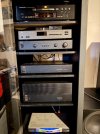
OK, I had to know for sure.. I spent a few hours last night tearing down and rebuilding my system. I need to play with it some more, still early.. movies sound awesome lol.. never heard this AVR sound so good. Just gotta work on music playback.. right now it is not as good as what I had. Is there an AV unit that can do movies and music equally well? Can just be a pre.. I already have amps. Can get one more for the center..

AVR.jpeg

Don't mind the wear and tear. That unit was new when I bought it, and lived through both of my kids growing up while in my TV stand.. exposed to them lol.. I even bought a replacement remote because the original is thrashed..

Computer to AVR to GFA-555 to Cerwin Vega CLSC-15. Computer to AVR to GFA-535II to Definitive BP-1.2x. The AVR only has to drive the Definitive ProCenter C2. I have my DAC that I want to get into the mix but had a hard time last night running analogue with HDMI video. Gave up. I have a Definitive PF-700 on the left, and a Monitor Audio FB-210 on the right.
 
OK, I had to know for sure.. I spent a few hours last night tearing down and rebuilding my system. I need to play with it some more, still early.. movies sound awesome lol.. never heard this AVR sound so good. Just gotta work on music playback.. right now it is not as good as what I had. Is there an AV unit that can do movies and music equally well? Can just be a pre.. I already have amps. Can get one more for the center..

View attachment 3750103

Don't mind the wear and tear. That unit was new when I bought it, and lived through both of my kids growing up while in my TV stand.. exposed to them lol.. I even bought a replacement remote because the original is thrashed..

Computer to AVR to GFA-555 to Cerwin Vega CLSC-15. Computer to AVR to GFA-535II to Definitive BP-1.2x. The AVR only has to drive the Definitive ProCenter C2. I have my DAC that I want to get into the mix but had a hard time last night running analogue with HDMI video. Gave up. I have a Definitive PF-700 on the left, and a Monitor Audio FB-210 on the right.

I would start by changing from enhanced stereo to plain 2-channel stereo for music. Room cancellations and overemphasis of largely similar or identical content coming out of all channels makes almost “all-channel” sound modes sound awful for 2-channel music.

Music in movies can sound amazing on all channels, but that’s because each speaker has far more discreet content when it’s mixed for 5.2/7.1.
 
@freeagent
I have two main systems. One is a 5.1 system and the other is a 2.0 system I described in my previous post. The 5.1 system uses a Denon X3500H AVR, JBL L5s for F/R speakers, JBL EC35 for the center, JBL E10s for the rear and a HSU subwoofer. It does well for a dual use system for music and movies but the 2.0 Fosi system is noticeably better for music and does pretty good for video.

I think it is hard to have a 5.0 or 5.1 system excell at music as good as a 2.0 or 2.1 system does. I could add 2.0 components to my 5.1 system and switch between them. I will probably do this one day but I get pretty good stereo sound from my current setup. Good enough where I am not highly motivated to make any changes.

With your setup you could easily add a DAC and connect it to your computer via USB. You can use your computer as an output switch between the DAC and AVR. Then integrate the DAC's output into your system using a speaker switch for your L/R speakers.

Edit: I should have said using a source switch in front of the amp for your L/R speakers.
 
Last edited:
I have an SMSL D1 that I want to use, I have to play with some internal settings. I have not given up hope yet..
 
Thats actually pretty neat..

Sigh..

View attachment 3750585

I'm having a little trouble following your pics (also can't tell what model NAD you have from the pics). It looks like you swapped out the AVR for 2-channel preamp and amp versus the prior pic.

For 2-channel music -- did you try just setting it to plain 2-channel stereo mode? Virtually all AVR's sound awful on any "all channel" stereo sound mode -- you were running "enhanced stereo" in your first pic -- that will likely sound bad for the reasons mentioned in my prior post.

Normal 2-channel mode with the same AVR may sound better. I say "may" because some AVR's sound bad in 2-channel -- I think because they do volume control in digital in a way that degrades the signal (most newer AVR's seemed to have solved this by using a higher internal bit width so that doesn't happen).

Be sure to test it in 2-channel stereo mode before dismissing it's ability to sound good with 2-channel music.
 
For 2-channel music -- did you try just setting it to plain 2-channel stereo mode?
Yup, still sucks compared to what I am used to. I did use that AVR for ~8 years before I shelved it. It is a T748.

I honestly do not believe an AVR can sound good with music. I know it can sound good with movies, but it has never sounded good for music for me. I have 3 AVRs.. NAD, Marantz, and Integra.

And by good, I mean what I am hearing right now. This is an awesome setup in my opinion.
 
Yup, still sucks compared to what I am used to. I did use that AVR for ~8 years before I shelved it. It is a T748.

I honestly do not believe an AVR can sound good with music. I know it can sound good with movies, but it has never sounded good for music for me. I have 3 AVRs.. NAD, Marantz, and Integra.

And by good, I mean what I am hearing right now. This is an awesome setup in my opinion.

Ok, just wanted to make sure, because multi-channel stereo will suck on it's own even in an AVR that does 2-channel well.

My experience is largely the same as yours -- most Dolby Digital (at least older ones) AVR's really suck at 2-channel. The very old Dolby Pro AVR's (before Dolby Digital came out) sounded great for 2-channel because Dolby Pro didn't have any digital processing. I think the reason many AVR's suck with 2-channel is because they used to do digital volume control that would really reduce digital resolution (bit-depth) at anything less than full volume. It's hard to believe they could be so stupid as to do that -- but it seemed to be the case and "pure direct" buttons didn't seem to fix that (it would by pass the digital processing, but not the digital volume control).

Newer AVR's artificially expand the signal to 32 or more bits so they can use digital volume control without reducing bit depth. I think that became popular in the late 2000's. Your NAD T748 came out in 2011 I think, but it must not have the expanded bit width. My (circa 2020) Yamaha Aventage AVR sounds absolutely great for 2-channel, as it does for 7.1. My old Krell HTS and Sunfire Theater Grand IV A/V preamps (which cost multiples of the Yamaha) sounded great for 7.1 (the Krell was unparalleled to this day) -- but they were unlistenable for 2-channel. Especially the Krell -- off-the-charts great for movie, horrible for 2-channel.

Newer AVR's are likely to work well for 2-channel. I still can't believe nobody solve that 2-channel problem sooner (or let it happen in the first place) :dunno: .
 
The Denon X3500H AVR (~2018 model) I am using now in a 5.1 system has the best two channel stereo of any AVR that I have owned over the past 18-20 years. Also, I think the higher end the AVR has a better chance of having good two channel stereo due to it likely having a higher end DAC chip. I think the X3500H uses an AKM AK4458VN 32 bit, eight channel chip. The stereo output of the Fosi 2.0 system I have sounds better than the stereo 2.1 output of the X3500H but they are closer than I expected. It looks like the T748 has a 24 bit 192hz CL chip.
 
I wasn't going to reply to this thread which is bordering on clickbait. It is true that one man's meat is another man's poison. But there are also personal biases and preferences that take place with questions like this. Someone might not like the brand of a piece of equipment, and so they don't listen to it with open ears. Or they might not like the Country that the equipment is from. There does seem to be some anti-British equipment bias, you can certainly see it in all the hatred for Rega turntables that goes on over on the turntables forums. Other factors might also come into play, like a piece of equipment that sounds flat because it's 40 years old and unrestored.

However... I'm sitting here listening to some music, unwinding after a long day at work. Playing at the moment is remix version of the track "Incognito" from the band Incognito. It was recorded from my Dad's own vinyl copy on a 45rpm 12" single. It was recorded using a Rega Planar 2 turntable and a restored NAD 3020. I'm playing it through a NAD 5000 CD player, though another also-restored NAD 3020 amp, and Infinity 3000 speakers. When I look up from my phone, I can see where the speakers are placed in the room. So why is it, when I'm not looking ahead, I can hear a keyboard solo coming from further left than the left speaker? It almost sounds like it is coming from the very corner, which is not where the speaker is. And the rhythm guitar licks are coming from slightly left of center, but appear to be a few feet out into the room. It's almost like there is a soundstage here...
 
Some content I play can have the same effect as you describe. Most of what I play are flac files and it seems that some are better than others. Some sounds emanate outside the speakers, some to the rearand anywhere between them.not much is in front of the speakers. I think this is due to the listening position being around twelve feet from the speakers. For me, I chalk the randomness of this occurring to sound engineering, etc. along with the sound system being able to resolve it.

I think it is natural for people who have listened to a lot of gear and brands to develop biases. This is the case for hot rodding cars, playing golf, lawn care equipment, etc. Everyone one has their own preferences. As an example, I have more bias regarding speakers than I do with electronics and it is probably unjustified. Also, I don't like the process of vetting gear and find it frustrating. I have also grown tired of dealing with vintage components. In the area I moved to recently, trying to find a place to have repairs done is going to be frustrating. Fortunately, I think my days of using vintage components has come to an end.
 
I can see where the speakers are placed in the room. So why is it, when I'm not looking ahead, I can hear a keyboard solo coming from further left than the left speaker? It almost sounds like it is coming from the very corner, which is not where the speaker is. And the rhythm guitar licks are coming from slightly left of center, but appear to be a few feet out into the room. It's almost like there is a soundstage here...
Room mode plays a huge part in the 3D-like depth and width in music. The dynamics of reinforced and canceled sound waves within the room. These waves are frequency- and volume-dependent. They can enhance the 3D effect or cancel it.

;)

A good article.
 
Back
Top Bottom