

You are using an out of date browser. It may not display this or other websites correctly.
You should upgrade or use an alternative browser.
You should upgrade or use an alternative browser.
Dual Guide White Sources
- Thread starter IXLR8
- Start date
Register to hide this ad

NoTransistors
Dual Turntables Super-Restorer
I spoke to Adam at South Street, two days ago. He said that we will need to fabricate these things. It was suggested to use wire insulation, but this doesn't sound quite right. I am going to look at the tiny rubber end-bushings on the Penguin-brand aquarium filters. The shaft that holds the rotating impeller assembly is held in place with a piece of rubber on each end. These are available as replacement parts. Similar pieces exist on the Whisper aquarium filters. Get one at Walmart, and examine the part, if desired.
Or wait for me to post back with a solution.
You can try Joel, or there is a place in Canada that may have these things.
I have a Dual 1219 arriving soon, and will need to solve this issue in the next few days.
Seth
Forever Analog
Or wait for me to post back with a solution.
You can try Joel, or there is a place in Canada that may have these things.
I have a Dual 1219 arriving soon, and will need to solve this issue in the next few days.
Seth
Forever Analog

OvenMaster
Baby, you're my winterblue
1. Where precisely is this part located?
2. Does anyone have a pic of one? Or dimensions?
Tom
2. Does anyone have a pic of one? Or dimensions?
Tom
NoTransistors
Dual Turntables Super-Restorer
Tom,
It is a secret.
Seth
Forever Analog
It is a secret.
Seth
Forever Analog
OvenMaster
Baby, you're my winterblue
:finger: :lmao:  .
.
Tom
.Tom
NoTransistors
Dual Turntables Super-Restorer
My apologies, I thought you were referring to Cold Fusion.
It is a cylinder of delrin [probably cheaper plastic these days].
0.13" in diameter
About the same dimension in length
There is a hole 3/4 through the part, that permits it to slide over a spring-loaded rod.
This is your pain-in-the-ass clutch tip, for most Dual products. Location differs from model to model.
News: it wears out or dries out, rendering auto-return useless.
Seth
Forever Analog
It is a cylinder of delrin [probably cheaper plastic these days].
0.13" in diameter
About the same dimension in length
There is a hole 3/4 through the part, that permits it to slide over a spring-loaded rod.
This is your pain-in-the-ass clutch tip, for most Dual products. Location differs from model to model.
News: it wears out or dries out, rendering auto-return useless.
Seth
Forever Analog
OvenMaster
Baby, you're my winterblue
Cool, Seth, thanks. I'll put my thinking cap on... never know when I'll need one myself.
Regards from Tom
Regards from Tom


NoTransistors said:I spoke to Adam at South Street, two days ago. He said that we will need to fabricate these things. It was suggested to use wire insulation, but this doesn't sound quite right. I am going to look at the tiny rubber end-bushings on the Penguin-brand aquarium filters. The shaft that holds the rotating impeller assembly is held in place with a piece of rubber on each end. These are available as replacement parts. Similar pieces exist on the Whisper aquarium filters. Get one at Walmart, and examine the part, if desired.
Or wait for me to post back with a solution.
You can try Joel, or there is a place in Canada that may have these things.
I have a Dual 1219 arriving soon, and will need to solve this issue in the next few days.
Seth
Forever Analog
Hi Seth,
Not in a real hurry on this but it stays on my mind. Will wait to hear what soloution you come up with. Have not tracked down a service mamual for the 704 other than in German do you know where I might find or purchase one?
Lets know what all you have to do to your 1219 get it working smoothly. Those posts are a entertaining and great for learning.
NoTransistors
Dual Turntables Super-Restorer
ManualGenius is a common source for Dual literature. I do not have anything on your model.
Be forewarned that most of these repair books confuse rather than help.
Seth
Forever Analog
Be forewarned that most of these repair books confuse rather than help.
Seth
Forever Analog
rcdis said:Has any one solved the DUAL guide problem? I could use a guide or two myself.
rcdis
Just to touch base have a German vendor checking into it. Also noticed this http://audiokarma.org/forums/showthread.php?t=91387 it is called a "tonearm clutch pad" Dual part #223777 by Fred Longworth whom is extremly well versed.

Fred Longworth
audio fanatic
Hi, all.
The "guide" or "tonearm clutch pad" goes between a pin on the bottom of the tonearm base and the large, flat, spade-shaped end of the main lever.
The main lever has a pivot in the center. One end of the lever sits in a track on the cycling cam. The other (spade-shaped) end sits under the clutch pad.
When the turntable cycles, the main lever presses upward against the pad (and against the damped arm-lifter shaft) and then moves laterally. This causes the arm to do two things: lift and move sideways. A clutch pad is used so that if the arm is held in place, there is slip built into the system -- so the linkages to the arm won't self-destruct.
Inevitably the guide or clutch pad crumbles, and then it's metal against metal. Some Duals can still move the arm laterally in a half-assed way, but most lose lateral control. The full automatics stop moving over to the record (they stay on the arm rest) and the semi-automatics struggle to move the arm back to the arm rest, but usually fail and set the arm down somewhere on the record.
In my thread in dealer and vendor classifieds, there is a suggestion to use a part of a BIC pen. I have not as yet followed up on this. However, I will tell you that you can fashion a crude clutch pad from a cylinder of hot glue and an Xacto knife. The problem with this "solution" is that hot glue is softer than the original plastic and will wear out after a few hundred cycles.
I'm going to do some experimenting with this, and will keep Audio Karma members posted. I'm currently down to ONE in my inventory.
Fred Longworth
The "guide" or "tonearm clutch pad" goes between a pin on the bottom of the tonearm base and the large, flat, spade-shaped end of the main lever.
The main lever has a pivot in the center. One end of the lever sits in a track on the cycling cam. The other (spade-shaped) end sits under the clutch pad.
When the turntable cycles, the main lever presses upward against the pad (and against the damped arm-lifter shaft) and then moves laterally. This causes the arm to do two things: lift and move sideways. A clutch pad is used so that if the arm is held in place, there is slip built into the system -- so the linkages to the arm won't self-destruct.
Inevitably the guide or clutch pad crumbles, and then it's metal against metal. Some Duals can still move the arm laterally in a half-assed way, but most lose lateral control. The full automatics stop moving over to the record (they stay on the arm rest) and the semi-automatics struggle to move the arm back to the arm rest, but usually fail and set the arm down somewhere on the record.
In my thread in dealer and vendor classifieds, there is a suggestion to use a part of a BIC pen. I have not as yet followed up on this. However, I will tell you that you can fashion a crude clutch pad from a cylinder of hot glue and an Xacto knife. The problem with this "solution" is that hot glue is softer than the original plastic and will wear out after a few hundred cycles.
I'm going to do some experimenting with this, and will keep Audio Karma members posted. I'm currently down to ONE in my inventory.
Fred Longworth
OvenMaster
Baby, you're my winterblue
Apparently that's what was causing the creaking and groaning noises on mine for the past year. I lifted my chassis and that's precisely the part that's broken. :gigglemad
I cleaned off the old, dried-out grease that was there and put a tiny bit of new grease on the end of the shaft, and the noise is gone. I didn't take the broken part off yet. Operation hasn't ever suffered, and because mine's a cheapie, my main lever is all plastic Probably got a groove worn in that spade-shaped section there now. Methinks it's time to try the Bic pen barrel cap.
Tom
I cleaned off the old, dried-out grease that was there and put a tiny bit of new grease on the end of the shaft, and the noise is gone. I didn't take the broken part off yet. Operation hasn't ever suffered, and because mine's a cheapie, my main lever is all plastic
Probably got a groove worn in that spade-shaped section there now. Methinks it's time to try the Bic pen barrel cap.Tom

Dadbar
Super Member
When I was at Lowe's the other day killing time waiting for my son I was browsing through the hardware parts drawers there and noticed that they have little rubber caps that fit on the end of small bore metal rods. It didn't occur to buy any of these at the time but I think they might be ideal for this Dual repair. You might have to trim them down a bit.
Fred Longworth
audio fanatic
Yup, I think a "brouse" through Lowes and Home Depot is in order.
Fred Longworth
Fred Longworth
OvenMaster
Baby, you're my winterblue
Fred?
What precisely is this guide supposed to actually do?
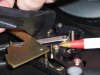
Last night I decided to try a pen cap repair, using one that I had hanging around. Below's a pic of the shaft tip without any of the broken guide pieces. Suffice it to say that my pen-cap repair was fine except during auto-return: the cap was too wide, and its movement was fouled by the gold part on the left, the "positioning rail". Look closely and you'll see zero wear on the sector part of the spade area of the main lever, where the guide is supposed to rest. I took the pen-cap off and reassembled everything, adding just a tiny amount of grease to the exposed tip until I can do a full, proper repair. Running the TT through all auto and cue functions seems perfectly fine (just as it has been for the past 18 months), so I'm at a loss to figure out just what this guide part is actually needed for.
Tom
What precisely is this guide supposed to actually do?
Last night I decided to try a pen cap repair, using one that I had hanging around. Below's a pic of the shaft tip without any of the broken guide pieces. Suffice it to say that my pen-cap repair was fine except during auto-return: the cap was too wide, and its movement was fouled by the gold part on the left, the "positioning rail". Look closely and you'll see zero wear on the sector part of the spade area of the main lever, where the guide is supposed to rest. I took the pen-cap off and reassembled everything, adding just a tiny amount of grease to the exposed tip until I can do a full, proper repair. Running the TT through all auto and cue functions seems perfectly fine (just as it has been for the past 18 months), so I'm at a loss to figure out just what this guide part is actually needed for.
Tom
Attachments
Fred Longworth
audio fanatic
The guide functions first as a spacer, i.e. it slightly reduces the clearance between the spade-shaped end of the main lever and the spring-loaded descender from the bottom on the arm that is used to move the arm laterally. This makes for good friction.
Second, it is a clutch, so that if the arm were locked down in the arm rest and a cycle were initiated, there would be no harm to the arm linkages.
Third, it is soft enough so that it provides damping and slightly reduces that scraping noise that would occur if metal were against metal.
Fourth -- and VERY important -- it concentrates the wear-and-tear on a small, replaceable part, rather than allowing steel to abrade against steel.
Fred Longworth
Second, it is a clutch, so that if the arm were locked down in the arm rest and a cycle were initiated, there would be no harm to the arm linkages.
Third, it is soft enough so that it provides damping and slightly reduces that scraping noise that would occur if metal were against metal.
Fourth -- and VERY important -- it concentrates the wear-and-tear on a small, replaceable part, rather than allowing steel to abrade against steel.
Fred Longworth
OvenMaster
Baby, you're my winterblue
:yes: Thanks, Fred! Now I know.
I'll be on the lookout for a suitable homebrew part and will post pix when I put it in. Much easier to get at than I had anticipated.
Regards from Tom
I'll be on the lookout for a suitable homebrew part and will post pix when I put it in. Much easier to get at than I had anticipated.
Regards from Tom
Similar threads


- Replies
- 14
- Views
- 4K


- Replies
- 2
- Views
- 1K
