• The move to the new server is done. There are some software and database maintenance updates in process. This has us passing the hat around to help out. We appreciate any donations. Seriously, even a dollar helps. The payment page may be found here - https://www.audiokarma.org/support.html

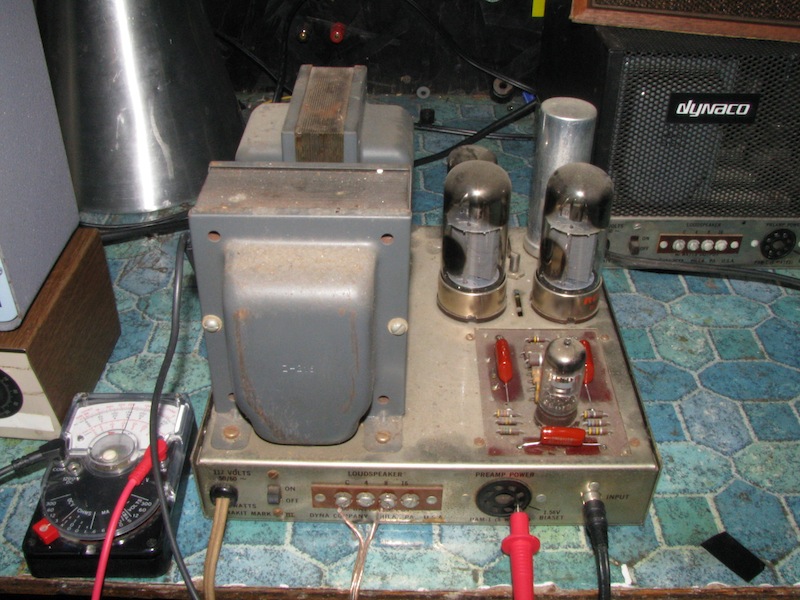
Dynakit ST70

The higher values on the optional replacement can cap won't hurt the sonics in any way , but actually improve them. Back in the day extra capacitance was very expensive so minimal was used in the PS. They were trying to keep to price of that amp down also as it was designed to be sold at the lowest cost possible.

One can also re-stuff the original can with individual caps to save a fair amount of $ and if you don't want to do that and want a super high quality replacement can cap look at Hayseed Hamfest replacements.

As for the rectifier tube, the ST-70 stresses them greatly and should have used 2. New production don't last like the old ones either and the addition of SS diodes in series with the tube help the tube last much longer without changing or hurting the sonics.
This really popular improvement is called the Diode Mod and UF4007 are newer faster diode for a few cents more. Pins #5 & #7 are unused pins on the socket and if you want to hide the diodes you can also just run them straight to pin's #4 & #6 in series with the wires and hide them in heat shrink tubing.
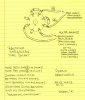
DIODE TubeRectifier-DiodeMod (1).jpg
 
Last edited:
I’d also not exceed the voltage rating of the coupling capacitors on the PC board because parts with a higher voltage rating will be physically larger, take up more real estate on the PC board and may also sit closer to the tubes, which means greater heat stress on the part. It might not end up being necessary to replace these capacitors, anyway.

Now this I don't agree with. Modern caps can have a higher voltage rating and can be the same size or much smaller. The 630 volt IC caps I used are half the size of the originals.

49097508163_77cdb73853_k.jpg


49101806648_770d6b49e3_k.jpg
 
Last edited:
A change from 30/20/20/20 to 40/80/30/20 does not have to be seen as a change to the original circuit topology but rather as an "enhancement" to bring out a bit more of the original circuit's sonic potential. As Adam pointed out, it needs to be installed in that order: 40/80/30/20, and it would be a good idea to ask for some more guidance on that when the time comes.
Alright, I'll do it! It is the same price, so why not. Would you suggest just buying a new can, or restuffing the old one? Where would I find the caps to restuff it with? I'm not trying to be cheap, but hey, if I can save some money, that would be cool. I've also checked out some electro harmonix EL34s on ebay, a matched quad is $30 cheaper than on tube sandmore.com. I'm hesitant though, Ebay is Ebay. The 7199 adapters are a lot cheaper as well, but again, I'm hesitant.

Back to the can, I like how the values are stamped into the original one, and the new ones have a sticker.
 
Buy the 40/80/30/20 can from Dynakits. Kevin will include a wiring diagram with it. Be sure to follow the instructions. Don’t be like me and put it in like the old one and cause problems.

I initially kept the 7199s and bought the $60 7199 circuit board. Then, adapters to use other tubes. After trying other tubes I prefer them to the GE 7199s and wish I had just purchased the other board. 6U8, 6GHA, 6EA8 (my choice) are very affordable and essentially the same tube as 7199 with a different pinout. There are differences, but not significant differences.
 
Last edited:
Modern materials, on the ST-70 doesn't matter on the cap or it's lead unless the cap is huge around just because it's slightly taller it won't be any closer, larger value larger cap is common knowledge no lesson needed, look at my pictures the IC caps aren't touching the board and they're farther from the tube than the originals, orange drops would sit the same,distance from the board, whether you like IC's is neither here nor there
 
Understood, and in Post #55 I acknowledged that the new capacitors the OP is looking at are smaller. I also raised the question of how they are wound differently to be so small. I have wondered if there might actually be some sort of compromise to make them more space-saving, other than just being metallized. Maybe the metallized film is thinner, or maybe they're just wound tighter, I don't know. There's a good deal of engineering that goes into capacitors. But I'm sure there are capacitors available that are still similar in size to the originals, and the higher the voltage rating for a certain make and model of capacitor, the larger it will be.

I just measured an original 0.05µF capacitor on a sample of PC3 I have, and its diameter is about 0.45" inches. Being tubular it can be mounted flush to the board. A radial leaded capacitor can’t really be mounted flush to the board. One that I am thinking of is the popular 715P Orange Drop, which at 600 volt rating has a maximum body height of 0.56". That doesn’t sound like a big difference, but add a little lead length and you're sitting that much closer to a hot tube. The 0.047µF @600VDC Auricap XO, according to one of their dealers, is 0.68".

As I indicated in Post #55 the IC probably works fine. It just wouldn’t be my first choice.

I used those very Orange Drops sizing up to .22, which seems to be a somewhat popular thing to do in ST-70s. However, returning to the stock values using the smaller caps sold by Dynakitparts seemed to improve the sound of the amp. They are quite a bit smaller than the originals.
 
From anecdotal reports, as well as from my own experience, the orange drops seem to have a somewhat warmer sound. From what you're saying, I'd guess the Illinois sounds a bit brighter?
It’s hard to really say. If anything, I think the amp sounds smoother with the Illinois caps. I remember thinking it sounded a bit more transparent so that could be brighter, maybe more extension.
 
FWIW, a couple years ago I sat down with all the Russian variants of the GZ34. I had the Sovtek, Tung Sol, Mullard and Genelex. I tested each in circuit and found the voltage drop, sag effects and B+ to be virtually identical. The internal elements also looked to be identical. The only difference I could guarantee was the screening and base configuration.

How is it that so many people feel so strongly that there is a measurable difference in quality?
Robustness and service longevity make the differences that matter.
 
Last edited:
To restuff a can capacitor Google it as there is lots of info and pictures on the net. Thin long caps with the leads on one end are used. Just have to make sure the voltage rating is the same or higher than the original, and it never hurts to be higher.
 
Modern materials? Anything more specific than that? I did see your pictures. Again, I acknowledge that the IC is on the small side, as you say. As far as whether the 715P orange drop sits higher than the IC (as with the Auricap XO), don’t take my word for it. Here is where I found the dimensions...

715P look on page 6 for the 600 volt 0.047µF maximum height spec: https://www.cde.com/resources/catalogs/715p.pdf

Diameter of Auricap XO 0.047uF 600Vdc is here: https://www.partsconnexion.com/AURIXO-75915.html

Most images I’ve seen of installation of radial leaded capacitors usually include some lead clearance on the top side of the board. In some cases, I’ve seen some where they’re practically pushed up against the side of the tube. So, yes, this may be a workmanship issue, but just the same it’s more likely to happen with radial leaded capacitors unless care is taken. The epoxy coating on the body of a radial leaded capacitor can proceed down onto the lead where it exits the capacitor. If the leads are pushed down too far, some of the epoxy can get into the hole, which would not be desirable.

I agree that what I like is neither here nor there – as far as the OP's goals are concerned. This is why I am putting my efforts into assisting the OP with reaching his goal.

Edit: correction.

Modern materials is the answer pretty sure you don't really need a "lesson", perfectly familiar with orange drops used them for decades on tube radios, the Auricap is a ridiculous example trying to make yourself right, no one would use it on a ST-70 board. Helping the OP was also my goal till this side road started.
 
Lest the OP be led astray, should a mention of the bias issues on these tubes be made? I too, love the 6CA7 EH but had to modify the bias circuit to make them work.
Didn't have a problem, but have shunted the selenium with a silicon rectifier to lower the voltage drop, and added 100k failsafe resistors to the bias pot that may have helped the range. Before, bias for them was near the end of the pots, now middling.
 
I had to replace the selenium diode and add resistors across the original 10k bias resistors to get EL34s to bias. The 6CA7 EHs still biased hot requiring further modification, although I didn’t get them from McShane. I am also using the individual bias circuit from Dynakits which may be a factor, although Kevin doesn’t think so. A search of that tube on AK will show a problem with them biasing hot, so I think it’s worth a mention.
 
Bias with Tung-Sols EL34B's wasn't a problem. Stock volume pots achieved bias at a little over halfway so lots of adjustment left. That was with the bias mod. Forgot I had done it
 
Peter, the tubes you refer to are in fact anomalies. I know they had those EH tubes and there was also WInged C tubes with high current ratings. It was an off spec batch that ran to the high side of inherent idle current. They elected to sell them with that disclaimer and I have used them without any issues.

The tubes themselves do not usually require any unusual bias settings as compared to other 6CA7 tubes.
 
Peter, the tubes you refer to are in fact anomalies. I know they had those EH tubes and there was also WInged C tubes with high current ratings. It was an off spec batch that ran to the high side of inherent idle current. They elected to sell them with that disclaimer and I have used them without any issues.

The tubes themselves do not usually require any unusual bias settings as compared to other 6CA7 tubes.
I saw those and wondered about them also. I wondered if the disclaimer was more focused towards cathode biased guitar amps. Being that the bias can't be adjusted.
 
I ordered my E-H 6CA7s a year and a half ago, and have never had any issues getting them to bias up. Seemed to be pretty much the same as the E-H EL34s they replaced in that regard. Of course, I've replaced the selenium rectifier with a silicon diode, but that never affected any of the EL34s I tried to run in the same amp, and I was even able to get 6L6GCs to bias up fine back when I was still testing it.

With regards to capacitors, I haven't done any comparisons between types. However, my Dynaco amps have sounded good even with the cheap caps I used. As I mentioned, when I recapped my ST-70, I used whatever caps I had around, which were Philips 'postage stamp' types for the 0.1s, and two tubular mylar caps for the 0.05s. With the Mark IIIs and ST-35, I used NTE MLR mylar/polyester 'red drop' caps, as seen here:
markiii_2.jpg

markiii_3.jpg

st35_2.jpg
 
Last edited:
Back
Top Bottom