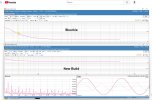
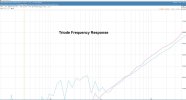
Just a quick update. After some critical listening, I like UL better than triode. UL to me just sounded better balanced throughout the full range. Triode with zero feedback especially was very bloated in the midrange. If I do any future builds, I will skip the UL/Triode toggle capability. I also preferred the 5751 over the 12AX7.
Good news is my Analog Discovery 3 will be delivered soon.
This is so much a subjective personal thing- I understand people gravitate to tube amps because they are looking for something that sounds different, decrying the "sterile" technical accuracy of modern solid state amplifiers. There are so many ways to make an amplifier sound different, by intentionally introducing different mixes of distortion and harmonic content (error) into an otherwise accurate reproduction. It is humorous to me those who enjoy introducing distortion in this way would poo-poo any sort of signal processing, filters, sound effects and the like that could apply similar distortions as being somehow impure or gimmick. Driving an amplifier design to have intentional distortion is very much a guitar-world approach- I have seen so many tube circuit tortured into producing just the right sound, and "tuning" a high fidelity amplifier based only upon how it sounds is perfectly valid in that world, but just does not make sense to me in high fidelity. Whether tube, or silicon, I would expect an amp to be as wide and flat as possible, with as little distortion as achievable, and in such case, a tube amp will still manage to sound different than a silicon amp, but still present an accurate reproduction of the input.
In the amps that I have built, pretty much SE or PP pentodes in pentode mode with global negative feedback, I really don't play with ultra-linear or triode mode because using high open-loop gain and global negative feedback is SO much more accurate. The global negative feedback resistor sets the amount of feedback, which does affect tone somewhat, but much more so overall gain. The capacitor parallel the feedback resistor sets the frequency compensation, which effects the flatness of output across frequency. When tuning the frequency compensation of global negative feedback, there is seemingly only one valid "correct" amount of compensation- that which results in the flattest frequency response across the widest extent possible, and provides the best transient stability.
In
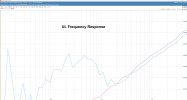
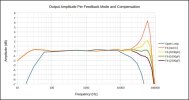
my "Mirror Mite" project, a 6AQ5 (7-pin 6V6) push-pull amplifier, I took some compelling data on frequency response per compensation capacitor value shown in the chart below. This is at a very low power level so limitations of output transformer saturation at the low end, and winding capacitance/inductance "slew rate limiting" at the high end are not the limiting factors- The open loop (no feedback) result is in blue- roughly 50Hz to roughly 15kHz at 1dB down. Applying =any= feedback, compensated or not, dramatically improved the low end- now reproducing down to 15Hz at 1dB down. Frequency compensation only affects the upper end- and the amount of compensation dramatically alters the reproduction.
With negative feedback, but no compensation, this exposes a downside of any feedback in that it allows the input of the amplifier to now see bad behaviors of the output transformer and amplify them. The result is that the resonant frequency of the output transformer (this is a value transformer) dominates from 20kHz to 60kHz causing a huge spike (in orange) in output amplitude that was not there in open loop. Not only can this cause oscillation in the amplifier, but it has an unpleasant effect even on audible frequencies by exaggerating transient response. (This is shown and discussed more in the images below the chart). However, this can be corrected by adding compensation capacitance, and with different amounts of cap that resonant peak is brought down to the green line at 1650pF. That compensated response is not only correcting for the bad behavior, it is now providing a flat response all the way out to 60kHz, dramatically better than achievable without feedback. Its hard to reason that any other value of this cap would be correct. While I would never hear that, it does have dramatic effect upon transient response and overall accuracy of audible frequencies.
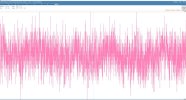
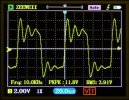
The two images below show transient output response for a 10kHz square wave input at low power levels. Uncompensated feedback shown on the left, where output transformer ringing causes exaggerated response to any and all transients, and while 60kHz ring is not audible, it does create audible error in reproduction. With proper feedback compensation shown on the right, the amplifier is now critically damped, meaning that there is a brief overshoot, but it is brought back under control very quickly and the audible 10kHz square wave is more faithfully reproduced.
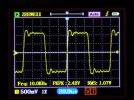
It is interesting to compare the transient response with compensated feedback above to the open-loop (no feedback) response shown below for the same amplifier. With no feedback, the input does not see the output transformer resonance, so it reproduces the 10kHz square wave beautifully, at least in terms of there being absolutely no overshoot or ringing. (just as the blue response in the chart above has no resonant spike at higher frequencies.) Note however, the result of the rapid frequency roll-off above 10kHz- the amplifier is becoming a low pass filter, rounding off the edges of the square wave by attenuating all of the higher frequencies required to reproduce the square edges. The rise and fall edge rate is quite slow, meaning it will have more difficulty giving crisp edges to transients in the music. Now, things become philosophical- what is better? The very smooth, rounded reproduction of open loop, meaning you will not be hearing much content above 10kHz, or the more technically precise representation of the square wave above with more overshoot? There are a lot of factors to consider- The very much better bass response could be compelling, but my output transformer is so small it would saturate at higher power levels and never deliver the 15Hz promise seen at very low power, so maybe it does not matter. The very much better high frequency response from 10kHz all the way to 60kHz seems appealing, but I probably could not hear it. Great arguments can be made for either side, but I will attest running open loop does sound very good (to my old ears at least). I ran this amplifier open loop for a good while, and it was only the fact that the sound fell apart at higher volumes that I decided that compensated feedback was the only way to go. It is now apparent that from sound quality at lower levels alone, there will be fans of either approach.

I am going through all of this to think out loud, but also to indicate that the Analog Discovery will enable you to have more tools to observe and understand what impact the modes of feedback, and to what degree, and what compensation have on the actual behavior of the amplifier, and ultimately the accuracy of reproduction. When you have this increased visibility, you will no longer have to choose or tune feedback based only upon how it sounds. Perhaps this is interesting to you, and perhaps not- I don't disagree that in the end, all that matters is how much you enjoy the amplifier. For me personally, and my engineering background, I enjoy knowing that what I have built has technical merit beyond just sounding good, and that adds to my overall enjoyment, be it placebo or not.



 Glad to hear your ears agree with mine. Did you play with different feedback resistors? With that switch you could wire it to AB listen without having to break out the soldering iron between sessions.