Just chiming in on this very old thread as it relates to the Marantz 2230, and to add an interesting commentary on recent observations regarding some replacement caps being used in the classic and vintage equipment field, and the real world requirements for such parts.
It is a long commentary (so long it's in 2 postings). But I am not intending to hijack this thread from the OP. Only merely to add an experiential aside to it.
We have had as a 'garage' system for over 20 years now a 2230. When we first acquired it, I did a minimum restoration to protect the outputs and assure safe operation. And it ran that way for about 15 years or so, until one afternoon I noticed the OE Elna main filter was dripping electrolyte all over the counter under it. Then it finally got the full treatment that I normally lavished on my Fisher tube instruments. And it had earned it.
My rule of thumb with vintage equipment is to respect the original designer's voicing and circuit choices to preserve the device for future generations to enjoy. It's the philosophy of a trust. Heavily hacked up examples are simply not as desirable or valuable to future generations. I've seen this with many Fisher tube instruments that have been Dr. Stereo'ed and modified into oblivion, and no longer work, look, or sound like a golden-era Fisher anymore. These old classics are now marching gracefully into their sixth and seventh decades, and every generation rediscovers them anew. And there is then a fresh run on them.
And every 10-15 years or so, some enthusiasts and techs armed with their Wellers, scopes and fresh parts somehow think that an instrument that continues to admirably function 60 years out can be made 'better' with some wholesale circuit and parts changes. And so many are lost to the modification beast each time.
Today, very few intact specimens faithful to the original design now remain, and those that do are now commanding increasingly high values. And many of those made 'better' by being converted to different output tubes and heavily reworked circuits are now sitting in landfills or being used as parts donor units.
But I digress. Back to the 2230.
So interestingly, with that philosophy, on this 2230, Silmics were used in many locations not just for their excellent performance, but also because the instrument was originally built with Elnas throughout in the early 70s. And they DO sound good. Where a Silmic would not fit, a comparable quality Nichicon was used. Every board was renewed, but not reinvented, or values changed. Original active components were not replaced if they still functioned well. And most all did, as the 2230 operates them all fairly conservatively.
For that big single filter, the elderly hemorrhaging Elna was replaced with a screw terminal Sprague Powerlytic (at that time a wallet-wincing $50+ capacitor). A fine replacement that should last a very, very long time, and perform well. And it has. For the next replacement, I'll be watching from above.
The 2230 is one of the later capacitive-coupled output transistor designs by the big makers of that era. A dinosaur by today’s standards, but still a rich sounding, musically captivating one. And while all the other parts choices renewed the 2230 to its original sonic lushness, the ones that had the most impact -- by far -- were the two main couplers. The originals were starting to fade. And I was fortunate enough to still have in my dusty parts boxes two NOS Black Gates in the exact values needed.
The 2230 was about to cross the Rubycon (pun intended).
And that one singular parts replacement transformed the little garage 2230 into a giant killer. When visitors walk into that garage, their heads turn and their jaws drop. Yes, Black Gates in the direct signal path are really that good.
So the little 2230 sings along faithfully, shocking visitors, to the present day. Only a couple people knew what was its under hood secret.
...
I don't do too much bench work anymore because of my failing eyes. Most of my bench gear is now gone or packed away for the descendants. I still give advice on the care of ancient Fishers when I can. But I recently had an interesting conversation with a still very active professional tech who I occasionally send work to about what he's been seeing lately. The conversation turned to capacitors.
In recent years, 105c rated, and in particular low impedance, high ripple caps have been dropped into a lot of gear as replacements by measurement-obsessed enthusiasts and hobbyists (many of whom openly sneer at audio grade parts and define an electrolytic’s worth based solely on advertised impedance, ESR, tan, and ripple values). A great many wannabe engineers among them, who know just enough to insult and offend others (particularly curious beginners, which I hate to see).
The Panasonics in particular have gotten a lot of attention by the hobbyists from this crowd over the years. The Pannys have great specs, they’re compact, and they’re cheap (for a first-tier maker part). A lot of professional techs also use them for service work, too, mainly because they're inexpensive, readily available, and saying so keeps the customers happy.
Out of the blue, my old tech friend voiced his opinion on these caps after many years in service, and how they’re doing now. And his opinion was "not well". Many units he is seeing come in with 20+ years on them are now leaking. And in many cases it is destroying the boards underneath them. He is not seeing the same problems with other first-line Japanese caps, and is now replacing the bad Pannys with Nichicons where the board can still be saved.
And as a final unsolicited comment, he added that in the last 30+ years as a tech he had yet to ever see a failed Black Gate on his bench, and in his experience they seem to be lasting, and still testing, like they will run forever. And that is consistent with some other information I understood about these remarkable, exotic, eye-wateringly expensive caps. They were originally designed to have an indefinite service life exceeding 30 years. And they apparently have. That is quite a contrast to the leaking, board-destroying, FC and FMs now crossing my tech friend's bench.
So were the BGs worth the 10x premium over an FC 20 years ago? I'll leave that for you to decide this far out.
This is not to be a knock on any particular brand of part, and in fact in today’s industry, getting 20-25 years out of an electrolytic is an excellent service life. Those Pannys delivered full value. Most consumers don't even keep their equipment that long.
But it does lead into some broader observations about what hobbyists fixate on today, verses what the designers and us now retiring (or soon to retire) hands considered relevant 30, 40 or 50 years ago.
...
The first is that most competently designed instruments and circuits, both today and 60 years ago, were designed conservatively. And most will operate perfectly well and for a very long time on general purpose electrolytics.
The hobbyist obsession over high spec, high ripple and very low ESR, impedance and leakage specification capacitors today as somehow required for good power supply operation is simply unwarranted for most equipment then, and now.
That is not to say that the capacitor manufacturer's specifications do not matter. They do. But for a well-designed supply or other circuit, the more modest performance of a general purpose capacitor works perfectly well for many years, and in fact have been used in both mainstream and in a lot of even 'high end' consumer electronics. These instruments were designed for such mainstream parts.
Crack open a fancy 25-30 year old Kilowatt-eating Classe mono block (that still works and measures great), and you'll find it stuffed full of inexpensive 85c general purpose Nichicons. Our old Cal Alpha, a now legendary 30 year old tube DAC that sold new for well over $2,000 (a black box with tubes and zero internal ventilation), is loaded with cheap general purpose Taiwanese caps.
It recently got a recap, and not with low impedance or high temp Pannys or PWs.
There are exceptions to this, and that is where a more aggressively specified part may be worth considering. Some old Counterpoint gear immediately comes to mind where the supplies were designed at the ragged edge. But absent some unconventional designer choices, most equipment will not require a Panny FM or Nichicon UPW to operate well again for many decades.
The general build quality of the replacement part and the good original design around them will determine that outcome.
Again, most competently designed equipment was designed for general purpose capacitors, not heightened specification ones. Including in the power supplies. That capacitor manufacturers make such specialized capacitors does not necessarily mean that the designers use them. Where you find an exceptional case that requires unusual servicing (i.e. a problem design), some of the higher specification replacements are often considered in the field. But otherwise, a similar general purpose part is perfectly appropriate ... and what the circuit was designed to use.
...
The second observation, and a corollary to the first, is that with few exceptions, most older equipment does not need a 105c part, and the use of a standard 85c part will operate for a very, very long time. Almost always because it was well designed to do so. Among the warmest running consumer electronics were hot-running tube gear stuffed full of 15 or 20 burning vacuum tubes (all often stuffed in a tight little cabinet). Yet I would routinely see 45 and 50+ year old Fishers, Scotts and Macs still cruising along nicely on their original 85c (or lower) rated Mallory, Sprauge or GI twist locks. The only thing that typically happened (if they weren't cold energized by a foolish collector after sitting too long) was fading capacitance after about 55 or so years. Yes, even those great old cans from the Kennedy Administration sometimes start drying out.
And I would always replace the tired small under chassis electrolytics on them with 85c Atoms, which are still soldiering on fine, some now in service for over 30 years themselves and still working great.
The same thing is true for your classic Marantz receivers, and most all other older audio electronics. And a lot of more recent production equipment, too. They were designed around 85c parts, and many go on for decades on them. A 105c replacement is a luxury, but rarely a necessity, in those applications. If you want to drop 105c replacements in your PSU build, go for it. But don't preach to others that it must be so, or that they are making some major mistake using an 85c part. That's a falsehood.
As I mentioned, there are some exceptions. But they are mainly from failures of design ... a cap practically leaning on a regulator sink or provided inadequate ventilation is not going to last as long. Or an unusual application environment: a hot running car or an oven or heater containing electronics. There, a 105c part or higher might add a couple extra years of service.
...
And that leads into the reasons why the higher temp/low impedance parts have gained favor in recent years.
What spurred on the hobbyist rage towards the high temp, low impedance/ESR caps have been two things, neither of which you will find in decent older gear: the stolen-formula capacitor plague of a couple decades ago (where the wrong stolen formula prematurely failed, destroying thousands of boards), and the trend to miniaturization involving tight and poor placement of mainly dubious quality Chinese capacitors in more recent equipment.
People don't realize just how hot 85c is, let alone 105c. Way too hot to even touch. Those are temps more associated to a heavily leaking or shorted part. Most semiconductors have difficulty even operating at those temps. And virtually no decent consumer equipment ever runs near that warm. Again, there are exceptions, but I am taking about the norm.
A few years ago, a poster on one of the we-know-best-DIY-audio-science boards ridiculously pronounced that the best replacement capacitors for these consumer electronics supplies were automotive grade capacitors. Now maybe if your Marantz is sitting on a running gasoline engine, or your preamp runs three inches from a red hot exhaust manifold, those caps might make a difference. Or when the cheap Chinese caps on the oven controls of your Kitchen Aid oven crap out after an ill-advised 900F self-clean cycle.
But in the usual consumer electronic operating environment of 40-60c, a 135c automotive part is gross overkill, both in specification and to the wallet.
And applying the usual temperature/life exponential calculations, an 85c part will still last many decades in most equipment. A 105c one will likely outlive the installer, at least as to ambient temperature related declines.
Again, if you want to use a 105c part, do so. But don't deride the use of 85c parts that are just as good from a practical perspective in most situations. It's what the designer used in virtually every case ... unless they were working around a problematic design.



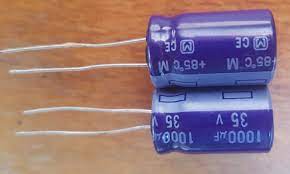




 and for sure this is the holy grail for recap audio, especially for 70's SS cap coupled receivers and amps.
 , but I feel that the lower bass is missing to enjoy the music at its fullest
 .
.