

You are using an out of date browser. It may not display this or other websites correctly.
You should upgrade or use an alternative browser.
You should upgrade or use an alternative browser.
Fisher 400 - phono works!
- Thread starter kappclark
- Start date
-
- Tags
- fisher 400
Register to hide this ad

On the 400, a 250W bulb is essentially not doing a damned thing, but taking up space. It's capacity exceeds the NORMAL FULL LOAD DRAW of the 400(200W), and does nothing to limit current. Take it off and run it straight to the wall, recheck all your voltages.
Yeah, in other words.....take off the training wheels, and skin yer knees a few times.
Yeah, in other words.....take off the training wheels, and skin yer knees a few times.

Tim D
Super Member
The DBT w/250W bulb would represent an approximate 60 ohm restriction in your line in. Power = Voltage squared/Resistance or said another way R = V squared/P. If you plug in 120V and 250W into the equation you get around 57 ohms. That's a significant dropping resistor in your line. Ok for testing but going to really restrain and hold things back if you run daily that way. So it's doing more than taking up space.
Note that the 250W bulb insures that even if you have a dead short in your amp/receiver and all 250W goes against the light bulb that you won't pull more than about 2 amps. (P = V * I, or 250W = 120V * 2.08A). Good for testing in case you have a short or excessive current draw in your unit.
Personally I use a variac and a Kill-a-watt so that I can measure what is coming into the amp. I then measure the power supply voltages and important voltages on every tube. My usual goal is to not have a variac (or DBT in the circuit when I'm done working on it.) unless my line voltage is way high - which mine is not. If your line voltage is high you may want to invest in a bucking transformer (maybe DIY.) A bucking transformer will lower your input voltage without having that lossy resistance (light bulb) in your line which brings a whole different set of somewhat undesirable affects. I usually put a thermistor (CL-90) in my line which helps protect the power switch from arc'ing and also drops about 1 or 2 volts when warmed up. For me that is all I need. Others may need to drop more than that.
As a check though, you could measure how much voltage is actually being received by your unit with the bulb in place. If it is lower than 110 then it is dropping too much. You could also measure what is your line voltage. If you are 120 or less I'd vote to just put in a thermistor and leave it at that. If it is much more than 120 then you might want to consider other options (bucking transformer.)
Note that the 250W bulb insures that even if you have a dead short in your amp/receiver and all 250W goes against the light bulb that you won't pull more than about 2 amps. (P = V * I, or 250W = 120V * 2.08A). Good for testing in case you have a short or excessive current draw in your unit.
Personally I use a variac and a Kill-a-watt so that I can measure what is coming into the amp. I then measure the power supply voltages and important voltages on every tube. My usual goal is to not have a variac (or DBT in the circuit when I'm done working on it.) unless my line voltage is way high - which mine is not. If your line voltage is high you may want to invest in a bucking transformer (maybe DIY.) A bucking transformer will lower your input voltage without having that lossy resistance (light bulb) in your line which brings a whole different set of somewhat undesirable affects. I usually put a thermistor (CL-90) in my line which helps protect the power switch from arc'ing and also drops about 1 or 2 volts when warmed up. For me that is all I need. Others may need to drop more than that.
As a check though, you could measure how much voltage is actually being received by your unit with the bulb in place. If it is lower than 110 then it is dropping too much. You could also measure what is your line voltage. If you are 120 or less I'd vote to just put in a thermistor and leave it at that. If it is much more than 120 then you might want to consider other options (bucking transformer.)

Thank you all -- she is flying solo now, and no surprises .... now have excuse to get a kill-a-watt (thks for suggestion) .. for today, I think I will just play ...might start the dial re-stringing - seems to have more power than I expected ...
happy also to pick up WGY out of Albany...(outdoor antenna)
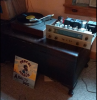
happy also to pick up WGY out of Albany...(outdoor antenna)
I have been listening to record albums since 7 this morning -- I have been a vinyl fan for 40+ years ... I have never heard a phono setup like this -- the performance is addictive ... Every record reveals MORE detail, vocals, space, pace etc ...I am not sure if it the tube sound or the fabulous phono section ... what a great combination ..I can't get enough ... Listened to a variety of styles - now am listening to Aja by Steely Dan -- the fisher makes this very good recording just so good .. before that was Rumors (Fleetwood Mac) -- absolutely amazing ... the difference is tubes and a genius named Avery Fisher ... Recommend album The Circle Game by Tom Rush --
I am afraid I will be so terribly disappointed when I connect the network player to the AUX jack - will FLAC files sound anywhere near as good ??
the Yamaha receiver I have upstairs does not have a phono, so I used a basic outboard phono preamp through the line input, and it did the job - it played the records, but not like this --- this is an experience ..
They say "You don't know what you don't know" -- well I now know that I really didn't know about tube sound ... this is like some mountain top experience for me -- Honest!
The TT is a stock AR, with a Shure M97 -- the speakers are an older set of PSB Alphas (from mid 90's) .. there is more than enough power for them (91 db sensitivity) -- I now understand why this is such a hot item on EBay -- and why this wonderful group has so much enthusiasm ... this is a very high quality piece of equipment ..all the stuff I have owned before was decent (Yamaha, Onkyo, NAD, Polk etc), but this is simply a higher tier ...
This unit does not distort -- everything is there -- it doesn't seem to give ground...I have zero listening fatigue ...
Sorry to go overboard - but I couldn't have done this w/o the help of the fellow enthusiasts here - and I thank you all for encouraging me not to bail on the Fisher in its original condition -- I thought there was no hope -- but(!)
Newly converted, I humbly remain ..
I am afraid I will be so terribly disappointed when I connect the network player to the AUX jack - will FLAC files sound anywhere near as good ??
the Yamaha receiver I have upstairs does not have a phono, so I used a basic outboard phono preamp through the line input, and it did the job - it played the records, but not like this --- this is an experience ..
They say "You don't know what you don't know" -- well I now know that I really didn't know about tube sound ... this is like some mountain top experience for me -- Honest!
The TT is a stock AR, with a Shure M97 -- the speakers are an older set of PSB Alphas (from mid 90's) .. there is more than enough power for them (91 db sensitivity) -- I now understand why this is such a hot item on EBay -- and why this wonderful group has so much enthusiasm ... this is a very high quality piece of equipment ..all the stuff I have owned before was decent (Yamaha, Onkyo, NAD, Polk etc), but this is simply a higher tier ...
This unit does not distort -- everything is there -- it doesn't seem to give ground...I have zero listening fatigue ...
Sorry to go overboard - but I couldn't have done this w/o the help of the fellow enthusiasts here - and I thank you all for encouraging me not to bail on the Fisher in its original condition -- I thought there was no hope -- but(!)
Newly converted, I humbly remain ..


tonyg88
Super Member
You want to really flip out, Bill? Get a Pro-Ject Debut Carbon TT and drop $700+ on an Ortofon 2M Black cart. Do the proper cart alignment. You think you hear detail now? The 2M Black is unbelievable. "Aja" is my test drive record. Every cymbal hit is clear as a bell. Thorne
I have the blue version which sounds great
You want to really flip out, Bill? Get a Pro-Ject Debut Carbon TT and drop $700+ on an Ortofon 2M Black cart. Do the proper cart alignment. You think you hear detail now? The 2M Black is unbelievable. "Aja" is my test drive record. Every cymbal hit is clear as a bell. Thorne
Aja is a fabulous recording - I just finished listening and find it so much more satisfying than the CD..
Somewhere I bet there is a thread on AK "Best test records for tube stereos" or something like that --- I nominate Aja, and also Rumors and finally Tom Rush "The Circle Game" .. I remember listening to "Carmel" by Joe Sample at a high end place in Bryn Mawr PA - I bought the Polk 10a's on the spot ...There are so many wonderful recordings out there -- so nice to hear the original record of Procol Harum "A Salty Dog" just as you remember it from college..
early Cd releases of rock albums were such a disappointment sometimes either technically, or the fact that it was "re-mixed" so the sound was essentially unfamiliar..... vinyl became my refuge....and still is. In 80's with CD's coming I sold most of my record collection (I do regret this) BUT-- We have a used CD store in Brattleboro, and they also carry a large stock of good quality vinyl....hope to pay a visit this weekend..
I recall well playing the cartridge game - enjoying the subtle differences between a Pickering and say an Empire, or Audio Technica.. ... had a decent turntables through the years, but always mid-line ..never ultra high end -- Thorne - I must swing by HV HiFi on my next trip back to Philly and drool !

Gotta love "A Whiter Shade of Pale" -- We did it in out band back in the 60's -- Hammond organ, Leslie, and all...........
Congrats on your 400!
Dave
Congrats on your 400!
Dave

I'll play: Paul Simon's Graceland. All day long.
Seems like there is an opportunity to come up with a great thread about the best vinyl .. Never heard the vinyl of unplugged - maybe I can find in Brattleboro this weekend..
right now listening to a London FFR recording of Beethoven 3rd piano concerto (1973) ..Ashkenazy is soloist w/ Solti and Chicago Symphony Orchestra ... can hear every note and nuance in this fabulous performance.... the Fisher has added so much joy to the music .. wife could not believe how good the sound was with Tom Rush (one of her favs) ...

right now listening to a London FFR recording of Beethoven 3rd piano concerto (1973) ..Ashkenazy is soloist w/ Solti and Chicago Symphony Orchestra ... can hear every note and nuance in this fabulous performance.... the Fisher has added so much joy to the music .. wife could not believe how good the sound was with Tom Rush (one of her favs) ...

fred soop
Super Member
The DBT w/250W bulb would represent an approximate 60 ohm restriction in your line in. Power = Voltage squared/Resistance or said another way R = V squared/P. If you plug in 120V and 250W into the equation you get around 57 ohms. That's a significant dropping resistor in your line. Ok for testing but going to really restrain and hold things back if you run daily that way. So it's doing more than taking up space.
.....
That calculated resistance is only for a fully illuminated bulb. Resistance is not linear as in a fixed resistor. It drops with a bulb that is not fully illuminated, possibly by a factor of 10 with a completely cold bulb.
Tim D
Super Member
That calculated resistance is only for a fully illuminated bulb. Resistance is not linear as in a fixed resistor. It drops with a bulb that is not fully illuminated, possibly by a factor of 10 with a completely cold bulb.
Fred,
A valid point that it won't be exactly 57 ohms as the voltage across it will be less than the nominal 120VAC. The voltage vs current plot is non-linear as you indicated. It can be easily measured with a kill-a-watt downstream from the DBT (to the point where the kill-a-watt drops out due to low voltage.) You could even make your own plot that way.
Here's a random example of a plot of an incandescent bulb's voltage vs current.
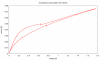
For a Fisher 400 it's going to attempt to come up to full operation, but with less voltage available with the bulb in the circuit. Assuming that it starts playing it's going to be drawing most of its design current - maybe 1.5 amps. How much voltage is across the light bulb would have to be measured, but it won't be anywhere near 120VAC since the Fisher will need most of that just to warm up and produce sound.
What does all that mean? Well, it means that you can't use the design values on the bulb to calculate the bulb's resistance as Fred indicated when used as a DBT. The resistance will be less than the design values.
Thanks for correcting me Fred.
Tim D
Super Member
So Fred shot holes in my math and he was right to do so. What got lost in the math though is why is it not a good idea to put a resistance in the input to a power supply? How about an analogy?
A good example would be the water supply for your house. If you take the valve that supplies water to your house and close it by 90% you might not notice it much when you wash your hands in the sink. The faucet simply may not draw enough water (current) to cause the overall water pressure to drop (by much) when washing your hands. But then go take a shower and have someone flush the toilet at the same time and you will notice the water pressure will drop dramatically with that supply valve closed down. Your shower may become a trickle or at least the force of water will be noticeably decreased. This is due to the added restriction to the supply.
For the example, water pressure is analogous to voltage (electrical pressure). If you put restrictions (resistive components) in the input to the power supply you are going to hurt the power supply's ability to provide a steady voltage (pressure) to the amplifier and other circuits during increase in demand. That is very undesirable and leads to a decrease in available power and an increase in distortion. There are better ways to lower the voltage to a power supply. Bucking Transformers come to mind. There are others. In fact I am guilty of falling into this trap because I normally use thermistors in the power supply primary in part to lower the incoming line voltage by a volt or two. Thermistors are another type of resistive component. For me that small bit I can sacrifice, something bigger - not so much.
Note that in all this I have seen threads where members are adding resistors in the power supply to balance out, lower or adjust the B+ draws sometimes to compensate for higher line voltage. The same pitfalls apply in that such restrictions are like closing the valve down. It harms the ability of the power supply to provide steady voltage when there is an increase in demand for current. Sometimes it's unavoidable and most of you will point out that power supplies are full of resistors. That is all correct, but now you know the impacts of those decisions. Use resistive components in the power supply input if you must but avoid using them if you don't.
A good example would be the water supply for your house. If you take the valve that supplies water to your house and close it by 90% you might not notice it much when you wash your hands in the sink. The faucet simply may not draw enough water (current) to cause the overall water pressure to drop (by much) when washing your hands. But then go take a shower and have someone flush the toilet at the same time and you will notice the water pressure will drop dramatically with that supply valve closed down. Your shower may become a trickle or at least the force of water will be noticeably decreased. This is due to the added restriction to the supply.
For the example, water pressure is analogous to voltage (electrical pressure). If you put restrictions (resistive components) in the input to the power supply you are going to hurt the power supply's ability to provide a steady voltage (pressure) to the amplifier and other circuits during increase in demand. That is very undesirable and leads to a decrease in available power and an increase in distortion. There are better ways to lower the voltage to a power supply. Bucking Transformers come to mind. There are others. In fact I am guilty of falling into this trap because I normally use thermistors in the power supply primary in part to lower the incoming line voltage by a volt or two. Thermistors are another type of resistive component. For me that small bit I can sacrifice, something bigger - not so much.
Note that in all this I have seen threads where members are adding resistors in the power supply to balance out, lower or adjust the B+ draws sometimes to compensate for higher line voltage. The same pitfalls apply in that such restrictions are like closing the valve down. It harms the ability of the power supply to provide steady voltage when there is an increase in demand for current. Sometimes it's unavoidable and most of you will point out that power supplies are full of resistors. That is all correct, but now you know the impacts of those decisions. Use resistive components in the power supply input if you must but avoid using them if you don't.
Nicely explained - always liked the water - valve - pressure analogy. I am happy to say it appears the PS in the 400 is working very well, as are the 7868's .. I imagine the water analogy works well with capacitors, and sending 500V to a 100V cap will burst the water baloon....continuing on in the water world, I have always tried to think of caps as springs or like the bladder in our water storage tank, which provides water pressure to the house, after the well pump (the "voltage source") has done its job in pressuring the water tank...


