• The move to the new server is done. There are some software and database maintenance updates in process. This has us passing the hat around to help out. We appreciate any donations. Seriously, even a dollar helps. The payment page may be found here - https://www.audiokarma.org/support.html

Fisher FM-100-B issues

Your unit in fact does have the diode matrix stereo/mono switching circuit -- it is built onto the small vertical board located right behind the mode selector switch. Therefore, the stereo/mono switching circuit can't be the problem unless there is a lose connection on the board, which is unlikely.

Since you now indicate that it only happens in stereo mode, that shines a light on the MPX sub-chassis then, where in your case, it looks like you have not recapped the output coupling caps. The style of caps that Fisher used were good at holding their value, and good at not leaking, but rather infamous for becoming intermittent with time -- which is exactly the symptom you are describing. Replacing those caps (size appropriate caps required) will quite likely solve your problem.

Dave
 
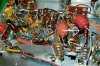
These are the culprits, eh? (See white arrows in the attached picture)
They will be culled and replacements will be installed over the holiday weeks.
Meantime, I will do my best to get voltages recorded under test conditions for the MPX tube pins. I will report back.
 

Attachments

  • 20191217_010544.jpg
    20191217_010544.jpg
    128.4 KB · Views: 45
Remember that all schematic indicated voltages were taken with no antenna connected, and the tuning dial turned fully down to the low frequency end, so that the unit is receiving no signal. It does make a difference.

Dave
 
Of course Prof. Dave was right.
Replacing the coupling caps in the MPX section corrected the dropped channel. Now I'm getting decent reception, good stereo switching, and a fantastic tone. I think it's very nearly ready for an alignment and to take a permanent place in my system. I'm really looking forward to this project wrapping up, and having this incredible sounding and gorgeous unit in my system.

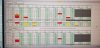
I took a complete set of voltages. See attached. The green columns are spec voltages , DC (NL= not listed, G=ground, H=heater - not exhaustive). yellow is where I have a voltage, but nothing in the service manual. Red is where things are out of whack. Orange is mildly out of whack. Looks like I need to replace the 6DJ8 in the V8 position. Yeah?
Also not sure if the variances in the MPX voltages (which are generally much improved) are an issue at this point, especially since I'm getting good reception and stereo separation... remarkably good, actually.

Muting isn't working especially well, but that's not a huge concern for me as I have only 2 stations I regularly listen to so I'm not scanning much.

I'd love input if folks think they can assist with the remaining out-of-spec voltages, before I take it in for an alignment.

Many thanks!

Oh, and if anyone would like to use my spreadsheet for their own restoration/testing, just shoot me a message, happy to share it!
 

Attachments

Most voltages look fine, but some should be rechecked or were taken under conditions of unknown influence:

1. Voltage variations at V102 are no doubt related to the specific tube installed, and are fine.

2. Voltage at V100 pin 6 should be rechecked for accuracy. This is likely wrong.

3. On V9 pin 7 -- recheck, or try another tube. Likely no problem.

4. On V8, the voltage at pin 7 is no problem. Pin 1 voltage is likely not accurate -- or if it is, is likely the reason the muting function performance is off. Pin 2 voltage will likely come in line when pin 1 voltage is resolved.

5. V6 and V7 pin 1 readings: likely wrong due to your meter's loading. Try connecting a 100K resistor in series with your red meter probe when taking these readings, with the resistor close to the point being measured.

Make sure there is no external influence on the tuner circuits: Turn off all florescent lamps, and remove any nearby pieces of equipment that use switching type power supplies, including computers, wall warts, and LED lamps. These two sources throw out tons of RF garbage, so that you think there is no signal influence because of no antenna connection and the tuning dial turned all the way to the left, but really, there still is, and particularly so because the bottom cover is off.

Finally, You might consider installing Mouser P/N 995-SL03-22101 for the current limiter device. A CL-90 is a 2 A device and really too big for the tuner. As a result, when using it, it never really gets up to full operating temp, leaving the temp it actually achieves susceptible to ambient conditions (winter/summer, in case, out of case, etc.), which can contribute to drifting. The part number I gave you is for a 1A device, and eliminates this concern. In general, a CL device should not be rated for more current than the fuse is for the unit being protected.

I hope this helps!

Dave
 
Well, I've finally returned to the FM-100-B.
I got it working quite nicely at Christmas, despite the few remaining, previously documented imperfections. I wasn't too worried because I wasn't typically using the tuner for more than an hour or two a couple times a week. Well, I'm now exclusively working from home and spending a LOT more time in the music room/home office (which is also the electronics shop and a guest room....). The tuner is now seeing 50 hours of use per week, and 60+ for the amp (which now runs much cooler thanks to Dave's Zener diode clamp modification).

This increase in usage made me want to ensure the FM-100-B is operating exactly as it should (I know the X-100-B is), and also wonder about tube life. Knowing I never took care of those lingering "imperfections", I opened up the FM-100-B. I swapped the CL-90 with the recommended part (Thanks again, Dave!). Tube sockets were cleaned again, with a better brush. Pots were hit with D5 again, and I applied some oil to the tuning wheel shaft bearings (which cured their squeak). I also rechecked operating voltages,with my VTVM so loading would not be a source of error, and after having shut down and unplugged... well, everything except the variac, the VTVM and the overhead incandescent light. My laptop was nearby, but on battery power, So I think stray RF should have been minimized.

The attached photo shows my measurements.

V3,V4, V9, and both V 101, and 102, remain close to the right values, and V6 is indeed close enough for comfort, having resolved the loading issue during measurement. The issue with V5 pin 6 remains. And the issues with V7, 8 and V100 remain as well. I didn't check V1 or V2.

I thought I'd try new 6au6/a tubes in the 5 6 and 7 positions, and I have a spare, known good GE 12at7wa that I put in for V100. I do not own a spare 6DJ8 to swap for V8. Rechecking voltages, I stopped pretty quickly because even with the new tubes, I got nearly the same exact measured values, plus or minus 10% (which isn't enough to bring them in line).
I'm not sure where to go with it at this point. Suggestions welcomed.
 

Attachments

  • 20200324_233022.jpg
    20200324_233022.jpg
    85.6 KB · Views: 8
I don't think you really have any problems. For the 6AU6 tubes, their screen grid (pin 6) current can vary widely from one tube to the next, which is normal and really insignificant. It will affect the pin 1 and pin 6 indications and your indications at these locations is just not that out of the realm of normalcy. Also, make sure the pin 1 voltage at V7 is made with the muting circuit set as indicated.

The pins 1-2 and 3 of V8 will be highly tube dependent. As long as the muting function is working correctly, this is the biggest indicator that all is well.

The voltage at pin 7 of V8 will be very dependent on the strength of the MPX station received, as well as the operating condition of the MPX unit.

As for the voltage at pin 6 of V101: Ground point 1 of the MPX sub-chassis connections as shown on the MPX section schematic, and then take your reading. Your very high reading there is almost surely due to the noise detector circuit reacting to the white noise present when no station is being received.

Let us know!

Dave
 
Dave, thanks as always for the input!

I won't worry about the 6AU6 tubes. Side question: what operational issues would I experience when a 6AU6 starts to go bad?

Muting and stereo switching is working quite well, so it sounds like V8 is not a concern, despite it consistently being a negative value even with strong stereo signal (radio station, as I don't have a working FM signal generator).

I'll look at V100 again as soon as I get a chance, and report back.
 
As the 6AU6 tubes weaken, their gain is reduced. But honestly, you typically won't really know if one is getting weak because there is just so darn much gain in the IF strip with 5 tubes that one has to really fall off the bandwagon before you'll know it from a general operating condition.

If I may, I'd like to ask a question for my own info I'm gathering on specifically the FM-100B: Assuming your amplifier is fully warmed and ready to go, have you ever noticed when turning the tuner on that:

1. During the short time window where the tuner is initially warming up (i.e. that short period where the signal strength meter is rising from 0 up to it normal 4.5-5 indication, and the audio is coming up), that there is either a very short squeak or squeal during that time (not loud, but easily loud enough to hear), or that the meter sort of "burps" during its rise (with or without the noise)? Or..........

2. Instead of #1 above, the signal strength meter remains at 0 during the same short warmup period (with no audio output), and then at the end of it, the meter suddenly and quickly rises to its normal indication, and the audio comes on rather instantly, as if a switch was suddenly turned on? This scenario is usually not accompanied by a squeak, but if it is, it is extremely short and more subdued.

Any answers are appreciated!

Dave
 
Dave, happy to help!
The second scenario you describe is pretty much my normal experience.

To add some detail, mainly about the stereo beacon indicator:
Immediately as I turn the AC knob to Local, the dial lamp illuminates, as well as all visible tubes, and the stereo beacon lamp accompanied by the click of the relay a fraction of a second after power is turned on. For about 7 seconds after the power is switched on, the stereo beacon light stays on, then the relay clicks and the light goes off for about 3 seconds. The tuner produces no noise (other than the relay clicks) during this time. No squeal, no squeak, and there is no audible signal output. The signal strength indicator remains at the bottom of the scale.
At right about ten seconds after 'power on', the relay clicks again, stereo beacon light comes back on, and the signal strength indicator jumps almost instantly to full strength and the audio signal reaches full strength equally rapidly.

If it makes any difference, I normally leave FM muting between 4 and 5, Selector on Automatic, and I use a matching transformer between the tuner and an audiprisim model 6500 FM antenna.
 
Thanks so much for the information! The second scenario is also how my own unit acted as well -- until I put some new NOS non-Fisher labeled tubes in it where it then changed to the first scenario. I've also had a number of client pieces that I've gather information from as well, and always add to that whenever I can (as I'm doing here) to get the most accurate picture possible over the widest number of units. The bottom line is that neither scenario I presented is really normal, as the action at turn on should be the normal delay from cold tubes, and then as the tubes begin to conduct, the signal strength meter and audio should both start to rise and come in at a rate similar to that of the tube conduction ramping up in the final moments of their heating.

Thanks again!

Dave
 
Dave, small update:

After reading your above comment, I decided to experiment with the settings on my tuner to see if that changed anything. This morning when I "went to work", I turned FM Muting off, and selected MONO operation before turning the power on for the tuner. When I turned the power on (again to 'Local'), the results were slightly different than I am used to:

The same initial conditions occurred - all lights come on, meter remains still, near instant click of stereo relay and illumination of the stereo beacon light. Same 6 to 7 seconds with no sound, all lights on. Same relay click/beacon light extinguished at right around 7 seconds after start.

Then...
A slightly longer period with no sound, maybe 4 to 5 seconds rather than 3. So not dramatic, but noticable. After this 4 to 5 seconds, the signal strength needle went up more slowly than I am used to, and the "ramp up" to full signal volume was slightly longer as well.
Again, not dramatic, but if normal is about 1 second for full audio signal volume, and about 2 seconds for the signal needle to rise to full extent, with the new setup my tuner yielded full audio level in more like 2 to 3 seconds and the meter took 3 to 4 seconds to rise to rise to full extent.

These differences are small enough that it's quite possible other environmental factors were in play, but I figured I would offer some additional input.
 
I do appreciate the further input! As well, this is all checked on my own unit with the unit set to Mono operation with the Muting function turned off. The only difference is that when I turn my tuner on, I turn the power switch to the first "on" position ("Distant"), rather than moving beyond that to the Local position.

Also, do note this: There is a single relay in the FM-100B, that can only be activated (if required) after V8 warms up. The only "click" you should be hearing at turn on is that of the power switch itself. It is the very fact that the stereo switching relay is not activated that the Stereo Beacon lamp illuminates. In the deactivated state, the contacts controlling the Beacon lamp are in the NC (normally closed) state, which is the state the relay is in when receiving an FM MPX Stereo station. It is when the stereo pilot signal is not available that the relay then pulls in, and extinguishes the Beacon lamp. Therefore, the Beacon lamp should come on at the same time the dial lamps do (instantly) at turn on, but then turn off after about 7" after turn on, when V-8 begins conducting. The lamp will then either remain off, or turn back on as the tuned station so dictates. The timing is such that the Beacon may in fact quickly burp -- turning off and then quickly back on depending on how the RF section comes up to speed.

What I ultimately found when watching these events (how the meter and sound come up to speed), is that it is typically a fluid situation. That is, it may act one way as described at one time, and another way at another time if for no other reason than to be different. It is also dependent on how much down time there is between use.

Dave
 
On my 100-B my experiences with startup tend to emulate Dave's in the Distant (with regard to the Stereo beacon) mode with a mixture of Klamsoss meter Scenario's in that sometimes the strength meter comes up fast with the sound level, or slow, mostly depending on the length of time between start-ups. If less than 8 hours it comes up fast as the sound level increases, but a day or more it drags behind the sound level. It had initially a mix of FISHER tubes with sylvania's as I remember. (I'm in Arizona right now). I put a full set of NOS GE's (except the 12ax7 and 12at7's which are all Fisher Tele's) in the RF/IF positions with no changes before I left. Emissions and gm on both sets are >95% of spec. The MPX needs to be recapped (Apparently I didn't do that when I recapped and worked on it 4 years ago). I'll get on that when I get home, whenever that is with the Local and State Gov't's in total chaos(SNAFU!). We're fairly isolated where we are in Chino Valley.
 
Thanks Larry -- So you find it to be a fluid situation as well -- sometimes it acts one way, sometimes, another. I believe I've isolate the reason for all of this nonsense, and even developed a "cure" if you will. But frankly, I don't think anyone considers it enough of a nuisance to address. I only did because of the squeek, and it bugged me as to why......

Thanks both.

Dave
 
Back
Top Bottom