

You are using an out of date browser. It may not display this or other websites correctly.
You should upgrade or use an alternative browser.
You should upgrade or use an alternative browser.
Fulton Musical Industries
- Thread starter JBStemp
- Start date
Hello,
My name is Jordan. In my adventures of collecting, flipping and enjoying quality audio components of yesteryear, I have stumbled upon a pair of Fulton Model Js. I responded to a craigslist ad for free cassettes and when I went to get them, I was drawn to his speakers he had set up in his basement. They were Js, and they sounded great, and to my surprise he had an extra set in his garage that he wanted gone. I now have them, along with a mess of questions for you enlightened ones.
Now, one of the kickers of this deal was that I didn't receive the electrostatic tweeter array. It seems that my seller had them repaired about a decade ago perhaps, and they were lost, or not returned, or something. I believe that he originally took them to Natural Sound in Lincoln NE for repair, and then the store closed and possibly moved to Sioux Falls SD, then to Washington? and im not sure what happened from there. But being as this is some rare and special stuff used in these speakers I figured maybe you guys could help locate the fellow who has them, or maybe he is part of this thread. All I know right now is that his eBay Handle is thewhy1, and his name is Jim.
Anyways, thats one piece of the puzzle. In the interim of not having high range in my Js, I have heard from the guy I bought them from that some people have grwon fond of using these DJ cabinets for a high end instead of the blue electrostats?......http://www.ebay.com/itm/PRO-AUDIO-D...390267?hash=item3d17358bfb:g -0AAOxyyjpRwQms
seems like a strange choice to me... any thoughts? And while we are on that subject, what other options do I have for a high end if I cant track down the FMI 6 that belongs there?
I just recently got them into my basement for adjustments and initial testing, using only the bass cabs and fmi80 for now. I used a Dynaco SCA80 for my first tests, hooked to a digital tuner. I had the amp hooked to the very bottom terrminals, with the binding wires or posts connecting each row all the way up to the top one on each side. The FMI 80 was hooked to the third set up from the bottom, and it sounded a bit strange to me, however, I did not have it wired in reverse polarity like mentioned here. would that make that much of an audible difference?
when I hook it up in reverse polarity does that mean I keep the wires (+)to(+) and (-)to(-) on the terminals of the bass cab and then (-)to(+) and (+)to(-) on the speaker? my description is that the fmi 80 sounded like it had a limit, or a point where at around half volume distortion was evident. I hate distortion. All Ive ever wanted is a speaker with a very high tolerance for volume before it starts to distort, whether I turn it up that high on a regular basis is my choice, but i want to know my speakers can handle it when I want to.
Also, it seems that this was mentioned a few pages back but I didnt see a response to this question. The shorting plugs... I thought that the bass cab and FMI was rather mild upon first impression, but i know it is considered a natural sound speaker arrangement. When I pulled the bottom shorting plug, I definitely got more bass. Is there anything wrong with running it this way?
Since I dont have any tweeters at this point, I am just testing things out with bass cab and FMI80, should the shorting bars or straps or whatever be disconnected from the top row of terminals while I test in this incomplete arrangement? can I just take some tweeters out of some junk speakers and wire them up for my purposes right now? or do they need to be a certain kind or something?
Last question for now, and i believe this was asked earlier, for those of us less inclined as some, is there any absolute DO NOTs with these speakers, things that will result in irreversible despair and disrepair?
My name is Jordan. In my adventures of collecting, flipping and enjoying quality audio components of yesteryear, I have stumbled upon a pair of Fulton Model Js. I responded to a craigslist ad for free cassettes and when I went to get them, I was drawn to his speakers he had set up in his basement. They were Js, and they sounded great, and to my surprise he had an extra set in his garage that he wanted gone. I now have them, along with a mess of questions for you enlightened ones.
Now, one of the kickers of this deal was that I didn't receive the electrostatic tweeter array. It seems that my seller had them repaired about a decade ago perhaps, and they were lost, or not returned, or something. I believe that he originally took them to Natural Sound in Lincoln NE for repair, and then the store closed and possibly moved to Sioux Falls SD, then to Washington? and im not sure what happened from there. But being as this is some rare and special stuff used in these speakers I figured maybe you guys could help locate the fellow who has them, or maybe he is part of this thread. All I know right now is that his eBay Handle is thewhy1, and his name is Jim.
Anyways, thats one piece of the puzzle. In the interim of not having high range in my Js, I have heard from the guy I bought them from that some people have grwon fond of using these DJ cabinets for a high end instead of the blue electrostats?......http://www.ebay.com/itm/PRO-AUDIO-D...390267?hash=item3d17358bfb:g
-0AAOxyyjpRwQmsseems like a strange choice to me... any thoughts? And while we are on that subject, what other options do I have for a high end if I cant track down the FMI 6 that belongs there?
I just recently got them into my basement for adjustments and initial testing, using only the bass cabs and fmi80 for now. I used a Dynaco SCA80 for my first tests, hooked to a digital tuner. I had the amp hooked to the very bottom terrminals, with the binding wires or posts connecting each row all the way up to the top one on each side. The FMI 80 was hooked to the third set up from the bottom, and it sounded a bit strange to me, however, I did not have it wired in reverse polarity like mentioned here. would that make that much of an audible difference?
when I hook it up in reverse polarity does that mean I keep the wires (+)to(+) and (-)to(-) on the terminals of the bass cab and then (-)to(+) and (+)to(-) on the speaker? my description is that the fmi 80 sounded like it had a limit, or a point where at around half volume distortion was evident. I hate distortion. All Ive ever wanted is a speaker with a very high tolerance for volume before it starts to distort, whether I turn it up that high on a regular basis is my choice, but i want to know my speakers can handle it when I want to.
Also, it seems that this was mentioned a few pages back but I didnt see a response to this question. The shorting plugs... I thought that the bass cab and FMI was rather mild upon first impression, but i know it is considered a natural sound speaker arrangement. When I pulled the bottom shorting plug, I definitely got more bass. Is there anything wrong with running it this way?
Since I dont have any tweeters at this point, I am just testing things out with bass cab and FMI80, should the shorting bars or straps or whatever be disconnected from the top row of terminals while I test in this incomplete arrangement? can I just take some tweeters out of some junk speakers and wire them up for my purposes right now? or do they need to be a certain kind or something?
Last question for now, and i believe this was asked earlier, for those of us less inclined as some, is there any absolute DO NOTs with these speakers, things that will result in irreversible despair and disrepair?

sheltie dave
Addicted Member
Yes, do not whip these speakers, they do not do LOUD.


timsclips
Well-Known Member
I knew this store well, went out of business in 1979 after to original owner sold it.Natural Sound in Lincoln NE
these speakers cant do loud? seems strange... I mean I know that they are built for accurate reproduction, but i should be able to crank it a bit if I want right? I hear distortion at about half volume from my rotel stack,120wpc, meters showing that theyre pumping about 100 w at peak into the Js
Guys, I still need some help if you could lend some of your knowledge.
I have the Fulton Js up in my listening room now. well, most of them. missing the esr6 that supposedly ebay handle thewhy1 has... I dont know. But anyways. I opened the cabs this week, flipped the 10 inch bass driver 180, put the even weight on the 12 in downfiring to send the cone down to where it once was ( a plate worked great), resealed everything with mortite, and lugged them 3 stories up to my music room. They really sounded pretty good with just the bass cabs and the fmi 80s to be honest. Im currently using a sansui g901db to drive them but I have a carver tfm35 amp i could use as well if suggested... what is the suggested power supposed to be to these? i read on the first page of this only 60w program material. so then what power should go to each driver if individually amped?
Im sorry I have so many questions. I really value your input here.
My lack of RTR electrostatics got me searching for alternatives, and i found that at one point. Dr. Fulton used EV t35 drivers with some peerless tweeters in a box as a substitute.... ive only seen one photo of this. anyways, I tracked down ONE Electrovoice T350, the seven pund big bad brother of of the t35. I hooked it to where i would hook the RTRs on the bass cab and it is very overpowering, can barely hear anything else but the single EV.
So at what frequency do the fultons crossover to the RTR electrostats???
what are your suggestions on using a set of these T350s in place of missing esr6? active crossover? 8ohm L pad? is an L pad enough to prevent damage? or are the fultons still feeding bad noise to the EVs?
Help
I have the Fulton Js up in my listening room now. well, most of them. missing the esr6 that supposedly ebay handle thewhy1 has... I dont know. But anyways. I opened the cabs this week, flipped the 10 inch bass driver 180, put the even weight on the 12 in downfiring to send the cone down to where it once was ( a plate worked great), resealed everything with mortite, and lugged them 3 stories up to my music room. They really sounded pretty good with just the bass cabs and the fmi 80s to be honest. Im currently using a sansui g901db to drive them but I have a carver tfm35 amp i could use as well if suggested... what is the suggested power supposed to be to these? i read on the first page of this only 60w program material. so then what power should go to each driver if individually amped?
Im sorry I have so many questions. I really value your input here.
My lack of RTR electrostatics got me searching for alternatives, and i found that at one point. Dr. Fulton used EV t35 drivers with some peerless tweeters in a box as a substitute.... ive only seen one photo of this. anyways, I tracked down ONE Electrovoice T350, the seven pund big bad brother of of the t35. I hooked it to where i would hook the RTRs on the bass cab and it is very overpowering, can barely hear anything else but the single EV.
So at what frequency do the fultons crossover to the RTR electrostats???
what are your suggestions on using a set of these T350s in place of missing esr6? active crossover? 8ohm L pad? is an L pad enough to prevent damage? or are the fultons still feeding bad noise to the EVs?
Help
Attachments
am i not getting a response because im in the wrong thread with this kind of question or what? like this thread 'fulton musical industries' is more for general information regarding the brand and history and im getting too technical with my questions? just looking for some advise..

soundmotor
super modified
am i not getting a response because im in the wrong thread with this kind of question or what? like this thread 'fulton musical industries' is more for general information regarding the brand and history and im getting too technical with my questions? just looking for some advise..
Great question, usually you can't shut people up on speakers.

Guys, I still need some help if you could lend some of your knowledge.
I have the Fulton Js up in my listening room now. well, most of them. missing the esr6 that supposedly ebay handle thewhy1 has... I dont know. But anyways. I opened the cabs this week, flipped the 10 inch bass driver 180, put the even weight on the 12 in downfiring to send the cone down to where it once was ( a plate worked great), resealed everything with mortite, and lugged them 3 stories up to my music room. They really sounded pretty good with just the bass cabs and the fmi 80s to be honest. Im currently using a sansui g901db to drive them but I have a carver tfm35 amp i could use as well if suggested... what is the suggested power supposed to be to these? i read on the first page of this only 60w program material. so then what power should go to each driver if individually amped?
Im sorry I have so many questions. I really value your input here.
My lack of RTR electrostatics got me searching for alternatives, and i found that at one point. Dr. Fulton used EV t35 drivers with some peerless tweeters in a box as a substitute.... ive only seen one photo of this. anyways, I tracked down ONE Electrovoice T350, the seven pund big bad brother of of the t35. I hooked it to where i would hook the RTRs on the bass cab and it is very overpowering, can barely hear anything else but the single EV.
So at what frequency do the fultons crossover to the RTR electrostats???
what are your suggestions on using a set of these T350s in place of missing esr6? active crossover? 8ohm L pad? is an L pad enough to prevent damage? or are the fultons still feeding bad noise to the EVs?
Help
The T350 tweeter is an absolutely amazing vintage horned tweeter when implemented correctly... When it comes to speaker and crossover design, I am a big-time newbie. But, I do have experience with Fultons and the 350
If you can figure out how to get the frequency range right to match up with the Fultons, I'd imagine it would make a good substitute (it won't touch what the ESR-6s can provide, but would still be a good step up from where you're at now)
Can't give you the specs or steps to make it happen, but setting the T350 with an L-pad so you can adjust volume, and getting whatever components needed to match the crossover freq of the J's, I'd think you'll be satisfied until you can come across the ESRs
If you only have one T350, be prepared to spend some serious money on another, these fetch big bucks for a vintage tweeter. But you could always get lucky and find one cheap/free.
Have tried most of the amplifiers in my signature on them. The Tandberg's definitely sound the best with them. Although they are 100wpc and 150wpc, I believe the Js have a 50 or 60 watt rating, and for how big they are and the INSANE amount of crossover components, they really don't need much power at all. I'd guess when I listen, the peak power maaaybe hits 10watts (but thats a total guess, could always hookup the KA-9100 to get a better idea)
Lastly, according the the J manual, the crossover point going to the electrostatics is 7K Hz... would want to shot for around that I'd imagine

Last edited:

Brian Beck
Active Member
I believe that Fulton used the T-35, not the larger T-350 in his Premieres. The Klipsch K-77 is identical to the T-35, just rebadged. The earlier versions used Alnico magnets, which is what I see in my Premiere tops. There was a later version with a ceramic magnet when cobalt became scarce.
Could be because of the AK server change. I am subscribed to this thread but I did not receive any notification about your recent posts.
Also, very few people know anything about Fulton/FMI beyond hearsay and conjecture. Hopefully, I have advanced beyond that to rumor and speculation
You ask a lot of interesting questions, some of which I have answers to. I am busy right now and will try later to help you on your quest.
am i not getting a response because im in the wrong thread with this kind of question or what? like this thread 'fulton musical industries' is more for general information regarding the brand and history and im getting too technical with my questions? just looking for some advise..
Could be because of the AK server change. I am subscribed to this thread but I did not receive any notification about your recent posts.
Also, very few people know anything about Fulton/FMI beyond hearsay and conjecture. Hopefully, I have advanced beyond that to rumor and speculation
You ask a lot of interesting questions, some of which I have answers to. I am busy right now and will try later to help you on your quest.
Brian Beck
Active Member
Jordan, are you still out there?
I have been very busy lately, but I did want to try to help with your questions. Plus I wanted to find the time look inside a set of Premier tops that I have, ones that use the T35 tweeter, and see If I could glean anything worthwhile about the crossover to the T35. I even took out a T35 to peek behind it, but I couldn't see deep enough into the recesses of a very complicated box to be able to discern anything useful about the crossover to the T35. It matters little anyway because your application will be quite different.
But first things first. The J Modular used the FMI-80 as the midrange/tweeter. Most of the music that you hear from the J Modular comes from the 80s. One variant of the J Modular that was sold combined only the 80s and the bass cabinet WITHOUT the electrostatic tweeters. The 80s alone, as you say, do fine in the treble. You might even live with that setup until a set of FMI-6 (ESR-6) electrostatic tweeters comes your way (keep looking!).
When the electrostatic tweeter is used, the 80 still runs full range, untouched on the high end. Read that again; nothing is done to roll-off the 80's high end, except for how the speakers, placed on their sides, and directed squarely forward, no longer put the main axis of the Peerless tweeters at your ears. So there is a spatial component to the crossover (as, truth be told, there is to most speakers). The electrostatic tweeters are simply connected in parallel across the main input terminals. Neither the bass cabinet or anything else in the main J Modular modifies the response of the electrostatic tweeter. All crossover components for that tweeter are in its own box. And yes, here Fulton added his touch. The electrostatic tweeter is modified in a few ways, most notably in the crossover, which is fairly simple. The original RTR ESR-6 had a specified crossover at 1500 Hz. The J Modular is spec'd to have a crossover from the 80 to the electrostatic at 6400 Hz. Sometimes you'd see 6000, or 7000 Hz. But, like all crossover specs, this is not a brick wall, and it is subject to the interpretation of the designer as to how he specs it. So the two speakers overlap over a large range of frequencies. The tweeter is positioned to be in time alignment with the 80. Any other tweeter that you'd use would have to be adjusted, not only electrically, but spatially to achieve some semblance of coherence. That takes experimentation and your good ears.
The T35 was used in the Premiere line when the electrostatics were discontinued by RTR. Yes, of course, the T350 and the T35 will overwhelm the 80 because they are highly sensitive ("efficient"), being horns. Fulton used this to his advantage by shaving off the lower frequencies and leaving only the very highest frequencies to come out of the T35s, where horn colorations don't matter. He also padded them down to match them with the other drivers. If you played the T350 without any series capacitor or other high-pass crossover, you risked blowing up the diaphragm with the extra power of mids and lows that this speaker was not designed to handle. You would need to play with adding series caps to try to achieve a similar 6400 Hz crossover and you'd have to pad down (attenuate) the excessive sensitivity to match the 80. I think this could be daunting to make it work.
Me? I wouldn't bother with the T350, not here. Sorry....
Someone said "Yes, do not whip these speakers, they do not do LOUD." Well, that really is not true. They can play very loudly. True, if your smaller amp starts to clip, it will spray harmonics into the two Peerless tweeters and take them out, but that would be louder than loud. The J Modulars are pretty sensitive, so that the famous HK 430 at 25 wpc was more than adequate for all but head-banging music. The Audio Research D-150 (150 wpc) was the high power amp of choice for the Js back in the day.
Jordan, I now see a whole bunch of other questions that you asked. I simply don't have to time to address everything that I know about these many topics now, but I hope at least this tweeter discussion was helpful. Hopefully others will chime in.
I have been very busy lately, but I did want to try to help with your questions. Plus I wanted to find the time look inside a set of Premier tops that I have, ones that use the T35 tweeter, and see If I could glean anything worthwhile about the crossover to the T35. I even took out a T35 to peek behind it, but I couldn't see deep enough into the recesses of a very complicated box to be able to discern anything useful about the crossover to the T35. It matters little anyway because your application will be quite different.
But first things first. The J Modular used the FMI-80 as the midrange/tweeter. Most of the music that you hear from the J Modular comes from the 80s. One variant of the J Modular that was sold combined only the 80s and the bass cabinet WITHOUT the electrostatic tweeters. The 80s alone, as you say, do fine in the treble. You might even live with that setup until a set of FMI-6 (ESR-6) electrostatic tweeters comes your way (keep looking!).
When the electrostatic tweeter is used, the 80 still runs full range, untouched on the high end. Read that again; nothing is done to roll-off the 80's high end, except for how the speakers, placed on their sides, and directed squarely forward, no longer put the main axis of the Peerless tweeters at your ears. So there is a spatial component to the crossover (as, truth be told, there is to most speakers). The electrostatic tweeters are simply connected in parallel across the main input terminals. Neither the bass cabinet or anything else in the main J Modular modifies the response of the electrostatic tweeter. All crossover components for that tweeter are in its own box. And yes, here Fulton added his touch. The electrostatic tweeter is modified in a few ways, most notably in the crossover, which is fairly simple. The original RTR ESR-6 had a specified crossover at 1500 Hz. The J Modular is spec'd to have a crossover from the 80 to the electrostatic at 6400 Hz. Sometimes you'd see 6000, or 7000 Hz. But, like all crossover specs, this is not a brick wall, and it is subject to the interpretation of the designer as to how he specs it. So the two speakers overlap over a large range of frequencies. The tweeter is positioned to be in time alignment with the 80. Any other tweeter that you'd use would have to be adjusted, not only electrically, but spatially to achieve some semblance of coherence. That takes experimentation and your good ears.
The T35 was used in the Premiere line when the electrostatics were discontinued by RTR. Yes, of course, the T350 and the T35 will overwhelm the 80 because they are highly sensitive ("efficient"), being horns. Fulton used this to his advantage by shaving off the lower frequencies and leaving only the very highest frequencies to come out of the T35s, where horn colorations don't matter. He also padded them down to match them with the other drivers. If you played the T350 without any series capacitor or other high-pass crossover, you risked blowing up the diaphragm with the extra power of mids and lows that this speaker was not designed to handle. You would need to play with adding series caps to try to achieve a similar 6400 Hz crossover and you'd have to pad down (attenuate) the excessive sensitivity to match the 80. I think this could be daunting to make it work.
Me? I wouldn't bother with the T350, not here. Sorry....
Someone said "Yes, do not whip these speakers, they do not do LOUD." Well, that really is not true. They can play very loudly. True, if your smaller amp starts to clip, it will spray harmonics into the two Peerless tweeters and take them out, but that would be louder than loud. The J Modulars are pretty sensitive, so that the famous HK 430 at 25 wpc was more than adequate for all but head-banging music. The Audio Research D-150 (150 wpc) was the high power amp of choice for the Js back in the day.
Jordan, I now see a whole bunch of other questions that you asked. I simply don't have to time to address everything that I know about these many topics now, but I hope at least this tweeter discussion was helpful. Hopefully others will chime in.
I'm still here, I haven't realized that there have been responses. Sorry.
In the time between now and my last posting, I have moved and the Fultons just got set up in the new music room, in my finished basement, which is fully built into the ground, the neighbors will appreciate that. I do happen to have every bit of documentation and instruction setup manuals for these speakers, so I went ahead and Bi-amped them with a Hafler powering the entire bass cab, and my Sansui 901DB running the FMI80 as well as the DJ piezo+horn array that I referenced earlier, at 80 dollars for a pair with free shipping i figured they were worth a shot. The previous owner said that he saw somewhere that someone had used them in place of the ESR6's. and to be honest, I rather like them, they are not overpowering and they seem to crossover through the network at the right point. The T350 I had did in fact, as predicted earlier by Brian, blown the diaphram (don't drink and HI-Fi.) But i still was able to sell it for a considerable amount of money, so thats water under the bridge. The biggest improvement that I have done, and should have done a long time ago, is run my receiver and components through a furman power conditioner, that took care of the clipping of the amp, and I can now crank them up quite loud without much distortion. Before i was getting horrible pops and bad woofer noise at just over a 1/4 volume, with only the Sansui running all modules of the J with the straps intact. It makes me immensely happy to have solved that problem.
Brian mentioned earlier that the Audio research D-150 was the high power amp choice for these, but then mentions that the J's dont need much power at all. My Hafler I believe is a DH-200 which makes it 100 watts per channel, which is running the bass cab. THe bass is far more responsive and deep after bi-amping, but it also may be the new room, which doesnt have angled attic ceiling like my previous listening room. Im putting the 160wpc from the sansui into the FMI 80s and the Piezo-horn array, the latter of which claims to be able to handle 200 watts each, so I suppose I should not be too worried about it blowing up the 80s with that power, because some or most of it can be sucked up by the tweeters. Im currently positioning them somewhat similar to how Bob recommended placing the ESR6's.
I wouldnt say that Im new at this, but I have never had a set of speakers like this. I suppose Im just here providing my personal adventure with these and venting concerns to make sure I dont ruin them somehow. Cheers.
In the time between now and my last posting, I have moved and the Fultons just got set up in the new music room, in my finished basement, which is fully built into the ground, the neighbors will appreciate that. I do happen to have every bit of documentation and instruction setup manuals for these speakers, so I went ahead and Bi-amped them with a Hafler powering the entire bass cab, and my Sansui 901DB running the FMI80 as well as the DJ piezo+horn array that I referenced earlier, at 80 dollars for a pair with free shipping i figured they were worth a shot. The previous owner said that he saw somewhere that someone had used them in place of the ESR6's. and to be honest, I rather like them, they are not overpowering and they seem to crossover through the network at the right point. The T350 I had did in fact, as predicted earlier by Brian, blown the diaphram (don't drink and HI-Fi.) But i still was able to sell it for a considerable amount of money, so thats water under the bridge. The biggest improvement that I have done, and should have done a long time ago, is run my receiver and components through a furman power conditioner, that took care of the clipping of the amp, and I can now crank them up quite loud without much distortion. Before i was getting horrible pops and bad woofer noise at just over a 1/4 volume, with only the Sansui running all modules of the J with the straps intact. It makes me immensely happy to have solved that problem.
Brian mentioned earlier that the Audio research D-150 was the high power amp choice for these, but then mentions that the J's dont need much power at all. My Hafler I believe is a DH-200 which makes it 100 watts per channel, which is running the bass cab. THe bass is far more responsive and deep after bi-amping, but it also may be the new room, which doesnt have angled attic ceiling like my previous listening room. Im putting the 160wpc from the sansui into the FMI 80s and the Piezo-horn array, the latter of which claims to be able to handle 200 watts each, so I suppose I should not be too worried about it blowing up the 80s with that power, because some or most of it can be sucked up by the tweeters. Im currently positioning them somewhat similar to how Bob recommended placing the ESR6's.
I wouldnt say that Im new at this, but I have never had a set of speakers like this. I suppose Im just here providing my personal adventure with these and venting concerns to make sure I dont ruin them somehow. Cheers.
Some Nuance's just went up for sale on ebay
http://www.ebay.com/itm/Rare-Fulton-FMI-Nuance-Floor-Speakers-/371870181697
Sure wish they were closer
http://www.ebay.com/itm/Rare-Fulton-FMI-Nuance-Floor-Speakers-/371870181697
Sure wish they were closer
Brian Beck
Active Member
I have gotten several Private Messages asking me questions about Fultons. I never set out to be a Fulton expert, but along the way I do seem to have gathered a lot of information, and I am happy to help where I can. But the point of a forum like AK is to share. If a question is posted publicly on a forum thread, it can be replied to by more than one person, and those responses are visible to all. A conversation can ensue. It is very efficient and it is permanently available to the world.
Recently an AK member sent me several questions by PM:
When I suggested that he post these questions on this forum, he said "I really don't want to start an entire thread on this simple question, if and when you have time just let me know, if not thanks anyways "
"
So, OK, I guess it is my job to post his questions and my answers here, for all to see.
First of all, the FMI-80 was wired in a peculiar manner. The whole speaker is wired "out of phase" for reasons that I do not comprehend. When the 80 is used as the midrange in the J Modular, the 80 must be reverse wired: + to - and - to +. This is clearly stated in the J Modular instructions: "Connect the FMI 80 to the midrange strip, positive of the 80 to the negative or left binding post, and the negative binding post of the 80 to the positive or right binding post of the midrange strip. NOTE THIS CONNECTION IS MADE IN REVERSE POLARITY."
So this J Modular connection "corrects" the 80's polarity and matches it to the ESL tweeter and the J woofers. The tweeters inside the 80 are wired in parallel (+ to +, - to -) and then connected via the crossover cap to the woofer + to +, - to -. So the tweeters and woofer are in-phase relative to each other, but both are out-of-phase as connected to the rear screw terminals. Odd, huh?
This member says: "besides the tweeters having a capacitor to filter the lows in the 80 cabinet..." The Fulton-added crossover cap in the ESL tweeters does not "filter the lows" of the 80. The ESL tweeter has no electrical effect on the 80 whatsoever. The original RTR schematic for the ESL shows crossover components that were not used by Fulton, and these may be confusing. The ESL is wired separately and directly to the amplifier terminals on the back of the J Modular cabinet. The ESL and the tweeters inside the 80 both run unrestricted on top. Fulton set the ESL's internal high-pass filter (an added cap) to a very high frequency, around 6 or 7 KHz. So the ESL simply fills in where the 80 tweeters are naturally starting to roll off, especially at the angle that 80 is positioned physically inside the J Modular.
He also asks: "did the j's filter the low end of the mid range or was it just run fullrange?" If he is asking if the J Modular woofer crossover (the famously complex beast) filters the low-end of the 80, the answer is mostly definitely yes. The spec sheet claims a crossover point of about 375 Hz, which significantly alleviates the 80's woofer burden in the bass, transferring it to the 10" driver below. That busy crossover assembly also tunes the response of the 10" and 12" drivers.
"and if so how was this done?" By skill, listening, patience, and a lot of trial and error!
Recently an AK member sent me several questions by PM:
Greetings, Reason for contacting you .....well there are many reasons LOL, I would like some clarification if you don't mind, on the correct wiring or phasing of the 80 woofer relative to the 80 peerless tweeters, are both in phase + to + and - to - or?
The real reason why i ask these questions I am not terribly enthralled with the premiere tweeter array it does OK with some things and really not to my liking with others, with that said I have a very nice pair of esr 6.... fulton modded ( I have schematics) plus [a friend] was very kind and sent pictures of his good sounding pair and yours too
anyways I am playing with them now I am using RTR cabinet (similar in size to the 80 cabinet) with special midrange driver and single tweeter and IMO is an excellent speaker all by itself ok...so the ESR6 goes on top of this, IMO excellent but still need clarification, besides the tweeters having a capacitor to filter the lows in the 80 cabinet did the j's filter the low end of the mid range or was it just run fullrange? and if so how was this done?
When I suggested that he post these questions on this forum, he said "I really don't want to start an entire thread on this simple question, if and when you have time just let me know, if not thanks anyways
"So, OK, I guess it is my job to post his questions and my answers here, for all to see.
First of all, the FMI-80 was wired in a peculiar manner. The whole speaker is wired "out of phase" for reasons that I do not comprehend. When the 80 is used as the midrange in the J Modular, the 80 must be reverse wired: + to - and - to +. This is clearly stated in the J Modular instructions: "Connect the FMI 80 to the midrange strip, positive of the 80 to the negative or left binding post, and the negative binding post of the 80 to the positive or right binding post of the midrange strip. NOTE THIS CONNECTION IS MADE IN REVERSE POLARITY."
So this J Modular connection "corrects" the 80's polarity and matches it to the ESL tweeter and the J woofers. The tweeters inside the 80 are wired in parallel (+ to +, - to -) and then connected via the crossover cap to the woofer + to +, - to -. So the tweeters and woofer are in-phase relative to each other, but both are out-of-phase as connected to the rear screw terminals. Odd, huh?
This member says: "besides the tweeters having a capacitor to filter the lows in the 80 cabinet..." The Fulton-added crossover cap in the ESL tweeters does not "filter the lows" of the 80. The ESL tweeter has no electrical effect on the 80 whatsoever. The original RTR schematic for the ESL shows crossover components that were not used by Fulton, and these may be confusing. The ESL is wired separately and directly to the amplifier terminals on the back of the J Modular cabinet. The ESL and the tweeters inside the 80 both run unrestricted on top. Fulton set the ESL's internal high-pass filter (an added cap) to a very high frequency, around 6 or 7 KHz. So the ESL simply fills in where the 80 tweeters are naturally starting to roll off, especially at the angle that 80 is positioned physically inside the J Modular.
He also asks: "did the j's filter the low end of the mid range or was it just run fullrange?" If he is asking if the J Modular woofer crossover (the famously complex beast) filters the low-end of the 80, the answer is mostly definitely yes. The spec sheet claims a crossover point of about 375 Hz, which significantly alleviates the 80's woofer burden in the bass, transferring it to the 10" driver below. That busy crossover assembly also tunes the response of the 10" and 12" drivers.
"and if so how was this done?" By skill, listening, patience, and a lot of trial and error!

Sk8ter
Active Member
Hello Brian, I guess my suggestion of simple question and answer were not warranted, there is nothing simple with anything Mr Fulton did, Now I have 2 pairs of 80's one pair's tweeters are wired out of phase to the woofer, it seems these are all over map the other pair is wired all together in phase! weird, anyways we know the 80 cabinet has a 6mf to roll off the lows in the tweeters, the question I had was if Fulton used a capacitor to roll off the highs in the 80 woofer then 2 series capacitors( one in the sub cabinet) and one in the 80 cabinet will raise the crossover of the tweeters! Hence why i asked if the 80 cabinet for the J modular was run full range,that way it would not change ,last question I asked if there was a midrange crossover how was this done...meaning what value capacitor was in the J modular, my guess is at least 20mf 30mf??
On a side note both myself and Tom have been playing our P12's with the wrong crossover for the 80 cabinets!!!
if you have a min give me a call
On a side note both myself and Tom have been playing our P12's with the wrong crossover for the 80 cabinets!!!
if you have a min give me a call
Last edited:
Sk8ter
Active Member
Brian in your post #74 you wrote:
By the way, inside the 80 itself, the 8" woofer and those two tweeters are hooked up in reverse polarity to each other. The woofer has no crossover; the tweeters only a cap in series. So reversing the polarity of the whole 80 brings the two tweeters back "in phase" with those ESL tweeters.
but in the post above this, you said they are both phased the same, I hope you can now appreciate my questions lets get it right for the record
I do have both the J-modular manuals and there are discrepancy between them, for instance ESL on top the 80 one says 1.5" other 2.5!
Brian when you have a moment please give me a call
By the way, inside the 80 itself, the 8" woofer and those two tweeters are hooked up in reverse polarity to each other. The woofer has no crossover; the tweeters only a cap in series. So reversing the polarity of the whole 80 brings the two tweeters back "in phase" with those ESL tweeters.
but in the post above this, you said they are both phased the same, I hope you can now appreciate my questions lets get it right for the record
I do have both the J-modular manuals and there are discrepancy between them, for instance ESL on top the 80 one says 1.5" other 2.5!
Brian when you have a moment please give me a call
Brian Beck
Active Member
In 2013 I was relying on a schematic of the 80 that had been drawn by another well-known Fultonite, whom I shall not name here  . It turns out that he got it wrong. I was repeating bad info. It never made sense to me. Speakers with first-order crossovers, such as the 80, must have their drivers wired in the same polarity. In case any of you have seen that schematic floating around, it also shows the tweeters incorrectly identified as Peerless MT20s. They are the MT-225s. In the 4 years since that post (which I'd forgotten about) I have opened and/or measured most of the five pairs of 80s that I own. They are wired as I wrote above in post #175. That is, to repeat: the Rola woofer and the two paralleled Peerless tweeters are wired in polarity relative to each other, but the terminal strip on the back panel is wired in reverse (relative to all the drivers). Just to make sure I wasn't going crazy, I just did a simple polarity test by connecting a AA cell across the terminals, an easy check. With the + and - of the battery connected briefly to the + and - of the terminal strip, respectively, the woofer popped inward. "Outta phase".
Anyway, Sk8ter, I'm not sure how your line of questioning relates to your using RTR bookshelf speakers in the midrange instead of 80s. Out of curiosity some years ago, I bought a pair of RTR Series II-A bookshelf speakers that are a bit larger than 80s. They use the same Rola woofer and similar, if not identical Peerless tweeters, arrayed differently on the front panel. I A-B'd them side-by-side with 80s. The RTRs were not even close in sound quality to the 80s, sounding colored and closed-in, as I recall. Hope yours are not this model. The most important part of the J Modular is the "midrange", the 80. I am not as warm on the Premiere line as the Js, except for the beefier bass.
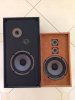
. It turns out that he got it wrong. I was repeating bad info. It never made sense to me. Speakers with first-order crossovers, such as the 80, must have their drivers wired in the same polarity. In case any of you have seen that schematic floating around, it also shows the tweeters incorrectly identified as Peerless MT20s. They are the MT-225s. In the 4 years since that post (which I'd forgotten about) I have opened and/or measured most of the five pairs of 80s that I own. They are wired as I wrote above in post #175. That is, to repeat: the Rola woofer and the two paralleled Peerless tweeters are wired in polarity relative to each other, but the terminal strip on the back panel is wired in reverse (relative to all the drivers). Just to make sure I wasn't going crazy, I just did a simple polarity test by connecting a AA cell across the terminals, an easy check. With the + and - of the battery connected briefly to the + and - of the terminal strip, respectively, the woofer popped inward. "Outta phase".Anyway, Sk8ter, I'm not sure how your line of questioning relates to your using RTR bookshelf speakers in the midrange instead of 80s. Out of curiosity some years ago, I bought a pair of RTR Series II-A bookshelf speakers that are a bit larger than 80s. They use the same Rola woofer and similar, if not identical Peerless tweeters, arrayed differently on the front panel. I A-B'd them side-by-side with 80s. The RTRs were not even close in sound quality to the 80s, sounding colored and closed-in, as I recall. Hope yours are not this model. The most important part of the J Modular is the "midrange", the 80. I am not as warm on the Premiere line as the Js, except for the beefier bass.
Sk8ter
Active Member
Ok Thanks for the clarification, give me a call we should talk anyways.
If you know me, as tom does you will know I have very good hearing, I don't rush to judgement quickly anymore because I have been fooled LOL
The 80 rola woofers have many issues almost every one sounds different has different distortion "levels" its quite unique, my focus has been for the last several years from like 2005 has been Fulton system/systems. I build tonearms and retip cartridges for many people, I am experience trouble shooter, I would like to think I am talented bloke! :O)
I know what Jeff/Tom knows about the fulton stuff, I am still learning!
call me
If you know me, as tom does you will know I have very good hearing, I don't rush to judgement quickly anymore because I have been fooled LOL
The 80 rola woofers have many issues almost every one sounds different has different distortion "levels" its quite unique, my focus has been for the last several years from like 2005 has been Fulton system/systems. I build tonearms and retip cartridges for many people, I am experience trouble shooter, I would like to think I am talented bloke! :O)
I know what Jeff/Tom knows about the fulton stuff, I am still learning!
call me
Sk8ter
Active Member
For those who are using the J modulars and need tweeters for the your 80 cabinets, This is the best replacement, unless you happen to have a friend who has a case of the peerless tweeters this will be your best NEW option.
http://www.ebay.com/itm/Visaton-TW-6-NG-8-Ohm-Konushochtöner-100-Watt-070202/150938762536?ssPageName=STRK:MEBIDX:IT&_trksid=p2060353.m1438.l2649
I have been meaning to purchase a few for a few years now, but I have not gotten around to it
http://www.ebay.com/itm/Visaton-TW-6-NG-8-Ohm-Konushochtöner-100-Watt-070202/150938762536?ssPageName=STRK:MEBIDX:IT&_trksid=p2060353.m1438.l2649
I have been meaning to purchase a few for a few years now, but I have not gotten around to it
Last edited: