• The move to the new server is done. There are some software and database maintenance updates in process. This has us passing the hat around to help out. We appreciate any donations. Seriously, even a dollar helps. The payment page may be found here - https://www.audiokarma.org/support.html

Gainclone vs Vintage

Cubdog,

You made some false statements before dropping the mic. I am responding.

At no point did I say "all chip amps" are inferior to what I prefer to listen to. Please show me where I said that.
I did not tell you or anyone else what you can or cannot hear. In fact, I've made no comments on how chip amps sound. Again, please show me where I said that in this thread?
I have not insulted any "fine audio engineers". Ever. I have stated facts- existing chip amps are 'off-the-shelf' solutions and require no R&D to fabricate- it has all been done by someone else.
I did not say what you like is inferior to what I like. Again, please point me to where I said that.

Peace out. :)
I'll let anyone reading this thread to draw their own conclusions. I've stated my opinion.
 
Anytime one of you chippers wants a bake off, put the best little thing you have in your pocket, modded or not and we will see how it does driving Dahlquist DQ 10's in my home in New York, State. If you think you need fancy connectors and speaker wire bring that too. Yes I would like to be educated. I am running a MC cart though so bring your own front end. The source is quality vinyl. You really don't have a prayer guy's! I did say the chip amps are amazing, for what they are.
Well dawg. I ain't buying these and showing up in upstate NY. But these chip amps will piss all over a pair of DQ10 after they melted the voice coils and caught them on fire. Chip amps capable of driving 1 ohm Apogee Scintilla. Not all chip amps are created equal.

http://www.6moons.com/audioreviews/h2o2/1.html

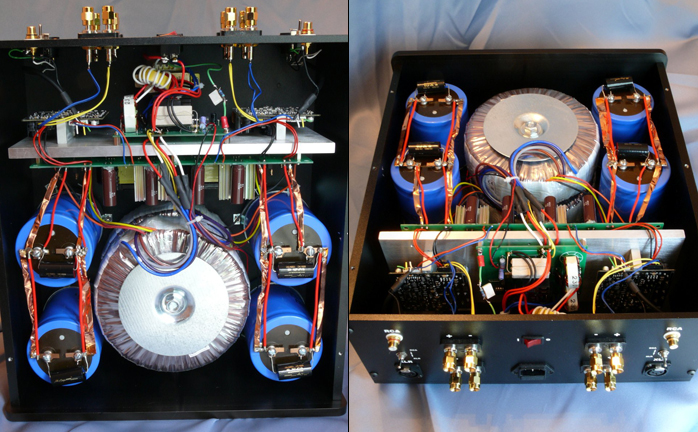
amp_2up_open.jpg


Regards
Mister Pig
 
$4995 for the preamp + $3200 for the amplifier and they still look like a DIY effort. A nice DIY effort, but not at $3200!

And this?..."On the amplifier the outputs cannot be shorted even momentarily or irreversible damage will result." Wow, that's quality. If they cannot take a short, excuse me but they are crap. That is a commonly frequent expectation of a domestic (and professional) amplifier to encounter without irreversible damage (and of course- no warranty claim)
 
I am not interested in melting my voice coils, or emptying my bank account. I like good music and the shortest path to get there, and I still say bring it, and educate me, please. I also don't believe in fairy dust!
 
$4995 for the preamp + $3200 for the amplifier and they still look like a DIY effort. A nice DIY effort, but not at $3200!

And this?..."On the amplifier the outputs cannot be shorted even momentarily or irreversible damage will result." Wow, that's quality. If they cannot take a short, excuse me but they are crap. That is a commonly frequent expectation of a domestic (and professional) amplifier to encounter without irreversible damage (and of course- no warranty claim)

There have been more than one amplifier designed without output protection. Direct coupled designs have a history of excellent sound quality. The ability to drive a 1 ohm load like the Scintilla is no small feat. The vast majority of discreet amplifiers would fail prematurely when tasked to running those Apogee.

Regards
Mister Pig
 
I am not interested in melting my voice coils, or emptying my bank account. I like good music and the shortest path to get there, and I still say bring it, and educate me, please. I also don't believe in fairy dust!
Well order us a pizza and some beer and wait...I will be along shortly.;)

Regards
Mister Pig
 
I'd take a well designed gainclone over many vintage units. I wish I had the talents to do so. I really like them. Even more I'd like to build a Hypex amp. You should research those as well.

Yah...

What makes them so great ?

Got any specs ??
 
Let's be honest here. That H20 amplifier is just a pair of ICEpower modules in a messy DIY style box with floating components soldered in mid air (look at the earth connection to the IEC socket or chassis), two toroidal transformers and 4 chassis mount caps. Wow, leading edge stuff there and totally worth $3200- not.

There is no 'engineering' in it by Henry Ho* other than working out where to drill the holes to mount the stuff he bought off the shelf.

ICEpower modules are (from their datasheets and website):
"intended as a versatile building block for designing innovative audio solutions"
and
"integrated, turn-key design reduces design-in cost and shortens Time-to-Market for the end products"
and
"The ICEpower ASС Series consists of intelligent audio power conversion solutions designed particularly for highly competitive consumer and professional audio applications"
and
"is an integrated multichannel amplifier and power supply solution"

Yep, I rest my case. Off the shelf chip amps- audio "solutions" - they say it themselves. There is simply no comparison to the quality Japanese gear of yesteryear where every individual topology, each screw, panel, bracket, knob, lever, switch and component was individually designed, specified, machined, manufactured and built into a bespoke product. They had component manufacturers build what the designers wanted. They'd demand semiconductors that the fabricators made for them. They didn't just sit around with a coffee and a bagel picking from a catalogue of pre-built modules for their top of the line products- they would have been laughed out of existence.

* if that is the 'designer's' name.
 
Interesting viewpoint John. While IC's (real IC's - integrated circuits) can be pretty amazing they can also dumb-down the design process kinda like Python has dumbed-down software "development".
.
 
Interesting viewpoint John. While IC's (real IC's - integrated circuits) can be pretty amazing they can also dumb-down the design process kinda like Python has dumbed-down software "development".
There are cases where a single IC can replace discrete design effort, or few lines of Python can replace a lot of low-level C code, but as a generalisation your statement is both ludicrous and ignorant. ICs made the entire computer revolution possible; Python is a big part of what makes cloud computing, data science, and "big data" processing possible. Precisely the opposite of "dumbed-down" has and is happening: higher-level components make higher-level, more sophisticated systems possible, and thus engineering moves from low-level nuts'n'bolts construction to complex architecture.
 
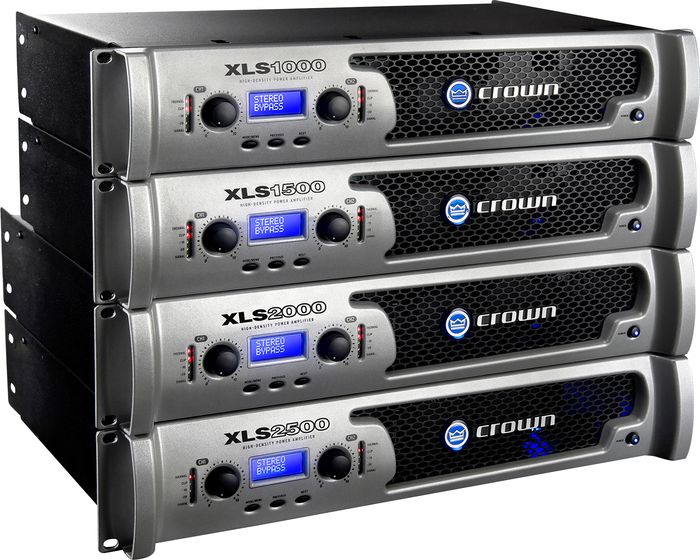
Reliability is not an issue otherwise Crown would not have switched to chip amps. No gear suffers abuse like pro gear.

The chip used in their DriveCore series is from Texas Instruments and is the size of a dime.

DV016_Jpg_Large_485459_XLS_family_stack_V.jpg
 
Let's be honest here. That H20 amplifier is just a pair of ICEpower modules in a messy DIY style box with floating components soldered in mid air (look at the earth connection to the IEC socket or chassis), two toroidal transformers and 4 chassis mount caps. Wow, leading edge stuff there and totally worth $3200- not.

There is no 'engineering' in it by Henry Ho* other than working out where to drill the holes to mount the stuff he bought off the shelf.

ICEpower modules are (from their datasheets and website):
"intended as a versatile building block for designing innovative audio solutions"
and
"integrated, turn-key design reduces design-in cost and shortens Time-to-Market for the end products"
and
"The ICEpower ASС Series consists of intelligent audio power conversion solutions designed particularly for highly competitive consumer and professional audio applications"
and
"is an integrated multichannel amplifier and power supply solution"

Yep, I rest my case. Off the shelf chip amps- audio "solutions" - they say it themselves. There is simply no comparison to the quality Japanese gear of yesteryear where every individual topology, each screw, panel, bracket, knob, lever, switch and component was individually designed, specified, machined, manufactured and built into a bespoke product. They had component manufacturers build what the designers wanted. They'd demand semiconductors that the fabricators made for them. They didn't just sit around with a coffee and a bagel picking from a catalogue of pre-built modules for their top of the line products- they would have been laughed out of existence.

* if that is the 'designer's' name.

And the vast majority of what they built was inferior in terms of sound quality to those pieces coming out of the garages and other humble origins where companies like Audio Research, Conrad Johnson, Krell, Sudgen, Creek, Alchemist, Amber, SOTA, VPI, Merrill, and other small audio companies started at. Only the very best offerings of the big Japanese companies were competitive in terms of sound quality, and most of that gear was never exported. Personally I would take the inspired offerings of a designer working in his garage over the yet another component in a long line of components designed by a soulless corporate behemoth.

Regards
Mister Pig
 
Yah...

What makes them so great ?

Got any specs ??

I'm not a builder, not a spec guy. I only know what I can hear. I have three systems currently in use. One is uses a KT88 tube amp. Another is anchored by Bel Canto mono blocks and in the third I use an inexpensive chip amp. I'd rank them, Bel Canto, tubes and chip in order of performance. But the differences in sound quality is surprisingly minimal. Guys around here don't like to hear that these little chip based amps can equal or surpass their beloved vintage gear but I believe that's true. And I'm in my sixties. My first amp was a Sansui that I bought when I was in the Navy back in the 70's. I get the sentimental value these dinosaurs have for some because that's true for me too. I just don't think they sound as good as most people around AK.
 
Hey Mr Pig,
Do you want a truffle pie. I am in New York, but in the woods, so it won't be a NY pizza as you might know it.
 
I'm not a builder, not a spec guy. I only know what I can hear. I have three systems currently in use. One is uses a KT88 tube amp. Another is anchored by Bel Canto mono blocks and in the third I use an inexpensive chip amp. I'd rank them, Bel Canto, tubes and chip in order of performance. But the differences in sound quality is surprisingly minimal. Guys around here don't like to hear that these little chip based amps can equal or surpass their beloved vintage gear but I believe that's true. And I'm in my sixties. My first amp was a Sansui that I bought when I was in the Navy back in the 70's. I get the sentimental value these dinosaurs have for some because that's true for me too. I just don't think they sound as good as most people around AK.

I'm glad you like them because that's the point of enjoying something. I am also in my sixties and built up kits so I know what they sound like therefore my ears are tuned to a certain amount of distortion. But to me it's a reference point from which I go forward. I would like to build another kit just for the sake of building though....but I think building is what brought me to buy my Yamaha MX-1000 which is the biggest difference in sound I've ever heard. But I do think these kit companies are guilty of false advertising and someone on AK could actually sue these characters for quite the stash of cash...
 
But I do think these kit companies are guilty of false advertising and someone on AK could actually sue these characters for quite the stash of cash...

You lost me? Exactly who is guilty and why is their advertising false?
 
Back
Top Bottom