• The move to the new server is done. There are some software and database maintenance updates in process. This has us passing the hat around to help out. We appreciate any donations. Seriously, even a dollar helps. The payment page may be found here - https://www.audiokarma.org/support.html

HH Scott 299D - Power But No Audio

I follow the dictum found in my 1987 Mercedes shop manual, “Replace on principle,” meaning that while you’re down in there, if there’s a part that frequently wears out and may be nearing the end of its average lifespan you might as well replace it now, especially if you had to take a whole bunch of stuff off to get there. That’s why I replace electrolytics that might be eligible for Medicare. I’m in the process of recapping a 1970s Pioneer amp and after changing the power supply caps brought the voltages within 1% of the schematic numbers rather than 10% on the old caps. Sure, the old caps were still within tolerance, but for how long?
 
Ok, well quite a discovery tracing everything through the schematic. Feel a little dumb and that I may have wasted your guy’s time, but the lesson here for me is to not simply replace components (and values) with what/how it was when it arrived. Sort of like earlier in the thread how I read the pair of resistors 470k in parallel to the can — which I interpreted to be 270k instead of 270.

I replaced the .022 cap to V1 and V101 how they were when I got this. However, going through the schematic (and now that I’m more knowledgeable how to interpret it), I see that the cap in the unit is connected to p7 on V101 and the other cap is connected to p8 on V1. The .022 should also be on p7 for V1.
 
Correct.
And you didn't waste anyone's time.
When we take the torch of tube audio understanding we take on the responsibility of educating and helping those who want to know. You gave us helpful info, and with persistence you'll fix this amp.
And what a treat it is when it works.
You can click it on and remember all the things you learned in order to get to be able to enjoy it.
 
Works!!!! Thanks guys! Was getting a little tired of testing it out on 6 Pieces of Silver getting to really know the right channel of it really well :p

Makes me think how many hands this unit has gone through and how many repairs to troubleshoot over the years. Learned a lot by doing this and walking through the schematic, rather than simply trusting how it was wired in the correct places when it arrived. I’m sure something else could come up with this, but I owe you guys a bunch of beers (if you drink). Thanks :beerchug:
 
Correct.
And you didn't waste anyone's time.
When we take the torch of tube audio understanding we take on the responsibility of educating and helping those who want to know. You gave us helpful info, and with persistence you'll fix this amp.
And what a treat it is when it works.
You can click it on and remember all the things you learned in order to get to be able to enjoy it.

Definitely and thanks. Part of me also wonders if it’s more difficult undoing what others did previously and reconstructing it, rather than building a unit from scratch.

I play guitar and have a ‘72 Hiwatt, which certainly has more room to work in. I was scared to death to even open up the chassis on that, but not now. The point-to-point wiring is a work of art. It was also interesting to see what mods had been done to it over the years, and knowing what to look for.

Turns out I may have found a new hobby :p
 
Definitely and thanks. Part of me also wonders if it’s more difficult undoing what others did previously and reconstructing it, rather than building a unit from scratch.

I play guitar and have a ‘72 Hiwatt, which certainly has more room to work in. I was scared to death to even open up the chassis on that, but not now. The point-to-point wiring is a work of art. It was also interesting to see what mods had been done to it over the years, and knowing what to look for.

Turns out I may have found a new hobby :p

Every trouble shooting op like this helps others going forward. And frankly, a lot of us enjoy it, especially if the asker persists and we all get to help solve the problem,. ;-)
 
moving pin 7 to pin 8 would actually explain this very well. Instead of going to the grid, you were feeding the cathode. There are amp circuits where this is done, and it works just fine but this isn't set up to do grounded grid operation like that. I can believe a very small amount of signal would actually get through the tube, but nowhere near enough to be useful.

but yeah, things definitely happen. Anyone that tells you they never connected something incorrectly is either lying or has never worked on anything.
 
A certain guy I know. Spent several days, perhaps several weeks over the course of years trying to troubleshoot a channel imbalance in a HH scott phonostage. In doing so my "friend" blueprinted out the entire stage and rebuilt the PECs as passives, ended up with a thorough understanding of the entire stage, (which is rather brilliant in its simplicity)
Once it's on paper in front of you instead of wrapped all through a selector and PEC, and multiple switches, it makes much more sense.
I'd hazard a guess that you have this circuit understood well enough at this point that if you set your mind to it, you could build a clone. That's what I did. Once my Lk72 worked right, it got sold, and at that point my preamp project was well underway.

Granted the circuit sounds fantastic in a well restored antique Scott, you're going to love it.
Taking the effort to build a clone of the circuit as a stand alone or as a part of a more complex preamp is an extremely worthwhile way to spend your time, in my opinion.
Building it out with CMF low noise resistors and film caps with a fresh power supply takes it another 20% past what can be accomplished with carbon comps.
That is my opinion, and you know what they say about opinions...
All I'm saying is : youve got most of the work done already, you know the parts, how they interact, you have a schematic... you're ready to build a knockoff...
 
Thought has crossed my mind to build a standalone phonostage at some point. Considering perhaps doing another HH Scott, or going in a different direction to restore a vintage turntable (which one would be quite another discussion). An Empire would be awesome but they are pretty pricey even when not in the greatest shape.

but yeah, things definitely happen. Anyone that tells you they never connected something incorrectly is either lying or has never worked on anything.

Around this thought, while doing this work on the 299D, I discovered this YouTube channel Stuart ukguitarampguy. His videos tend to be long but he doesn't edit his mistakes or incorrect assumptions, working through the thought process. I actually love it since I would learn as much, if not more, from the mistakes being made as the successes. I think on one video he wired a couple of capacitors the wrong direction, yet was able to laugh about it, correct and keep it all in the video. I'm sure most would have edited that all out. Most of the other videos I found are "this is the problem, let's fix it" and presto-change-o it all works out.
 
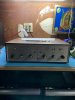
Well who knew getting a cabinet on was going to be just as difficult as the electronics? Got a spare wood case from eBay and refinished it. Had to remove the aluminum heat grate at the top since the chassis was a little too warped to fit in. However, kinda liking the idea of having the grate on the outside for easy access to tubes.

501E730A-48F3-4F12-838B-F8034F582D69.jpeg
 
cases can be as expensive as the entire units are. They were an accessory that not everyone bought, so just from go there were more amps than cabinets. Some got thrown away with their amps, others probably got destroyed in various ways so now its likely even more out of balance.
 
Yeah, I’m usually a fan of keeping them without the case for the tubes to air out. However, since this will be out in the open, protects it from the cat and my 10-year-old special needs daughter from being curious.
 
Back
Top Bottom