• The move to the new server is done. There are some software and database maintenance updates in process. This has us passing the hat around to help out. We appreciate any donations. Seriously, even a dollar helps. The payment page may be found here - https://www.audiokarma.org/support.html

I ruined some nice knobs! Anybody know how to resurrect them?

Kahoona

Super Member
I ruined some nice knobs! Does anyone have any experience repairing knobs? These are solid metal except for a plastic insert in some. I put them in a mix of Windex and Detergent to soak briefly and then forgot about them for a month. When I found them I scrubbed with a toothbrush. I tried some Brasso. No luck. I don't know if they were plated or just pot metal. They are from a Mitshbishi DA-C20. I am also looking for a set of replacements in BT but I don't have much hope. I tried that auction site too.


Register to hide this ad
What are they supposed to look like? Brass color or silver?

You could try spray paint. They make some pretty good spray paint.
 
Looks to be a brushed chrome?

I've had good luck using metal duct tape. Cut a couple layers slightly larger for the front of the knobs and fold those over the sides just a bit, then wrap the metal tape around the sides, ovelapping the back edge slightly. Press it into the knob and it should follow the contours nicely. If you screw it up, peel and try again.

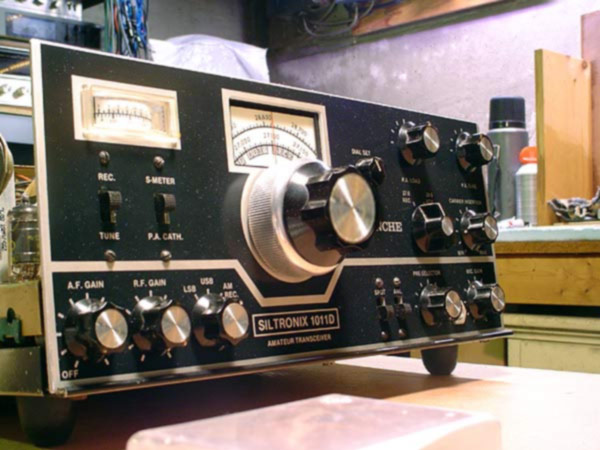
Stuff's pretty permanent and holds up well to use. You can also have fun with texture ... I did these a few years back, and you can see the swirl pattern I put in just spinning the knobs on a piece of sandpaper. A bit of metal polish hides a lot of little stuff too.

siltronix-knob-inserts.jpg
 
There's a product for plastic model builders called Alclad. There are many metallic colors. It is to be sprayed on over a gloss black base with an airbrush.
 
Alkali in the Windex corroded the aluminum by prolonged exposure, it's permanent. Coating them with a matt textured finish would be acceptable.
 
Oh, that's just surface oxidation and corrosion. Should be easily fixed.

Easiest way might be using a buffing pad with metal polish. You just some elbow grease. A buffing wheel chocked into a drill press running on high speed will remove crud from the surface.

Or some acid should also remove the surface corrosion. First thing I would have suggested in metal polish--I saw you used Brasso--which is an acid plus some detergent to form and remove soluble salts.

Try a stronger acid like Citric Acid (sold as Lemishine if you want small quantities) with some calcium carbonate (mild abrasive, same one that's in soft scrub) or finely powdered limestone or rottenstone, and an older, well-used scotchbrite scrubbing pad. That should loosen the corrosion and nicely clean those up.
 
That's brushed aluminum, right? Try buffing them with metal polish. Should work fine. You've just oxidized the surface. We've all done this with something made out of aluminum. Typical is running a pie tin or similar object through the dishwasher, etc.

I've cleaned tarnished and stained aluminum with hot citric acid in my dishwasher, which removes a lot of the surface oxide. (I run citric acid through the dishwasher to remove calcium deposits which will otherwise clog up the pump, and put all my stainless utensils in it at the same time to get them shined up.)

Lime Away will do the same thing, although it warns you about staining because it removes the oxide layer. I've used this to clean an espresso maker with an aluminum tank.

Might have to use some very fine sandpaper when done to put the brush back.
 
Thanks. They do feel like aluminum. If they are not plated that would be nice. I will try some acid to take off the corrosion as you suggest. I am sure that I have something around here. I am afraid that I will mess them up re-brushing the finish but I have nothing to loose. Pio- That is the original alright. Do you have that one? I am working on getting the blue lighting right. What amp are you using? I have a 10DC. These were mine long long ago and they have recently come back to me. They were monsters in their day. Retrovert- I'd definitely go for buffing them if I had a buffer. They I could use a green fiber wheel to brush them. I may be able to strap a 1/2" drill to a sawhorse to use as a buffer. I once worked in the family Jewelry store so I have done this.

I'll post pics if I get anywhere.
 
I've never had much luck using a drill for polishing as it doesn't spin fast enough. Dremel yes, but it flings polish everywhere. I don't have a buffer, but I do have access to a drill press. Not the greatest thing for the bearings, of course, to push them side to side.

Try putting the green pad down on a surface and moving the knob back and forth across it.
 
I've used these 'nail polishing' buffing sticks? Like the pink ones or white? are finer grit for polishing and have a foam core and are flexible and you can cut them. I guess you could make a shaft of sorts out of wood dowel to spin. Just saying the sticks are easy to hold and doesn't take much pressure at all to get a grain and I use them just for hand work of sorts too.
 
Try a stronger acid like Citric Acid (sold as Lemishine if you want small quantities) with some calcium carbonate (mild abrasive, same one that's in soft scrub) or finely powdered limestone or rottenstone, and an older, well-used scotchbrite scrubbing pad. That should loosen the corrosion and nicely clean those up.

Acid will certainly work on aluminum just as a strong base will. However, I wanted to point out that if you mix citric acid with calcium carbonate, that's an acid-base reaction just like adding vinegar to baking soda. The result will be a solution of calcium citrate, and the pH (acidic or basic) will be determined by whichever ingredient you added the most of. I don't even think you can buy finely powdered calcium carbonate that easily. Why not just use Soft Scrub (I love that stuff for shiny surfaces) before or after the acid? Best of both worlds.
 
If you want a weak acid, use dilute white vinegar alone.
Fwiw, this is a machined finish, it is gone, gone, gone.
Careful walnut shell blasting MAY get you a bare matte finish without eroding the surface, sand will be very, very risky.
 
For cleaning knobs like this next time, try a few drops of Jet Dri or similar in distilled water in an ultrasonic jewelry cleaner.
 
If these are actually solid metal of some thickness, using a drill or (better) a lathe, and polishing them up with some fine (grey) Scotchbrite should work. If you want a true "brushed" look, use coarser Scotchbrite. My fear is that the "metal" is plating or some other thing that won't react well to refinishing.
 
Acid will certainly work on aluminum just as a strong base will. However, I wanted to point out that if you mix citric acid with calcium carbonate, that's an acid-base reaction just like adding vinegar to baking soda. The result will be a solution of calcium citrate, and the pH (acidic or basic) will be determined by whichever ingredient you added the most of. I don't even think you can buy finely powdered calcium carbonate that easily. Why not just use Soft Scrub (I love that stuff for shiny surfaces) before or after the acid? Best of both worlds.

You are completely correct. I was thinking what was an easily accessible and lightweight abrasive besides jeweler's rouge, and having just used Softscrub to clean my sink it was in my mind and was thinking, calcium carbonate that would do it but without the bleach since that's a base. I have limestone, rottenstone, etc. in finely powdered form which I got from a tool supply shop to do metal polishing and wood refinishing. Which I use after the acid, not with.

Bleach will not remove aluminum oxides as well as acid. The surface really needs to be etched to remove that buildup.
 
If you want a weak acid, use dilute white vinegar alone.
Fwiw, this is a machined finish, it is gone, gone, gone.
Careful walnut shell blasting MAY get you a bare matte finish without eroding the surface, sand will be very, very risky.

I've polished up completely rusted axe heads to a mirror bright finish using acids, then fine abrasives, both by hand and with power tools.

In the case of a non-coated finish, it's mostly a matter of how much patience you have, and what abrasives you use.

"Over? Did you say "over"? Nothing is over until we decide it is! Was it over when the Germans bombed Pearl Harbor? Hell no! And it ain't over now!" — Bluto
 
Back
Top Bottom