• The move to the new server is done. There are some software and database maintenance updates in process. This has us passing the hat around to help out. We appreciate any donations. Seriously, even a dollar helps. The payment page may be found here - https://www.audiokarma.org/support.html

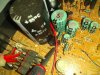
Is this bad? I know nothing about audio repair

gravis82

Active Member
Opened it up for the first time. It's circa 1983 JVC

I feel this is not good.
 

Attachments

  • IMG_20191223_205641190.jpg
    IMG_20191223_205641190.jpg
    145.1 KB · Views: 195
Register to hide this ad
I don't know if that is glue (used to stabilize larger caps under which you can see it), or electrolytic fluid, but either way it needs to be addressed. Old glue can become corrosive, and even conductive. Personally, I would pull the caps and any other components (like those resistors and what appears to be a diode) whose legs have been exposed to it.

BTW, I lean towards it being glue, but on the other hand it appears to have seeped more, and be much darker, than most glues I've seen.

If you know how to solder correctly, you can do this. Members can help you pick out new parts if you go that route.
 
Looks like glue. Should be easy to flake off if it’s that black. Good chance the leads it’s touching are on their way to being eaten up. Scrape it off and see what it looks like under there.
 
it all flaked off somewhat easily. Circuit board was a bit discolored underneath. It still works, although I have never heard it without this issue likely so I am not sure how well its working.

I have a soldering iron and have soldering some time ago just not on audio gear, so I could likely do this. Its not an expensive amp.

Do I replace with the same, or something 'better'?
 
Any sign of corrosion on those resistor, diode leeds? typically a green copper oxide tinge.
Maybe post an updated pic. If leeds are shinny then I wouldn't replace unless you suspect
the parts are faulty.
 
It’s assembly glue.

If it flaked off and things work, forget it.
IF you had electronic skills and IF it was a worthy unit, recap may be a good move but there is no reason to do that because of this.

FWIW, in the 100s of units I’ve worked on, I have never seen electrolyte “leak” and look like that.

I only know of a couple units that used a liquid electrolyte capacitor with enough fluid to actually flow out. 999/1000 capacitors that have “leaked” (vented) are not visible while installed. Big filter cap vent holes can be seen but board mount caps hide the situation.

Physical leaking is pretty rare.
Venting is more common and shows up as some white corrosion on the legs or in the vent hole on large caps.
DC leaking is the most common thing and/or ESR problems. Old caps can’t hold the DC they are supposed to, and the circuit starts to fail it’s duty.

 
It’s assembly glue.

If it flaked off and things work, forget it.
IF you had electronic skills and IF it was a worthy unit, recap may be a good move but there is no reason to do that because of this.

FWIW, in the 100s of units I’ve worked on, I have never seen electrolyte “leak” and look like that.

I only know of a couple units that used a liquid electrolyte capacitor with enough fluid to actually flow out. 999/1000 capacitors that have “leaked” (vented) are not visible while installed. Big filter cap vent holes can be seen but board mount caps hide the situation.

Physical leaking is pretty rare.
Venting is more common and shows up as some white corrosion on the legs or in the vent hole on large caps.
DC leaking is the most common thing and/or ESR problems. Old caps can’t hold the DC they are supposed to, and the circuit starts to fail it’s duty.

Agreed with this.
I just finished rebuilding the ECU for a friends Acura and found 9 physically leaking caps.
The only signs of issue (aside from no reading from the MAF) was a bit of darkening of the board below the caps. A lot of soaking and cleaning with isopropanol got it as good as it was gonna get. Still smelled like chemical fishy disgusting when resoldering.
 
It’s assembly glue.

If it flaked off and things work, forget it.
IF you had electronic skills and IF it was a worthy unit, recap may be a good move but there is no reason to do that because of this.

FWIW, in the 100s of units I’ve worked on, I have never seen electrolyte “leak” and look like that.

I only know of a couple units that used a liquid electrolyte capacitor with enough fluid to actually flow out. 999/1000 capacitors that have “leaked” (vented) are not visible while installed. Big filter cap vent holes can be seen but board mount caps hide the situation.

Physical leaking is pretty rare.
Venting is more common and shows up as some white corrosion on the legs or in the vent hole on large caps.
DC leaking is the most common thing and/or ESR problems. Old caps can’t hold the DC they are supposed to, and the circuit starts to fail it’s duty.
I will leave it. Thanks everyone for your help.
 
Back
Top Bottom