• The move to the new server is done. There are some software and database maintenance updates in process. This has us passing the hat around to help out. We appreciate any donations. Seriously, even a dollar helps. The payment page may be found here - https://www.audiokarma.org/support.html

JBL 4333a/Sansui EC138

IIRC, a 3106 is just a 2nd order with a 1.5 mfd and 0.3 mH choke.

Yes indeed those are the values , $50.00 will about cover the cost for much better quality parts ( > 2x mkp Caps, 2x Air-Core Coils + 1x 50W LPad ).

:)
 
Last edited:
So, while I wait parts for @EarlK 's circuit to arrive from parts express (I am from India, it'll be about 20 days to arrive), I continued to fool around

JBL 4344 MKii HF - Feeble treble. Way too low in quantity

JBL 3155 HF -Nice. Pretty linear with some minor hot spots. Of cource the tweeter doesn't meet MF and there is a void in that 8-10k region
Neverthless, promising, so I started to tweak

This is the 3155 HF:
1716585380585.png

- Started with C5, changed to 1uF - This calmed down the treble a bit and brought some life to midrange. Still unsatisfactory under 10khz
- Then changed R2 to 10ohm (assuming this is atteunating HF) - Surprise, upper treble dropped a bit further but is extremely evened out. Zero hot spots. It also lifted upper midrange a bit. This is very listenable but heart wants more. HF still doesn't meet MF. Although its very coherent sounding where I can't make out MF --> HF transition.

So I started to read what a parallel RL circuit does. Internet doesn't tell a lot, someone said it's a notch filter

What I am trying to achieve is a lesser steep slope for HF atteunation. Question for kind souls at AK:

1) What component decides the HF slope in this circuit?
2) What happens when L4 and R2 go up or down in values?

I know, I am throwing at wall until something sticks and at this point I should have some kind of measurement gear. But as someone with only soldering skills I can rely only on ears.
 
@Oyster150

You need to start playing with a crossover simulator ( which will give you visual feedback to your proposed component changes ).

Download the XSim ( .exe ) application.
- Best to keep your project files in a separate folder.

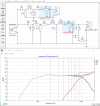
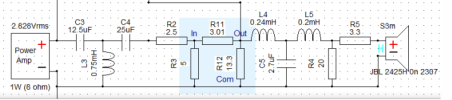
Here's a modified 3107 network ( with added horn-driver attenuation && a horn-driver LowPass for an @ 10K crossover point ).

I've included the XSim file ( zipped .dxo file ) for you to play with ( it uses my 2425h measurements and Widgets 077//2405H measurements ) .
- Right-Click on a part to change its values.

Modified JBL 3107 network for 2425H + 077 _modB_.png

Removing R1 gives the bump centered at 10K, due to changing the "Q" of the LC parts interacting.
- Don't run with that or the circuit impedance at 10K will drop below 3 ohms ( which can be an amp wrecker for many amps ).

Note: when XSim opens a file, it opens the frequency response window to 1/24db smoothing ( which is pretty jarring to look at > and un-necessarily HiRez ).

Change it to 1/6 db smoothing ( as this is accepted as being around the amount of detail that the human ear can reliably discern ).

:)
 

Attachments

Last edited:
@EarlK Can Lpads can be replaced with fixed values as suggested in your circuit ? Because I'd like to replicate as is, fixed values will do that, correct ?
 
@EarlK Can Lpads can be replaced with fixed values as suggested in your circuit ? Because I'd like to replicate as is, fixed values will do that, correct ?

Yes

:)

PS; ( IME ) its best to start-off using the variable Lpads + then once relative levels are established ( & enjoyed over a period of time ) > then replace with fixed resistors
 
Last edited:
@EarlK ,I built the circuit and find the midrange volume too low. I used fixed values instead of lpad. Think of using lpad to play with adjustment

Question, what all resistors can be eliminated if I used Lpad instead? 2.5/5/3.01/13.3 or 5/3.01/13.3 or 3.01/13.3 ?

1720945913604.png
 
@EarlK

While the crossover didn't work out (FR was much improved but speakers became much less sensitive), I stopped fighting the speakers and enjoy them for what they are.
In the 4 rooms I tried these speakers, there is a prominent 50-60hz stickiness on the 2235H. I used to enjoy this thrill earlier but on complex music it blurs details. Stuffing port helps but that also exposes limited details of the 2235H. I still like that driver for it's insane explosiveness

I have recently got an option to get 4344. It's got the same 2235H woofers. I did quite a bit of reading on the 4way JBLs and found your post on 4344mkii which uses ME150HS. So far there aren't lot of real world experiences shared with this woofer and no definitive answers. Some say it's bass light, but don't mention how bass light.

My quandary is, and a short answer will do, 4344 or 4344mkii or 4345 or can I do better ? My preferences are resolution, bandwidth and tiny bit more coherence (at least no nasty HF peaks) but I also wouldn't want a very bass light system, adequate+articulate bass, something that is flatter and more resolving than 2235 but also capable of reproducing at least 30hz
 
We have access to reasonably priced older 43xx in South Asia.
A underwhelming demo of 4338 (kinda overdamped and tad grainy) has kept me away from similarly sized and horn design 4365/4367
 
Last edited:
@EarlK
Your measurements of le85 vs 2425, was the le85 equipped with 2420 diaphragm (Aluminum tangential) ?
I am trying to figure out if the difference in response is due to diaphragms alone or motor as well

I don't own any le85 drivers >> therefore, most any le85 traces ( that I posted ) would likely have belonged to Zilch.

Zilch had many le85s, all with original 2420 diaphragms.

:)
 
Last edited:
I listened to several different 2420s/LE85s before I found a pair that I liked enough to replace my LE175s. The LE175, which came with an aluminum tangential diaphragm, has a better bottom end/is warmer and if you're going to use a tweeter anyway, I feel is a sweeter combination. (But they still aren't anywhere near as warm and inviting as the 2251Js in the Mermans.)

Turns out that the 2420s that I kept and use in my modified L200 cabinets have the original 2420 aluminum tangential diaphragms rather than the later 2420 aluminum diamond pattern. My center channel's 2420 had a diamond surround, but I was actually able to find a mislabeled ORIGINAL TANGENTIAL 2420 diaphragm for $65 on e-bay.

This diaphragm was in a 2425 box and advertised as a 2425, which are in low demand, especially used. But I recognized it for what it was! And I know that when people blow a diaphragm, they tend to replace the pair, especially if they have to go with a later/different type and will put the other, good one in one of the replacement boxes..., which is exactly what happened.

When the seller realized his mistake, he asked me if I wanted to cancel, which of course I didn't. Original tangential diaphragms are now made of unobtanium and can go for hundreds of dollars.
 
Last edited:
@toddalin
I listened to several different 2420s/LE85s : Did they have variations in sound?
Yes, the tangential diaphragms are warmer, mellower, sweeter at their low end though they don't go quite as high. The titanium 2425 diaphragms are too bright/brittle, though I do have them in my four surround speakers with 2425 drivers on butt cheeks.
 
@EarlK
Are these your measurements?

I have these Radian 1225-8 diaphragms but haven't tried them properly. Only checked their functionality on an isolated 2425 driver
@toddalin @EarlK Will the radians be closer to LE85 profile?

While I can just pop them in and see for it myself, replacing is a pain when you have to remove that 2235h woofer to reach 2425
 
Back
Top Bottom