• The move to the new server is done. There are some software and database maintenance updates in process. This has us passing the hat around to help out. We appreciate any donations. Seriously, even a dollar helps. The payment page may be found here - https://www.audiokarma.org/support.html

JVC QL-7 Turntable; unstable speed

You could well be right about the dual trigging.. First time I'd played with this scope.

I'll explore further and let you know what I discover.

Thanks again for your help!


Have you found where the 7 clicks are coming from? I'm thinking mechanical problem of some sort. Are they evenly spaced or asymmetric? I'm not familiar with the motor/drive assembly on your JVC but I've had a click noise on a Pioneer and it was damage to the spindle. I could see a slight wobble on rotation when I was eye-level with the platter.

Don't know if yours could be similar but check to see if you can feel anything through the platter, maybe spinning it by hand? I'm probably way of base here but you never know what damage can happen with shipping. Damaged bearings?

Best of luck,

dr
 
Last edited:
@desertrat748 I also am expecting it to be a mechanical issue, just want to rule out the electrical first - as if it is mechanical it may be a lost cause. Judging by eye the spindle appears to be true, doesn't wobble visibly at all. The 7 clicks are with the platter off, roughly evenly spaced, and may actually be normal when there is no load on the motor... When the platter is spun by hand there is a consistent dragging sound, but it disappears when the motor spins. Turning the spindle by hand (with platter off) I hear nothing at all. The concerning noise is a slight 'buzzing' when I run the turntable at either speed with platter on, that is just barely audible with a screwdriver handle to my ear and the tip to the plinth - it seems to correspond with the visible wobble on the strobe.

@EngineerNate You were right, after adjusting the scope to trigger only from Ch.1 both speeds were ever-so-slightly out of synch! Speed is still wobbly unfortunately, but thanks for helping me learn how to use this new scope! What is the "fg coil" you referred to, and what should I be looking for there? Thanks for the motor diagnostic advice, I'll be trying that ASAP.

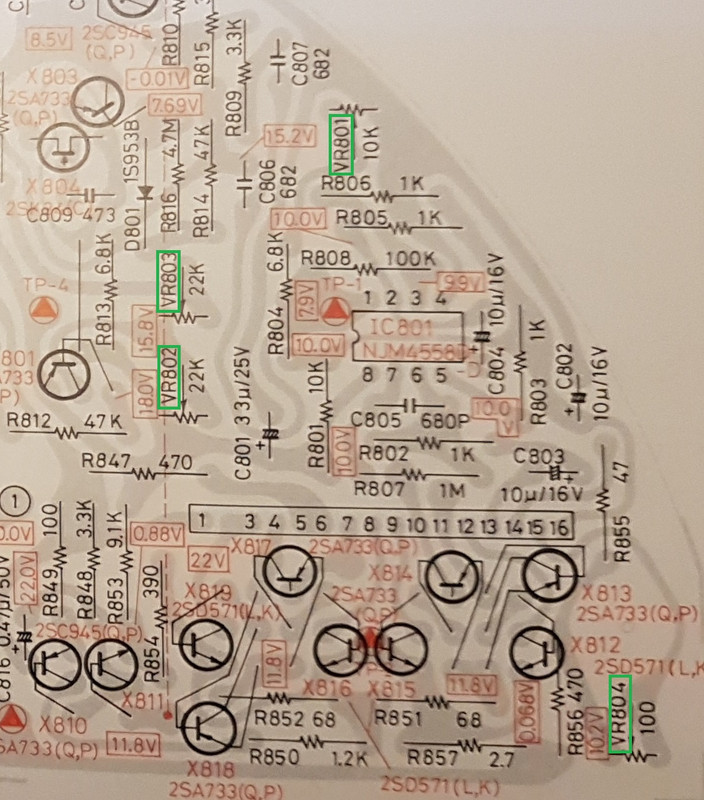
Could anyone hazard a guess as to what VR801 is meant to adjust?

VR804 is for the 'balance adjustment'
VR803 & VR802 are for speeds 45 and 33 respectively.

The manual doesn't mention VR801 except "Set the semi-fixed resistors VR801-804 to the mid position" when performing the power supply voltage check, prior to adjusting speed and balance.
image.jpg


I'm going to have to stop procrastinating and start methodically checking all the voltages and transistors.. Not looking forward to it; will take me many hours working upside down!

I'm afraid I might find all transistors working, and all voltages in spec... Which would likely mean a I'm at a dead-end, and that this turntable is only good for parts - then I'll need to track down another QL-7 which could be slow and expensive...

 
I had a QL-7 come in that had a badly worn thrust plate in the platter (motor) bearing. It was so worn down that the platter was scraping. IIRC, it was some type of plastic in the plate.

I cut a plastic piece to either replace the thrust plate or shim it (sadly, can't remember which). Whatever it was that i did, it worked *perfectly*. Amazing sounding deck when all is said and done.

May be worth taking a look at that.
 
@bangsezmax Thanks for the idea! That could possibly be the problem, as the speed variation seems to be a slow-down once per revolution (see video in previous post)... The noise it makes is so quiet however that the scraping of the platter would have to be microscopic...

I've never taken apart an electric motor before... should I be scared? Does it go back together as easily as it comes apart? Or does it require factory re-alignment and/or japanese hands to reassemble?
 
The tt-101 and 81 have additional circuitry, iirc the 101 has both a dual Quartz lock loop and a "push-pull" dual drive setup, whereas the 81 just has the additional lock loop. @JP probably knows the most about that.

Marketing and another TVK error.

I had a QL-7 come in that had a badly worn thrust plate in the platter (motor) bearing. It was so worn down that the platter was scraping. IIRC, it was some type of plastic in the plate.

Seconded.

That scope shot before is just noise. Can you post a high-res of the full schematic somewhere? These service manuals typically have errors.
 
@JP Hello and welcome to the conversation!

The schematic (and board layout) are on the previous page of this thread at the highest resolution my phone camera can manage. The schematic is however identical to this one: https://www.vinylengine.com/library/jvc/ql-a7.shtml minus the parts that control the automatic functions (The QL-A7 is auto-lift at end of side, whereas the QL-7 is fully manual)

I agree, the scope image you mention seems to be pure noise. I tried to measure it at every scale, between TP 2 and ground, and got nothing resembling a sine wave.

Any insight you might have would be very much appreciated!
 
FWIW-i had at least one test point on the ql-a2 I worked on that didn't ever look like the schematic drawing. It functioned fine and measured well for speed accuracy and w&f so I shrugged and moved on.

@JP - I know TVK isn't perfect. Do you know what actual technical differences exist in this line as you move up? I've seen people claiming these are "maglev" tables in other forums which is obviously nonsense considering they have a thrust bearing... But Victor must have done something to better the 81 and 101 over the 71.

Regarding the strobe video, can you take a count of the wobble over a minute or so it confirm it's exactly once per revolution? If it is, try marking the platter where it's happening and removing the platter and spinning it 180*. Does the wobble happen in sync with the mark still or is it off?
 
The schematic (and board layout) are on the previous page of this thread at the highest resolution my phone camera can manage. The schematic is however identical to this one: https://www.vinylengine.com/library/jvc/ql-a7.shtml minus the parts that control the automatic functions (The QL-A7 is auto-lift at end of side, whereas the QL-7 is fully manual)

The forum reduces the resolution rather drastically when you upload. Will look at A7 schematic, should have time Sat eve while the team ramps up for the big event.

@JP - I know TVK isn't perfect. Do you know what actual technical differences exist in this line as you move up? I've seen people claiming these are "maglev" tables in other forums which is obviously nonsense considering they have a thrust bearing... But Victor must have done something to better the 81 and 101 over the 71.

The 101 is a funny beast. Great motor, great performer, but 80% of the ICs are just for the counter circuit for the display, so a lot of complexity that doesn't do anything in regard to performance. I've never worked on an 71 or 81 as I pretty much only deal with the statement 'tables. Nothing against them, just not my thing.
 
Regarding the strobe video, can you take a count of the wobble over a minute or so it confirm it's exactly once per revolution? If it is, try marking the platter where it's happening and removing the platter and spinning it 180*. Does the wobble happen in sync with the mark still or is it off?

Definitely happens once per revolution. As per your advice I marked the platter with tape, and then flipped the platter 180* - the speed problem happens in synch with the tape regardless of which angle I install the platter at. I tried numerous times at various angles to confirm.

Interestingly the platter doesn't seat easily. When the motor is spinning it drops right into place, but with the motor turned off it was difficult to get it to drop in 180* opposite its usual position.

Does this indicate a warped platter? Visually the platter -appears- flat; my eye can detect no vertical deviation at all.

If the problem is the platter, are there any steps I can take to correct it?
Or would it need to be replaced?
 
Could just be a machining issue in the strobe markings. If that were the case it'd mean it's not actually varying speed.

You can probably hit the spindle hole with some scotch Brite and make it seat nicer. Is there any visible damage to the hole or to the spindle itself?

The real way to tell if it's actually varying is to throw a test record on it and measure the frequency variation of a constant test tone. :)
 
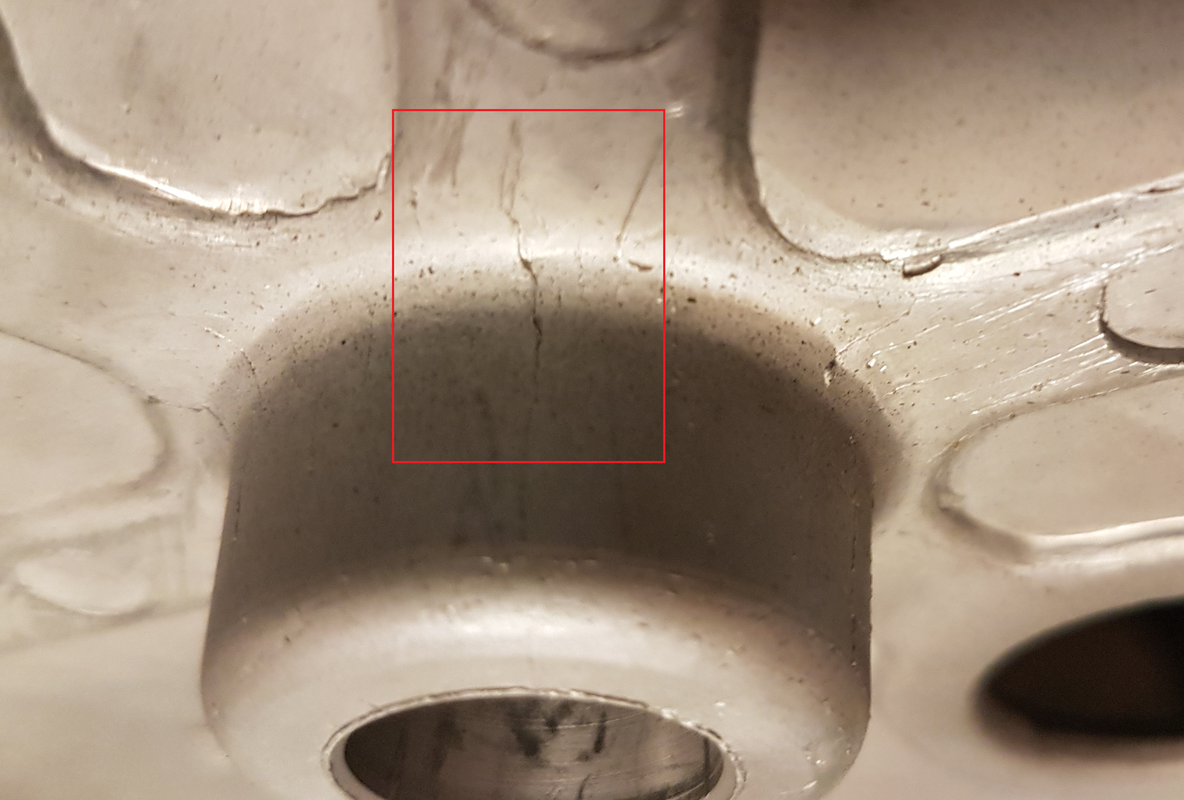
On closer inspection, there are several stress marks / cracks on the underside of the platter near the part that meets the spindle. Is this damage, or something left over from manufacturing?

under.png
 
I have some old test records from the 60s-80s, nothing laboratory grade though...

How would I measure the frequency variation? Record the test tone onto my computer?
 
I believe there are a few iPhone apps that can do it. I use a w&f application I found via the tapeheads forum, but it needs a 3150hz tone that your records may or may not have.

@JP could run a polar plot for you with just about any frequency if you ask nicely. ;)

Regarding the crack, most likely from the casting. Probably cooled too fast.
 
Record two, second turning the record 180 on the platter. Be sure to get the start of the track so there's an audible index. With that I can do two polar plots and see what eccentrices follow the record and which the platter.
 
Also, the clicking you mention hearing was while running the motor with the platter off? Just wanted to mention that that's generally a bad idea. The motor isn't designed to do that and will act pet erratically in that state.
 
Do I want to abrade the inside of the spindle hole with Scotch Brite, or the bottom of it?

I'll record any/all test tones I have access to and see what I can figure out.

I'm no expert with test records, but... If the record is even slightly warped or off-centre that would introduce more w&f than the turntable, wouldn't it?
 
I'm no expert with test records, but... If the record is even slightly warped or off-centre that would introduce more w&f than the turntable, wouldn't it?
Record two, second turning the record 180 on the platter. Be sure to get the start of the track so there's an audible index. With that I can do two polar plots and see what eccentrices follow the record and which the platter.

@JP you answered my question before I asked it! Thanks!

I'll have the recordings ready within a couple hours here.
 
Do I want to abrade the inside of the spindle hole with Scotch Brite, or the bottom of it?

I'll record any/all test tones I have access to and see what I can figure out.

I'm no expert with test records, but... If the record is even slightly warped or off-centre that would introduce more w&f than the turntable, wouldn't it?

I don't know how that table seats the platter, most use a tapered seat on the shaft so the inside of the spindle hole is what you'd need to clean. You can look on the spindle to see if it has any corrosion or grime on it and do the same. Just don't use anything more aggressive than scotch Brite.
 
Back
Top Bottom