• The move to the new server is done. There are some software and database maintenance updates in process. This has us passing the hat around to help out. We appreciate any donations. Seriously, even a dollar helps. The payment page may be found here - https://www.audiokarma.org/support.html

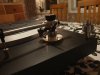
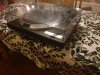
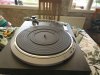
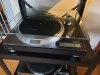
JVC QL-7 Turntable; unstable speed

First, the previous plots are incorrect. I neglected to realize that slowing down the track to get in the 3kHz range meant one revolution on the record was no longer one revolution on the plot.

I only did the Shure - these look really good. Assuming you rotated the record on the platter, all of blips show up in the same place on both plots, so they're in the record. Looks like a healthy 'table.

ShureTestA.png ShureTestB.png
 
@JP That's great news, thanks for doing those plots! But does it mean that my turntable is definitely NOT slowing down once per revolution? Is the strobe actually giving a false reading?

The neon bulb is aging and visibly flickering.. Could that be the whole problem? If so, how would I confirm this? And where could I find a replacement? The schematic gives no part number or spec..

My external strobe disc shows some wobble.. But maybe it isn't accurate either... (I'll stare at it again later today and see if it wobbles when the built-in strobe does)

In a way I feel more confused now... Since I'm back to wondering what the problem is, and/or if there even is one...
 
Notice post #20 on page 1 of this thread, I posted a video of the strobe. The flickering is best seen as a reflection above the strobe marking, and the wobbling is pronounced (though slightly less after EngineerNate helped me realize that I had my scope in dual-triggering mode when I went to adjust the speed)
 
Looking at those plots I don't see anything to be concerned about as far as the actual speed performance goes.

I'm actually surprised this table uses a neon strobe. Even some lower end JVC models used nice LED strobes.
 
It's not to say something it's dragging slightly in the motor - thought you said you heard noise, just that it's not affecting speed stability. Best way to tell if there's any drag being compensated for is to scope the drive lines. You'll see it plain as day if it's happening.
 
It's not to say something it's dragging slightly in the motor - thought you said you heard noise, just that it's not affecting speed stability. Best way to tell if there's any drag being compensated for is to scope the drive lines. You'll see it plain as day if it's happening.

Pulsing amplitude increases?

I think he said the clicking was only with the platter off, which isn't totally unexpected.

My TTS-4000 makes a slight whirring noise if I seal my ear up to the cast iron body. I badly want to investigate it but considering the rare-ness of the model I'm spooked about trying to disassemble the motor. I can hear a "zing" kind of noise if I spin the spindle really fast with the platter off. It's dead silent during playback. I am planning to try installing a delrin thrust pad to see if that is quieter than the current steel on steel. That's easy. Beyond that I can't figure out how to get inside the thing without risking damage.
 
It's not to say something it's dragging slightly in the motor - thought you said you heard noise, just that it's not affecting speed stability. Best way to tell if there's any drag being compensated for is to scope the drive lines. You'll see it plain as day if it's happening.

Okay, that's the next thing I'll do. I believe EngineerNate gave me instructions for that in a previous post.

Just to clarify though: My strobe IS lying to me?? And whatever the other problems are (strobe, motor, etc) they definitely are NOT slowing down the turntable once per revolution??

I'm a beginner compared to you guys, so what seems obvious may require clarification :)
 
Last edited:
Does anyone have a guess as to what kind of silicon oil the QL-7's tonearm lowering mechanism uses?

The service manual mentions changing the oil, but doesn't specify the viscosity.

I know that 100,000 cst - 500,000 cst is the likely range, but is there a formula for narrowing that down?

I use an unusually heavy cartridge (19 grams without the headshell), so should I err on the high side?
 
Does anyone have a guess as to what kind of silicon oil the QL-7's tonearm lowering mechanism uses?

The service manual mentions changing the oil, but doesn't specify the viscosity.

I know that 100,000 cst - 500,000 cst is the likely range, but is there a formula for narrowing that down?

I use an unusually heavy cartridge (19 grams without the headshell), so should I err on the high side?

In term of the Japanese production consumer type turn tables.

The 500,000 cst is generally used for turn table with S or J type medium/ heavy weight tone arms.

https://www.amainhobbies.com/kyosho...il-40cc-500000cst-kyosil500000/p453217?v=6935

https://www.amazon.com/SILICONE-FLUID-500-000-CST/dp/B00LCJIECY/ref=sr_1_fkmr1_1?ie=UTF8&qid=1539148622&sr=8-1-fkmr1&keywords=500,000+cst+silicone+oil

The lighter straight tone arms generally uses 300,000 cst silicone oil.

Not aware of any specific formula.

For those in between weight tone arms, you can mix 300,000 cst and 500,000 cst together to obtain the desire effect, have only seen it done once though. :dunno:
 
Last edited:
Just wanted to drop some useful information here for future QL-7 owners:

The arm lifter mechanism as shown in the QL-A7 (automatic version) service manual is different, and easy to service. The QL-7 manual makes no mention of how to change the silicon oil, and it took me quite a while to figure out how to do it! In the QL-A7 the whole assembly is removable, but in the QL-7 the shape of the tonearm base makes that impossible.

When I unscrewed the lifter arm and removed the screw, it exposed only a small extension from the actual cylinder which is just the tip of the iceberg. The actual cylinder is much larger in diameter. There are two tiny notches in the circular plate which surrounds that extension, which I initially thought were ports for injecting the silicon oil - turns out they are a means by which to unscrew the circular plate/cover and expose the inner parts (cylinder, spring, and also permits removal of the cueing lever). I cut a paper-clip into an elongated 'U' shape, and used it as a tool to rotate that plate/cover counter-clockwise until it unscrewed. After that I just pulled the cylinder out, applied oil to it, and reassembled.

Job done! Will find out tomorrow after the oil settles whether 500,000 cSt is appropriate [Thanks @Balifly !], but so far so good - the arm descends smoothly and at roughly the right speed.

I've had a busy couple weeks; haven't been inside to scope the motor as recommended by @EngineerNate and JP yet, but I will be getting to that ASAP. Still a bit confused about how w&f could test normal while the strobe is wobbling... But I have a renewed sense of optimism, and am as determined as ever to get this turntable ready for reliable daily use!

 
Last edited:
Just wanted to drop some useful information here for future QL-7 owners:

The arm lifter mechanism as shown in the QL-A7 (automatic version) service manual is different, and easy to service. The QL-7 manual makes no mention of how to change the silicon oil, and it took me quite a while to figure out how to do it! In the QL-A7 the whole assembly is removable, but in the QL-7 the shape of the tonearm base makes that impossible.

When I unscrewed the lifter arm and removed the screw, it exposed only a small extension from the actual cylinder which is just the tip of the iceberg. The actual cylinder is much larger in diameter. There are two tiny notches in the circular plate which surrounds that extension, which I initially thought were ports for injecting the silicon oil - turns out they are a means by which to unscrew the circular plate/cover and expose the inner parts (cylinder, spring, and also permits removal of the cueing lever). I cut a paper-clip into an elongated 'U' shape, and used it as a tool to rotate that plate/cover counter-clockwise until it unscrewed. After that I just pulled the cylinder out, applied oil to it, and reassembled.

Job done! Will find out tomorrow after the oil settles whether 500,000 cSt is appropriate [Thanks @Balifly !], but so far so good - the arm descends smoothly and at roughly the right speed.

I've had a busy couple weeks; haven't been inside to scope the motor as recommended by @EngineerNate and JP yet, but I will be getting to that ASAP. Still a bit confused about how w&f could test normal while the strobe is wobbling... But I have a renewed sense of optimism, and am as determined as ever to get this turntable ready for reliable daily use!

I have a JVC QL-7 that is working great, but I try to read posts about this model. Not having a technical background, I tried to slog through this post as best as possible. So, am hoping that your story has a happy ending, please let us know :)
 
@Pinkmagnolia Not much to report so far, life has been far too busy. My current hypothesis is that the neon bulb is worn out and flickering creating the illusion of an unstable strobe, but I have not yet replaced the bulb to confirm this. How is your QL-7 doing? Any similar problems? Any different ones?
 
Hello. I also have a newly purchased jvc ql7.

I had to start by replacing the rubber in the tonearm to the counterweight.

About the speed, mine works perfectly at 33rpm. However, about 1 time out of 20 it does not want to find the speed of 45rpm. Can a recap solve this?

My player has been standing still for about 15 years if it has anything to do with it.

I thank you for an informative thread.

20190918_225456.jpg 20190918_225626.jpg 20190922_111647.jpg 20190920_160736.jpg 20190920_173934.jpg
 
@Gustav80swe In my opinion replacing the electrolytic capacitors is a sensible first step for any electronics more than 30 years old - this TT is nearer to 40.
Even if it doesn't solve your specific problem it will deduct from the list of possible causes and you won't have to worry about Ecaps for another 20+ years.

P.S. Thanks for adding photos!
 
I also have a ql-7 that runs fine for a short time but then accelerates the speed very quickly. I've heard these tables are known for "runaway" speed issues, but it can be solved by a recap and changing the 4 variable resistors. How did the recap go for you? Was it pretty straight-forward or should I leave it to a pro to service?
 
@RebelKat If you're comfortable with soldering and desoldering then it's absolutely a DIY job; this table is very easy to disassemble and reassemble.
The circuit boards are easy to get at and well organized. As long as you don't damage the motor windings there isn't much that can go wrong.

I posted a list of electrolytic capacitors on page two of this thread. Be sure of observe polarity of course, but it should be marked on the board too.

I didn't replace the variable resistors in mine, just cleaned them with deoxit and followed the speed calibration procedure as per the service manual (oscilloscope required). If you don't have an oscilloscope then carefully mark the positions before cleaning. If the pots are faulty you should be able to tell with an ohmmeter.
 
Hello. I also have a newly purchased jvc ql7.

I had to start by replacing the rubber in the tonearm to the counterweight.

About the speed, mine works perfectly at 33rpm. However, about 1 time out of 20 it does not want to find the speed of 45rpm. Can a recap solve this?

My player has been standing still for about 15 years if it has anything to do with it.

I thank you for an informative thread.

@Gustav80swe
Some great looking turntables sitting there, I'm jealous!

You mention replacing the rubber insulator in the VTF stub on your QL-7 arm, where the weight screws on. What rubber did you use, where did you get it from, and how did you replace it? Was it fairly easy to do, and easy to locate the replacement rubber insulator etc.? I have a nice QL-7 here as well that the insulator will need replacing for eventually. It still has it's vintage Audio Technica AT-LS500/LC cart with a recently replaced Shibata stylus. A very nice sounding combination I must say, but the feet and plinth needs to be replaced as well. It's plinth is that old fiberboard from the 70's and the rubber feet are starting to sag and crack a little.

I have another project,.. TT-101 Victor direct drive unit with NIB Victor UA-7045 tonearm I got in a trade. I am having a custom plinth made to mount them both in, something made of sandwiched of metal and MDF, similar to the VPI Prime Signature base. Does anyone here know if the Victor TT-101 drive is 'Cogless', as it uses the slotless motor with Bi-Directional Servo control?

I was also thinking of maybe installing a used SME-3009 instead or a used VPI JMW unipivot arm with VTA on-the fly base, in lieu of the Victor UA-7045 arm. Both arms can be had cheaply. I'm trying to achieve something similar in sound quality to the latest VPI direct-drive 'cogless' table that is currently selling for north of 15k$ US.

In reality is there anything to gained using the JMW unipivot arm over the Victor UA-7045 gimbaled arm or SME-3009 sonically? I was planning to use a LOMC cartridge, something between .3mv and .7mv, but haven't settled firmly on any one specific cartridge, B/C I haven't decided on the tonearm choice yet.

Does this seem like a worthy project to pursue, given the TT-101 direct drive I own already and the Victor tonearm, or would I be better off buying something already assembled, or choosing completely different individual components to 'roll my own' table? The table I'm going for is lesser expensive, high sound quality, low maintenance, ease of operation unit for a secondary 2 channel vintage system. I already own a VPI Prime Signature,including the JMW 9" 3D arm and Sumiko Blackbird as my primary table. I like the idea of a direct drive table, something less fiddly for a second system, something my wife wont worry over using, unlike the VPI, which scares her to death. Sometimes it scares me too truth be told, especially after a few libations!

I've already performed a basic recap and service/maintenance on the low- hour TT-101 drive. It operates flawlessly and the UA 7045 arm is just like brand new, as it's never been installed or used.
 
Back
Top Bottom