
best-groove
Active Member
It seems to me that it is the pin that moves in a disjointed manner, not perpendicular on its axis.



Motor is not supposed to be turned on without the platter. It should have the platter on it and then it should spin. It will stutter when the platter is off.new to me JVC QL-A7, seems to have a serious spindle/motor issue, haven't opened it up yet, wanted to check first if this is likely going to require machining (because that's out of my skill range). All the buttons work, the brake engages, but the platter doesn't move at all and obviously the spindle is wobbling. Other issues are the counterweight droop and it's missing the bottom plate (neither are a big deal). Any thoughts appreciated!

stuck@redondo2018 If you turn the plate by hand when the switch is off does, it turn or is it stuck?
there is no movement at all - also, seems to me that the shaft/spindle is moving quite slowly - I (now) understand I should keep the platter on, but shouldn't it spin a bit faster?If it’s not spinning with the platter on, just jittery, it most likely has an issue with the speed control and/or an issue with the board. Check the plastic connectors on the board itself when you open the bottom of the unit. When you work on these, you will have to have put them high up on a table and work on them from underneath. Leave the platter on when you turn it on; I tilt mine up a little bit to make it easier to work on.


Not if the platter is off. It will jitter around slowly and I was told not to do that.there is no movement at all - also, seems to me that the shaft/spindle is moving quite slowly - I (now) understand I should keep the platter on, but shouldn't it spin a bit faster?
ok, so sounds like it is not likely a bent shaft or anything, that was my main concern - I'll open it up and see what I can see, thanks!Not if the platter is off. It will jitter around slowly and I was told not to do that.
I also had a similar problem when I purchased mine. I thought it was a bad motor or a bad capacitor until
I reached out to a technician in Portland who had published his repairs on a few of these models.
He actually only repairs keyboards, electric pianos, organs, mixing boards, recording studio equipment etc. But he is very knowledgeable with 40+ years of experience and repaired a few of these. With our model being the easiest of the three he said that in his experience, the old caps used for these seldom go bad, but much more common is the cable connector between the boards losing contact with corrosion and such. Also vibrations can cause solder joints to break and cause intermittent problems.
I removed my cable connectors and reattached and my table started spinning again with quartz lock up. However, when I moved to a new house, the vibration of just moving the table to a new location caused it to stop working again. I narrowed it down to some cold solder joints in one area of the board that controls the speed.
All I had to do was touch the resistor and capacitor in that area and voila, working perfectly fine again. I never had it stop working afterwards unless I physically move the table and cause excessive vibration. A hard rap on the plinth will cause it to either stop or spin rather slowly.
I have to take it apart and redo the solder joints in that area but it’s still working fine for the past 4 years. I just don’t want to mess with it anymore until I get another table or it stops working again.
Hopefully you will have something as simple as a cold solder joint or a bad connection at the cables. Don’t assume that it is a bad capacitor as most people will tell you. Repairmen will hundreds of hours of experience tell me otherwise.
Good luck and let us know if we can help you further. You can pm me if you want..
DR
Not if the platter is off. It will jitter around slowly and I was told not to do that.
ok, like I said, I just got it, no idea if that was done much before. I think I had it on for maybe 3 minutes altogether tops, I hope that didn't cause damage... but also hope that short of time isn't too disruptive... btw, everything is dead silent, so I'm taking that a plus signexactly, for any DD you must always use the platter, never power the turntable by running the motor without the platter acting as a flywheel, the risk of very serious damage to the motor is real.
I have calipers handy and I have a QL A7. What dimensions do you need? Can you post a pic of what you have left ? Mine was broken when I purchased it. It was barely attached. I used a bit of epoxy to make it solid again.Hi all -
Picked up a QL-A7 last week at a local auction for a bit of nothing. The usual counterweight droop is present. Motor spools up fine and is only fractionally slow at 33 or 45 based on the RPM app.
One of the top cover brackets was broken - took the good one and ginned up a 3d print file and am back in cover action. Will get that file uploaded to the usual online repositories. Happy to help anyone here with one if they’ve got a busted bracket. Don’t know if it extends to other models.
The lifter arm on the UA-5045 was snapped off to the left of the rest location. I can see the bit that survived raising and lowering when switched, but I don’t suppose anyone has a caliper handy and could give me some dimensions so that I could print a new one?
Cheers - Zach
Heres what’s leftI have calipers handy and I have a QL A7. What dimensions do you need? Can you post a pic of what you have left ? Mine was broken when I purchased it. It was barely attached. I used a bit of epoxy to make it solid again.
Do you have the piece with the screw? Just left of that?
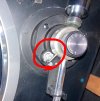
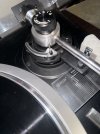
Does the arm ride on the lifter when it’s lowered at all or is the suspension on the Empire I stylus shot?PS. I fixed my drooping counter weight by completely removing the old rubber and then replacing it with a rubber grommets/washer that I found at local hardware store. Posted it up on here with pics.
The main tip I can say is to not worry about getting the counter weight apart and just use some dental tools to remove the old rubber. Cut the new rubber washer to fit and slit the edge to loop over the space. I used a small thin zip tie afterwards to make it secure and less prone to droop down.
? What are you referring to ?Does the arm ride on the lifter when it’s lowered at all or is the suspension on the Empire I stylus shot?

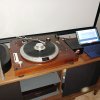
I assume that the little arm that the auto lifter contacts does not make contact with the lifter while the turntable is playing.? What are you referring to ?