• The move to the new server is done. There are some software and database maintenance updates in process. This has us passing the hat around to help out. We appreciate any donations. Seriously, even a dollar helps. The payment page may be found here - https://www.audiokarma.org/support.html

JVC R-X400 no output and LCD doing some weird things

those are not output transistors they are STK's and probably hens teeth.
Not to knock your efforts. To be honest too much spaghetti for me and I call those glass coffin victims because they sold you the case to put it in with the class door(s) so you stacked stuff in a box with no ventilation.

good luck with it. :D
 
those are not output transistors they are STK's and probably hens teeth.
Not to knock your efforts. To be honest too much spaghetti for me and I call those glass coffin victims because they sold you the case to put it in with the class door(s) so you stacked stuff in a box with no ventilation.

good luck with it. :D
That's a lot of terms I don't know, can you explain?
 
those are not output transistors they are STK's and probably hens teeth.
Not to knock your efforts. To be honest too much spaghetti for me and I call those glass coffin victims because they sold you the case to put it in with the class door(s) so you stacked stuff in a box with no ventilation.

good luck with it. :D
Oh, I looked up STK amp. It isn't an IC, they are NPN and PNPs. Black is NPN and green is PNP. Some Toshibas. They just have a really weird package that looks like the STK things, only three pins though.
 
those outputs are probably worth more than the whole thing if it was working properly ..what numbers are on them ?
 
Ah yes experience a good way to learn. I would tell myself "persevere" when I ran into big problems. Got to be extremely careful not to short things and respect the voltages especially when you get in the power supply they can be deadly.
 
Ah yes experience a good way to learn. I would tell myself "persevere" when I ran into big problems. Got to be extremely careful not to short things and respect the voltages especially when you get in the power supply they can be deadly.
Yeah I've learned that at this point. And electricity probably doesn't scare me as much as it should, as long as it is an invisible threat that is. I got shocked and barely cared until I watched it spark out.
 
you meant 2sd845 .
and i looked up the price . £8.50 each plus carriage . thats if you can even find genuine ones .
that was for the 2SB755
2sd845 are £11.99 each .
 
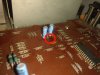
So I found a couple of capacitors that are looking kind of bad. The one I can't decide if it's electrolytic fluid or some sort of glue and need help with. The other is hard to see and is more noticeable in person. It just looks like a clear fluid on the board that won't wipe away. None of the other caps have it under them but I doubt they are doing well if that one is all screwed up.
 

Attachments

  • IMG_20171104_212547593.jpg
    IMG_20171104_212547593.jpg
    96.9 KB · Views: 25
  • 1509845288576.JPEG
    1509845288576.JPEG
    68.4 KB · Views: 25
The 2SB755 / 2SD845 Toshibas have been out of production for a LONG time and anything you see now is fake unless it is a used pull. You could easily sub Sanken 2SA1215 / 2SC2921 if they ever go bad. I have a JVC RX-750V and a RX-950V. There are very subtle differences between them The transformer is different and the driver and output transistors are different. The 100 WPC RX-750V uses 2SB755 / 2SD845 outputs. The 120WPC RX-950V uses 2SA1215 / 2SC2921 outputs. I'm sure they would fit perfectly on the heatsink. You would possibly need new mica though because the Sankens have a bigger case. The hole pattern is the same though.

We need to get a signal either from the preamp section or inject a signal into the amp section to see where you are not getting sound. Maybe a couple of things to check first...

Does the protection relay click? If this is like my JVC's and I'm pretty sure it is, when you hit the power button, you will hear one relay click. This will turn the switched outlets on the back on. After 4-5 seconds, the speaker relay should click in.

Carefully connect your DMM's ground lead to ground and the positive to the end of one of the emitter resistors that has one pin. Turn on. What is the DC voltage? Now check the other side. What is the voltage?
Be careful and do not slip with any test leads. Mini grabbers are perfect for this so you don't have to worry about slipping and shorting something out. This is a very common thing to happen.

BTW, I think this receiver is worth saving. It is the last year you could get silver. I have The JVC XL-V300 in silver that would match this perfectly :).
 
Make sure you get those zenner diodes replaced as soon as possible. If you have the unit on, those shorted diodes can cause havoc on the circuit board that powers the lcd display.

As for the caps, when ever you see that dark hard stuff like in your first picture that is always most likely just glue. it can look ugly, but is usually no problem.

As for the second pic, it is very possible that some electrolytic has leaked out but then again it could also just be nothing. Its really 50-50 and most likley is not a reason you are having problems.
 
Does the protection relay click? If this is like my JVC's and I'm pretty sure it is, when you hit the power button, you will hear one relay click. This will turn the switched outlets on the back on. After 4-5 seconds, the speaker relay should click in.
There is only one relay, it is literally right under the power switch on the main amp board, I'm pretty sure from when I hooked speakers up that's what it did. I will check the voltage on the other thing you said right now, might take a bit though as I have to do some reassembly and reply to other replys.
 
Make sure you get those zenner diodes replaced as soon as possible. If you have the unit on, those shorted diodes can cause havoc on the circuit board that powers the lcd display.

As for the caps, when ever you see that dark hard stuff like in your first picture that is always most likely just glue. it can look ugly, but is usually no problem.

As for the second pic, it is very possible that some electrolytic has leaked out but then again it could also just be nothing. Its really 50-50 and most likley is not a reason you are having problems.
Yeah I'm thinking the same thing, but it's something out of the ordinary I noticed while poking around with it.
 
Those are next to an IC (TC9163) that is used to switch inputs, I think.
Yeah I looked it up awhile ago(2 days or so) and it was something of the sort that did that, like a multiplexer even though that would be horribly impractical for this type of thing.
 
There is only one relay, it is literally right under the power switch on the main amp board, I'm pretty sure from when I hooked speakers up that's what it did. I will check the voltage on the other thing you said right now, might take a bit though as I have to do some reassembly and reply to other replys.
So this has an actual power switch that latches on. I see in one of your pics that the outlets are NOT switched. So that relay has to be the speaker protection relay. Does it click about 4-5 seconds after power up? If so that means the amp section is in better health than if it is not clicking.
 
So this has an actual power switch that latches on. I see in one of your pics that the outlets are NOT switched. So that relay has to be the speaker protection relay. Does it click about 4-5 seconds after power up? If so that means the amp section is in better health than if it is not clicking.
Yes somewhere around there time wise. And that's at least supposed to be good, right?
 
Yes somewhere around there time wise. And that's at least supposed to be good, right?
Yes, that is a very good sign!

Are you sure you don't have a tape monitor engaged? There are two and if either is engaged without a tape deck (or other) connected, then no sound.
 
Back
Top Bottom