• The move to the new server is done. There are some software and database maintenance updates in process. This has us passing the hat around to help out. We appreciate any donations. Seriously, even a dollar helps. The payment page may be found here - https://www.audiokarma.org/support.html

Kenwood Basic C1 Preamplifier Restoration/Upgrade

I'd look at what D3 does. If this is the same D3, I'd see if Q1 is ok. Something took out the diode.

upload_2022-11-29_20-24-36.png

my guess you could replace D3 (W06B) with a 1n400x something. See here or here for reference. Swing by, i probably have something that will work.

if Q1 is bad, @FootFungus says you can use a KSC2690A.
 

Attachments

  • upload_2022-11-29_20-23-38.png
    upload_2022-11-29_20-23-38.png
    95.2 KB · Views: 8
Last edited:
I will bet that diode is not the only thing bad on that power supply board. In fact at this point you may have damage elsewhere in the unit as well. At the very least I would check all the components down and up the chain from that diode. From what I have seen they do not simply burn out like a fuse. It looks like that diode has been getting pretty hot. Hot enough to discolor the board. Check all the resistors and at least you will know if they are good. It is possible that the dode had a poor solder joint and that caused it's failure. No way to know except to do some scouting around.
 
I’d remove C47 and make sure it’s not shorted. If it is it will take the diode right ground. Easy enough to remove and check.
 
Thanks, people! I will check Q1 and C47, but I also wanted to reference this earlier post that I had made. I had previously observed some corrosion on that very same diode (see attached pic)...could the glue on C47 have corroded D3 to cause failure? I thought I had heard some glues not playing so nice with board components.

So coming back to this, I posted on some trouble I had with a missing left channel in my C1 back on page 12 and about 8 months ago. Like others here, I originally suspected a dirty relay so I replaced it but I saw no improvement. I did find that tape inputs did work with both channel but he others did not. I was going to check the RCA connections tonight when I noticed that D3 also looked a little damaged. I didn't have my multimeter out of storage but does anyone know if this is serious or just some minor corrosion? That was the only visual issue I saw thus far. The other thing I wanted to ask about was where exactly to look for trouble on the RCA connections. I am assuming failures tend to happen where the plug assembly is soldered to the board it self? I should also that I previously had deoxit/faderlube on the pots and the switches as well butit sounds like some others are having these channel dropouts as well. View attachment 2192232
 
That corrosion could have come from the big cap leaking right next to the diode however most of that is factory glue. I have never heard or seen myself any corrosion caused by the glue.
 
Not all glues go corrosive with age, but some do, and some can even go conductive as well. I've seen corrosion from glue a number of times, in particular in Nakamichi receivers and CD players.

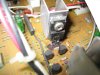
If I show a photo of corrosion with the glue around the base of a cap, we would always have the uncertainty if some leakage of electrolyte from the cap was involved in causing it. So I show a photo below of assembly glue that was used to hold a larger power transistor (part of a ±18V power supply circuit) to the main PCB in a Nakamichi SR-2A receiver.

This transistor runs quite hot, as one might suspect from the fact that Nakamichi fitted heat spreading wings on it. Even so, the heat from this transistor has toasted/blistered the glue at the leads. You can see a little corrosion on those leads themselves, but also note the corrosion on the jumper in front of the transistor, which is in direct contact with the glue. Also note that all the other jumpers and leads nearby are fine; it is only the one in contact with the glue that has corroded. The heat from the transistor certainly contributed to the degradation of the glue, and it may have enhanced its aging and help lead to the strong corrosion seen here, but I have seen corrosion develop on leads touched by glue where such heat isn't involved.

I think it is important in cases like this to remove the glue from contact with leads, to prevent further corrosion. Its mission (e.g., holding the component in place for wave soldering) has long since been completed. Usually the degraded glue can be pried/scraped off with a small flat-bladed screwdriver or a dental pick as it is quite brittle. Even in the extreme case below, I was able to remove the glue and clean up the board, leaving only a small heat stain on the PCB under the transistor. But the heat over time did degrade the solders on the transistor leads on the underside of the board, and those needed to be reflowed.

IMG_0027.JPG
 
That corrosion could have come from the big cap leaking right next to the diode however most of that is factory glue. I have never heard or seen myself any corrosion caused by the glue.

Sure, some glue or glue plus heat can cause corrosion. However I still have not seen any glue cause corrosion on any of the Kenwood C1-C2's that I have restored or that I have here now. Neither have I read about in any thread here or on other sites about the glue in a Kenwood C1 causing corrosion. The C1 was what I posted about. Not other brands of equipment due to this being a thread about the Kenwood C1 however @northpaw is certainly correct. I should have made myself clearer than mud about the whole glue situation. That is why I should not post at 1:45 AM I suppose.
 
I'm sorry for any misunderstanding I may have caused. I carefully read you prior posts, where you certainly were very specific about reference to the C1. The recent post seemed more general to me, so I thought it might be useful for general knowledge. I agree that the Kenwoods (I've only looked inside my C2) do not seem to have this problem, probably due to Kenwood using a glue that has aged far better than the glue a number of other manufacturers used.
 
@northpaw I cannot speak for anyone else but no problem here whatever. Your post was informative and on point as far as I am concerned.
 
I checked the DRM website and here is his recommendation

1 each - NJM4580D - Dual Low Noise Op Amp replaces NJM4560D - Phono preamp
 1 each - NJM4580D - Dual Low Noise Op Amp replaces NJM4560D - Tone control
 1 each - NJM2068D - Dual Low Noise Op Amp replaces NJM2043D - Flat amp
 3 each - 8 pin Machine Tooled IC sockets
 
I just got a c-1 for $58 on FB market place, according to the seller it does not power up, I don’t have it with me, does the C-1 have any fuses ?
What else cut it be ?
 
Do not think there are internal or external fuses. If it is a type E (see the schematic) there is a switch that can change the voltage from 220V to 120V. Check that and make sure it is properly set for your area.
 
pablo, download the schematic and verify power at the input of the power supply section. maybe the power switch failed.

if you have power, check the power at the op amps (or zeners).

should be pretty easy to track down.
 
May I ask a stupid question, how do you access the bottom side of the boards on a C1? Have to disassemble the front face, rear panel and take everything apart?
 
Back
Top Bottom